Keeping up
What changed, and when
This page is rewritten whenever the game is, and the game changes every few days. Everything below is a rule that moved under a player who had already read about it — newest first, a day at a time. Today is open; press any other day to see it.
1 November 2026 1 change
- 1.260.4 Soldiers and Pioneers now walk round water. Before, a march was refused if more than 40% of the straight line between the two places was water, even when dry ground led all the way round the bay or lagoon, so a Pioneer party could not be sent to open ground just across the water. Now, when the straight line is too wet, the column walks round by dry land if there is a way, and the march takes as long as the walk. Where no dry ground joins the two places it is refused as before and you still need War Praus. Read it.
31 October 2026 1 change
- 1.260.3 The Steward's list of soldiers now shows each one under your tribe's own name and at the price it will really charge. Before, it listed the plain names and prices, so a tribe with its own soldiers saw a different name, and sometimes a different cost, than in the Barracks. Nothing the Steward trains has changed, only what the list says. Read it.
25 October 2026 2 changes
- 1.259.0 Your champion no longer earns experience from fighting. Levels now come from adventures: a battle still wounds the champion and still counts as a win or a loss, but pays no experience unless the world has switched that kind of fight on (attacking an NPC village or a player’s, or being attacked by an NPC village, wild animals or a player). Experience a champion has already earned is untouched. Read it.
- 1.258.1 The coin button for hurrying a build is now also in the side panel of the building you are upgrading, in the village picture, not only in the Construction panel. Before, a village shown as the picture had no way to reach it. It still appears only where a world has switched coin boosts on, and only once the build has a crew on it. Read it.
24 October 2026 2 changes
- 1.258.0 There is an event calendar now. The calendar icon in the top bar opens a month with a dot on every day that has something on it: the Friday nights, the strongholds contests, the next wave of a war already under way, and the hour a bounty closes. Press a day to see what is on it and when, in your own time zone. It looks sixty days ahead. Read it.
- 1.257.3 Pressing a marked place while you are already on the map now takes you there. Before, the link only worked when the map was opening fresh; from the Marked list on the map itself nothing moved. It now centres on the place and selects its tile, with the village standing on it once the ground has loaded. Read it. Reported by Mat Purple
21 October 2026 3 changes
- 1.257.0 Gold coins can now hurry a build that is already running, where a world switches it on. In a village’s Construction panel a running build shows a button, “Take 2 hours off · 4 coins”: each press takes a share of the time left off the clock and charges for exactly that much, a build takes only a few presses, and the clock only ever approaches zero. Every purchase is a Build boost line in your balance sheet. Read it. Reported by Yukiya
- 1.255.7 The map now tells you when your village is off the part you are looking at. It reopens where you last left it, so after panning away you could come back to a map with none of your ground on it; a bar over the bottom now says “Your village is off the map” and one tap takes you home. Read it. Reported by Yukiya
- 1.255.6 The Champion screen now shows what Stewardship is worth: the percentage it adds to your home village’s production, how much that is an hour of timber, stone, iron and rice, and what the points you have chosen but not yet placed would make it. Read it. Reported by parameswara
20 October 2026 3 changes
- 1.255.4 The six pets are repainted as majestic portraits: a close-up of the animal itself, head and shoulders, with a steady gaze and natural light on its fur, scales or feathers, in place of the glowing spirit shapes. The tiger, crocodile, sun bear, gaur, mousedeer and hornbill are all easier to tell apart at a glance, including small beside your champion. Read it.
- 1.255.3 Points you put into your champion’s Resolve or Stewardship now stick: the screen was leaving those two out when it saved, so they were never placed and nothing said so (your points were not spent, so go back and place them). Each attribute also has a small (i) that explains what a point is worth, with an example and a link to the handbook, and Stewardship and Vigour are told apart. Read it. Reported by Yukiya
- 1.255.2 Your invitation link now comes with a QR code. In Settings, under Bring somebody in, a friend next to you can scan it with their phone to open the sign-up page with your link already on it, and Show it large fills the screen so it reads from across a table. Read it. Reported by Everett Monica
19 October 2026 5 changes
- 1.255.1 A soft chime now plays when a letter or notification arrives (switch it off in Settings, under Sound), and on a narrow phone the Letters icon is no longer pushed off the top of the screen. The Roadmap also marks each line with a bug or a sparkle, so a fix and a new feature read at a glance. Read it. Reported by Everett Monica
- 1.255.0 “How your round went” on your profile now opens a full analytics page: click your ranking, villagers, levels built or flattened, attacks or defences to draw it over time, then scroll, zoom and compare. It also gives timber, stone, iron, rice and gold an account each and a searchable ledger of every movement. Records start from when they began being kept, and only you can see yours. Read it.
- 1.252.1 You can now filter your champion’s kept-aside equipment by part. Above the list on the Champion screen there is a chip for each part that has something spare - Head, Waist, Feet and the rest - with how many, and “All” to see everything again. Read it. Reported by Mat Purple
- 1.251.1 Fixed: the Roadmap timeline now starts where it should, in August. It was showing only the newest three hundred lines, so with a row for every version of the game it began in the middle of September and left out the open ones. Read it.
- 1.251.0 The Roadmap timeline now shows every version of the game from 1.0 to today, one row each, with the number of player reports it came from, a Live or Waiting status, and a bar for how long the work took. Click a subject for what was done and a bar for when it was reported, how long it was in hand and whether it is released. It scrolls sideways, fits a phone and a wide screen, and can be filtered and searched. Read it.
18 October 2026 9 changes
- 1.250.2 The Steward now costs twelve gold coins a day per village, taken one coin every two hours rather than twelve at once, so a purse that cannot find twelve together can still keep it working for a while. The Steward screen and the notice that it has stopped say how often the coin is taken instead of always saying “a day”. Read it.
- 1.250.1 The game now tells you when a newer version is live. A small notice, “A new version of the game is available” with a Reload button, appears by itself if the page you have open is out of date, so a tab left open for days no longer shows you things as they were. It never reloads on its own, in case you are in the middle of a letter. Read it.
- 1.250.0 The Roadmap has a Timeline tab now: every line laid out like a project plan, a row each with the days across the top, coloured stretches for the stages it passed through, a marker where it went live and a line for today. Read it.
- 1.249.4 Fixed: the Roadmap link in the footer took a signed-in player to the map instead of the Roadmap. It opens the Roadmap page now, signed in or not. Read it. Reported by Everett Monica
- 1.249.3 Fixed: a game page left open while an update went live could show “This part could not be drawn” when you opened the next screen. The page now reloads itself once to pick up the new version, and says so if it cannot. Read it. Reported by Pokcik
- 1.249.0 There is a Roadmap page now, linked from the footer and readable without an account. It follows each fix and enhancement from the moment it is received through looked into, built, tested and live, with a note at every step and the version it went live in. It shows how many reports a line came from but never what you wrote or who you are. Read it.
- 1.248.2 Fixed: the Bazaar screen told a player to build a Bazaar in a village that already had one. A village can hold more than one, and when the first plot in order was still empty the screen read that one and ignored the built Bazaar beside it. It now looks at all of them. Read it. Reported by Rigel Ferris
- 1.248.1 A spice-grove battle report can now be shared by its link. Paste it into your kingdom’s channel and your mates can open it, as they can an assault report; before, a grove report answered “No such report” for everybody but the two sides. Scouting reports are still private. Read it. Reported by parameswara
- 1.247.1 The world chat count now survives being away. The number on the Global tab and the Letters button counts everything said by others since you last had the Global tab open, and is worked out when you open the game or come back to it - so a night away, or a phone that slept, no longer starts you again from nothing. Read it.
17 October 2026 3 changes
- 1.247.0 The Niaga pay less for the Steward. The administrators can now take a percentage off the Steward fee for the merchant tribe; it is worked out per village and rounded to a whole coin, never below one, and the price on a Niaga player’s Steward screen is the discounted one. It starts at nothing, so nothing changes until it is set. Read it.
- 1.246.1 Unread counts for the world chat. The Global tab under Letters now shows how many lines were said while you were away from it, and the Letters button adds that to your unread letters; opening Global clears it. In the classic menu, the Kingdom, Letters and the bell now all bob and roll their number up in the same way when something is waiting. Read it.
- 1.245.2 Two small fixes from your reports. The Steward’s Add a step list now says “not built yet” beside a plot with nothing built on it, and says you can plan it anyway - the Steward raises it from the first level, so you do not have to build it by hand first. And on a kingdom’s war plan, “Pledge soldiers” stays on the screen after you have pledged, as “Pledge more, from another village”, instead of vanishing. Read it.
16 October 2026 6 changes
- 1.245.0 The Friday night now rewards the people who join it. Stay signed in for a while during the three hours - ten minutes by default - and when the night ends you are paid gold and resources, once, into your capital; the amounts are set by the administrators and a note tells you what you got. Merely opening the game for a moment does not count. Read it.
- 1.244.1 Your champion’s companion now stands beside them. When a beast is walking at your champion’s side, its picture and name are drawn next to your champion on the Champion screen, instead of only appearing in the Companions list below. Read it. Reported by parameswara
- 1.244.0 The strongholds now pay gold. When a contest ends, each fort a kingdom is still holding pays out to its members who took part: 20 gold coins to the one who held it longest, 15 to every other member who held it or stood soldiers in it. A kingdom that lost a fort before the end is paid nothing for it, and the result lists who was paid what. Read it.
- 1.243.4 A building’s panel now says why you cannot pull it down. Pulling a building down needs a Grand Balai at level 10, and below that the panel used to say nothing at all; it now shows what is needed and what yours is. Reported by a player who wanted to remove a duplicate Storehouse. Read it. Reported by Andromeda
- 1.243.3 Every unfinished quest now has a button beside it that takes you to where it is done — Open the Grand Balai, Train soldiers, Go to the Bazaar, Find a place to settle — with the right building already open on your village. Suggested by a player. Read it. Reported by Pokcik
- 1.243.2 The Strongholds page now keeps every earlier contest. Under the last result there is a list of the ones before it, newest first, each filed under the round it was fought in, with the winner and how many forts each side held — a new contest no longer pushes the previous result out of sight. Read it. Reported by Everett Monica
15 October 2026 4 changes
- 1.242.0 Spice groves are no longer empty ground. Every grove nobody holds is guarded by the Lanun or by wild beasts — tap one on the map to see which — and a grove you hold is raided, by the Lanun or by beasts, between three and six hours after you take it and again after each raid. The bigger you are, the bigger the raid. The wilds refill every six hours and the beasts grow each time, so the early days are the cheap ones; the handbook now lists the beast’s strength and what guards each kind of grove. Read it.
- 1.241.0 Ships now sail only on water that really joins the two villages, port to port. A War Prau or Dragon Jong leaves a village with water beside it for another village with water beside it, the whole way by water, and the troops step off at the quay — no stretch of land to march. A river that never reaches the sea carries ships only along that river, and a fleet is refused for an inland village: the send screen says so, and the troops go on foot instead. Read it.
- 1.240.4 Every soldier on the Military page now shows three little marks for the sea, rivers and lagoons: bright where it can cross, dotted where it can only ford a part of a route, struck through where it cannot. Hover them for the plain words. The handbook’s soldier tables gain a Water column saying the same. Read it.
- 1.240.3 The handbook now gives every tribe’s soldiers in numbers: under the tribes, a table for each tribe with what each soldier costs, its attack and defence, speed, upkeep and how long it takes to train — with and without each training speed subscription — and the four tribes side by side, one measure at a time. Read it.
14 October 2026 2 changes
- 1.240.2 KAMPUNG has launched. The Alpha mark beside the name at the top of the screen is gone, and the pace now always shows there — ×1 on this world, so every duration you see is the duration you wait.
- 1.240.0 The Cyberjaya Discord’s chat channel now gets a short “Server status: online” post every six hours, with the round, how many players are on and how long the server has been up — so anyone can tell at a glance that the world is alive. Read it.
13 October 2026 2 changes
- 1.239.0 You can now pay gold coins by the hour for faster training. Every unit’s box on the Military page has a Training speed subscription: Basic (1 coin an hour, 7% faster), Advanced (2 coins, 12%) or Elite (3 coins, 18%), one subscription for all your villages. Training under way speeds up without restarting, nothing is charged until you confirm, and if your coins run out the boost simply ends. Read it.
- 1.238.1 A Darat tiger scout (Pengintai Harimau) now eats 3 rice an hour and a war elephant (Gajah Diraja) 5, where they ate 1 and 3 — a tiger and an elephant are dear to keep. Every other soldier eats what it did. Read it.
12 October 2026 5 changes
- 1.238.0 The 3D map now opens full screen, with drag to pan, the wheel to zoom, and buttons to zoom, switch the 3D off, find your village or close it. It draws much faster, and kingdom borders no longer slow it down. The map on the page is the flat one. Read it.
- 1.234.0 Some Lanun camps now have a champion of their own, named in the battle report. It adds its strength to the camp’s raids and its defence, and it is never hurt. Scout a camp before you send. Read it.
- 1.233.1 The map is now wide: it takes the whole page, the note about sailing sits underneath it, and the details of a tile you tap float over the map’s left edge. Read it.
- 1.233.0 Lanun camps can now fight as a tribe — Pelaut, for one — with that tribe’s soldiers and strengths, and some camps may hold bigger garrisons and stores than their tier gives. Scout a camp before you send. Read it.
- 1.232.1 The 3D map is much lighter to draw, so it no longer lags when you pan or zoom. Zoomed far out it now draws flat, because the heights would be too small to see anyway. Read it.
11 October 2026 6 changes
- 1.232.0 The map has a 3D button. It stands the ground at different heights — sea low, highland tall — in the same painted tiles, with your villages, marches and borders on top. Press it again for the flat map. Read it.
- 1.231.1 The handbook’s Darat pictures now call the donkey rider by its name, Penunggang Keldai; they had still carried the name of the boar rider it replaced. Read it.
- 1.231.0 The Army and Muster screens are one. The box of soldiers at the top of the Army screen now counts every soldier you have, not just the village you are in, and pressing it opens the muster roll right beneath: where each of them is standing, with the orders to bring them home. Muster is gone from the menu; old links to it land on the Army screen. Read it.
- 1.230.3 Choosing a building for an empty plot now works in the painted village as well as the grid. Press an empty plot, either way, and you are shown everything it could become. Read it.
- 1.230.1 The Darat boar rider is now a donkey rider, the Penunggang Keldai. Same strength, same cost, same speed, and a new portrait — only the animal changed. Read it.
- 1.230.0 The plots in the middle of your village are yours to fill. Only the Grand Balai, Storehouse and Rice Barn start built; every other plot starts empty and you choose what to raise on it. Warrior Halls, Stables, Workshops, Shipyards, Storehouses, Rice Barns and Bazaars can stand on more than one plot — two Warrior Halls train two lines at once, extra stores hold more, extra Bazaars keep more merchants. Nothing you have built moves. Read it.
10 October 2026 6 changes
- 1.228.1 The Pelaut, Darat and Niaga soldiers are painted as they now are: Pelaut boat crews and pirates in sea-blue and black, Darat on tiger, boar, rhino and elephant, Niaga on armoured kerbau in their guild colours. Read it.
- 1.227.0 The Pelaut, Darat and Niaga have their own armies now. The Pelaut ride no horses: their scouts, raiders and war-captains come by sampan and prau, cheaper and slower inland. The Darat ride the jungle — a tiger scout faster than any horse, a boar rider, a rhino knight and the royal elephant. The Niaga ride armoured kerbau: slower, tougher, carrying more. Every one of the three rosters has a new Malay name. Read it. Reported by Yukiya
- 1.226.0 Nine advanced quests past your second village, paying in gold coins and in Fine and Heirloom equipment for your champion. Quests now sits at the top of the menu, and a count in the corner rolls up with a little +1 when something new arrives. Read it.
- 1.225.0 World chat now lives inside Letters: one Letters button, with a Personal tab for your own conversations and a Global tab for the chat everyone reads. Old links to the world chat still land in the right place. Read it.
- 1.223.0 Bigger Lanun camps raid more often: tier 2 keeps its pace, tier 3 comes every 160 game-hours and tier 4 every 96. Camps and zombie villages can also be taken in hand by the world’s keepers, so a raid may now come from further off. Read it.
- 1.222.0 The menu is back down the left side, with every screen named. Your Kingdom, Letters, World chat and the bell sit together top right — and when something is waiting in one, its icon turns ember, shows the count and bobs, livelier the more there is. Read it.
9 October 2026 11 changes
- 1.221.0 Linked your Discord? Settings → Your name now keeps one name in both places: follow KAMPUNG and the Discord server shows your game name, or follow Discord and your game name becomes what the server calls you. Read it.
- 1.220.20 Letters and World chat have moved to the right of the top bar, beside the bell, so everything that reaches you is in one corner. The envelope shows how many letters you have not read. Read it. Reported by Yukiya
- 1.220.19 Events sits straight after the Map in the menu now, and wears a dot when the war has moved — a new phase or a new wave — since you last looked. Ember during an invasion, gold otherwise; opening Events clears it. Read it. Reported by Yukiya
- 1.220.17 Each tribe’s signature soldier is painted as its elite now — the Bajau Harpooner with a spirit-naga on his harpoon, the Ironwood Shieldman behind a tiger-spirit shield, the Kelasi with a burning kris, the Upahan in gold. Read it.
- 1.220.16 The pets are legends now: a gold-crowned spirit tiger, a jade naga-crocodile, a moon-bear in crescent armour, a forest-spirit ox, Sang Kancil wreathed in golden leaves and a phoenix-hornbill. Read it.
- 1.220.14 The archipelago’s magic is now the mark of rank: common soldiers are painted plain again, and only each tribe’s Royal Lancer, its signature soldier and the Darat war elephant carry it. Read it.
- 1.220.12 Every chapter of the handbook now opens on a painting — thirty-six new ones, from the palace water clock to the smith at his forge and the zombie village in the mist.
- 1.220.11 Every tribe’s soldiers and every pet have been repainted with the archipelago’s magic — Pelaut sea spirits, Darat mantra and mist, Sambar amok fire, Niaga gold, and a spirit tiger, a moon bear and a fire-winged hornbill among the pets. Read it.
- 1.220.8 The tribes’ siege engines are painted — the Darat’s Gajah Perang among them — on the training screen and in the handbook. Read it.
- 1.220.7 Each tribe now has its own siege engines too — the Darat drive a war elephant, the Gajah Perang, at the palisade — and each knocks down its own share of wall or village, balanced so none is simply better. Read it.
- 1.220.6 Your village opens on the grid for everybody now, including anybody who had looked at the painted village before; the game remembers which you choose from here.
8 October 2026 11 changes
- 1.220.5 Battle reports name every soldier as their own side fields them — an enemy’s Amok Blades, not a raw unit name. And the handbook opens its chapters on battle, the sea, kingdoms and every event with a painting.
- 1.220.4 Every player now has a champion from their first village — no building needed; name them on the champion screen. The Balai Pusaka is now the Balai Pahlawan, the hall of heroes, where a wounded champion mends faster. Read it.
- 1.220.3 Each tribe’s soldiers now have their own portraits — the Pelaut in sea blue, the Darat in earth and terrace green, the Sambar in red and black, the Niaga in songket and brass — on the training screen and in the handbook. Read it.
- 1.220.1 The handbook is illustrated: the six beasts and pets, every champion’s piece and the four treasures, the hired companies, the tribes’ emblems and the resources — and each tribe’s own soldiers as they are painted. Read it.
- 1.220.0 Every tribe now raises its own soldiers: the six common units each have a tribal name, look and shape — Pelaut skirmish, Darat hold, Sambar strike and carry, Niaga equip well — balanced so none is simply better. Read it.
- 1.219.9 From the next round your champion keeps their name, look, kit and pets, but starts again at level 1 — every round is a climb. And lines written in Discord now reach the game within seconds. Read it.
- 1.219.7 Your village now opens on the grid, which shows every plot, its level and what is being built at a glance. The painted village is one press away, and the game remembers if you choose it.
- 1.219.6 Signing in with Google no longer fails when Google is slow to answer: the game tries again on its own, up to three times, before asking you to.
- 1.219.5 The beta is ending: when this round’s invasion is decided the world is swept and KAMPUNG launches with Round 1. Your champion comes with you — the front page says what you keep and what is new.
- 1.219.4 Everything written in your kingdom’s Discord channel now reaches the kingdom chat, not only lines from linked members — anybody else appears under their Discord name, marked Discord. Read it.
- 1.218.2 Your kingdom’s Discord channel no longer loses the first message written in it: what linked members say there reaches the kingdom chat from the very first line. Read it.
7 October 2026 17 changes
- 1.218.0 A kingdom’s Laksamana and Bendahara can now propose open war to their Raja, who approves or rejects it — approving declares it. Only the Raja can declare open war directly. Read it.
- 1.216.0 Beasts now roam near your villages: a tiger, a crocodile, a sun bear, a gaur, a mousedeer and a hornbill. Send your champion to hunt one — beaten, it may follow them home as a pet that lends an attribute, and taming the same kind again deepens the bond. Read it.
- 1.215.1 Only a kingdom’s Raja can declare open war now, and once one is closed the kingdom waits a day of world time before declaring another. Announcements of open war name the player by their in-game name. Read it.
- 1.215.0 Champions have six attributes now: Valour (attack), Guard (defence), Bearing (lifts your army’s attack), Resolve (lifts your village’s defence), Stewardship (more resources from their home village) and Vigour (a faster march). Every champion’s points have been handed back once, to place again. Read it.
- 1.214.0 Your champion now outlives the round. When the archipelago is swept away, they keep their level, experience, attributes, look and kit, and the first village you found in the new round takes them in. Only the four treasures of the realm go back to be found again. Read it.
- 1.213.0 The Bazaar can now hire men for gold when there is no time to train: Hired Pikemen, Blades and Riders, in the village the moment you pay. Each contract lasts a day of world time, and then they leave. Open the Bazaar and choose Hire. Read it.
- 1.212.0 Four treasures of the realm can now be found — the kris Taming Sari, the Baju Rantai, the royal elephant Gajah Kenaikan and the sceptre Cogan Alam. Each is stronger than any ordinary Heirloom, and only one of each exists in the world. Look for them on perilous expeditions once your champion reaches level 15. Read it.
- 1.211.0 Your champion’s spare pieces can now be sold at the Bazaar for gold. Choose Sell on a piece under Kept aside and name your price; it appears under Wares in the Bazaar for every player, and the gold goes to your vault when it sells. Read it.
- 1.209.2 Only a kingdom’s Raja can declare open war now, and once one is closed the kingdom waits a day of world time before declaring another. Announcements of open war name the player by their in-game name. Read it.
- 1.209.0 Every kingdom now has its own private channel on the Cyberjaya Discord, joined to the kingdom chat. Link your Discord account and you are added to your kingdom’s channel; nobody outside the kingdom can see it. Read it.
- 1.208.0 There is a world chat now — World chat in the menu — and it is joined to the Cyberjaya Discord: what you say here appears there, and what people say there appears here. Link your Discord account and your Discord lines show under your player name. Read it.
- 1.207.2 Signing in with Google no longer hangs when Google is slow to answer: after ten seconds you are told to try again, instead of waiting on a page that never moves. If a Google sign-in failed for you this morning, it will work now.
- 1.207.1 On the Cyberjaya Discord, game news now arrives in separate channels: events as they are published and won, each new round as it opens, and each update like this one.
- 1.207.0 Your gold is now yours, not each village’s: one vault shared by all your villages, so coin earned at any Bazaar pays for study, mercenaries or a trade anywhere. Click the coins in the resource bar for your balance sheet — every coin in and out this round, what it was for and the vault after each. What your villages held has been gathered into it. A village that changes hands no longer takes any of your gold with it. Read it.
- 1.206.6 Signing in with Google no longer hangs when Google is slow to answer: after ten seconds you are told to try again, instead of waiting on a page that never moves. If a Google sign-in failed for you this morning, it will work now.
- 1.206.5 Building the Balai Ilmu is only half of it — your army gets stronger when you choose something to study. Its panel now says so and opens the Study tab, you are told when one is first built, and while it stands idle a gold dot on the Army button shows the way. Read it.
- 1.206.4 Ships no longer sail over land. A fleet sails the water on its route; where the route crosses land, your troops march that stretch at their own pace, and a fleet with nobody aboard sails round. A route with no water on it cannot be sailed at all — send the troops on foot. Read it.
6 October 2026 3 changes
- 1.206.3 A champion wearing the Royal Songket is now painted in it — black and gold court songket on their own screen, the rankings and their profile, with their armour and boots fitted over it. Read it.
- 1.206.2 The Jade, Clay and Indigo Baju and the Royal Songket now have their own pictures in your champion’s kit, where they showed without one before. Read it.
- 1.206.1 Your battle log is private again. On somebody else’s profile you now see only the battles between the two of you, not every fight they have had. For two days anyone could read anyone’s whole battle log, strengths and losses included. Read it. Reported by parameswara
5 October 2026 3 changes
- 1.206.0 Cloth is now something your champion wears, not something you pick. A new cloth slot, open from the first level, takes a baju, and each gives its own virtue: the Jade Baju mends faster, the Clay Baju adds valour, the Indigo Baju adds bearing and pace. Your champion is painted in the baju they wear, and keeps their current cloth until they put one on. Above them all is the Royal Songket, gold thread from collar to sampin, which lifts every attribute and is found only from level 20. Read it.
- 1.205.1 Your champion’s figure now shows only what they wear — their armour and their footwear, in their own cloth. Weapons, headgear, sashes, charms and mounts are listed beside them on the champion screen rather than drawn. Read it.
- 1.205.0 Your champion now wears what they carry. The full-length figure on the champion screen shows every piece equipped — the blade in their hand, the armour on their chest, boots or sandals on their feet, the headdress, sash and charm, and the mount standing behind them — each painted to fit the way your champion stands, and it changes the moment you change their kit. Read it.
4 October 2026 3 changes
- 1.204.0 A profile’s Villages tab is now an archive. Pick any village the player held in a round, including ones since lost, to see its population over time (hourly to monthly) with its events marked on the line, and its story from founding to the end: milestones, attacks sent and suffered, who captured it and when. Village populations are recorded hourly from today. Read it.
- 1.203.0 A profile’s Battles tab now opens on a trend chart: every battle a point on a victory or defeat lane, so winning and losing runs show at a glance, with the battles, win rate and current streak above it. New filters (24 hours to all time, attacking or defending, victory or defeat) change the chart and the table together; tap a battle for the whole fight. Battle strength and losses are now visible to every player, not only the two who fought. Read it.
- 1.202.0 Open war: a kingdom’s officers can now challenge the whole archipelago at once, announced to everybody. While it stands, any attack, raid or scout between that kingdom and another, whichever way it goes, puts the two at war on the spot. Allies are never drawn in. Players in no kingdom can join the fight as individuals. The send dialog warns you before a march that would start a war, and the officers can close the call whenever they like. Read it.
3 October 2026 4 changes
- 1.201.2 Soldiers walking home from a landing are no longer lost when a raiding season ends. If a season ended while your survivors were still on the road back from an assault, they vanished. They now arrive home as they should. Read it. Reported by Rigel Ferris
- 1.201.1 No player can hold more villages than this world allows (ten). Founding a village always stopped there, but taking one by conquest or being handed one did not, so one player had reached eleven. Now a conquest or hand-over that would go past the limit is refused, and says which limit you hit. Villages already held are not taken away. Read it. Reported by Yukiya
- 1.201.0 Profiles are now a Chronicle. Under a player’s name, pick Overall for their lifetime (rounds played, battles won and lost, highest population, every name they have gone by) or pick a round to see where they finished, their population over the round, every battle with filters and a head-to-head record, and the villages they founded, took and lost. Who fought and who won is public; strengths and losses only ever show to the two players who fought, and your army over time only to you. Battles are kept from this round on, and the rest is recorded from today. Read it. Reported by Yukiya
- 1.200.1 A champion riding home from a battle now counts as still in the field until they arrive. Before, they counted as home the moment the battle ended: they could be sent on an expedition or another march from the road, and healed as though resting at home on the way. Read it. Reported by Kayu Berguna
2 October 2026 2 changes
- 1.200.0 The five strongholds: on evenings the operator chooses, five forts appear on the map for about two hours, kingdom against kingdom. Beat a fort’s garrison and your kingdom holds it with whoever survived; only your own kingdom can reinforce it, and allies who arrive are attacking. The kingdom holding the most forts when time runs out wins. Nothing is lost: when the forts vanish, every soldier who fought for them comes home, the dead included. Two new medals for the people who fought. Read it.
- 1.199.3 If you have not chosen a tribe, the tribe screen now opens when you sign in, once each time, until you do. Half the players this week had never chosen one, most likely without knowing the choice was there. A tribe gives you its strengths, its drawbacks and a soldier only it can raise. Not ready? Press Decide later and it will ask again next time. Read it. Reported by Rigel Ferris
1 October 2026 2 changes
- 1.199.2 Levels past twenty now work only in your capital, as they were always meant to. A village that stops being your capital keeps its levels, but anything past twenty produces and stores as level 20 there, and its page says so. Move the capital back and they work again. Before, an old capital kept its full yield, so the capital’s ceiling followed the crown from village to village. Read it. Reported by parameswara
- 1.199.1 Nobody can sit for an account on the other side of a war. While two kingdoms are at war, a sitter from one cannot be named by, or step into the seat of, a player in the other, and anybody already sitting is sent home. It works again when the war ends. A sitter whose seat is ended now lands back in their own account instead of the sign-in page. Read it.
30 September 2026 7 changes
- 1.199.0 Each war your kingdom is fighting now shows its front line: the attacks on the road right now, green marching out from you and red coming in, how many each way, and a countdown to the next one landing. Read it.
- 1.198.1 Cancelling a training batch now moves the batches behind it up. Before, they kept waiting for the cancelled one to finish, so a building could stand idle for most of an hour, or longer, with orders queued in it. Read it. Reported by aurora
- 1.198.0 Wars between kingdoms now have their own paintings: the declaration, the fighting, and each way a war can end. The war timeline goes hour by hour, with a line of battles won and lost, green and red bars of each side’s dead for every hour, and the same green and red bar on the totals and on every single fight. Read it.
- 1.197.2 Sitting for somebody no longer strands you in their account. A strip across the top of every screen shows whose seat you are in, with Return to my account, which takes you straight back to your own villages without signing in again. Read it.
- 1.197.1 Buying from the Bazaar counter now stops you at the room left in your stores, not their full size, and says which store is short before you press Buy. Before, a nearly full store let you ask for more than fitted and only refused after. Read it. Reported by Andromeda
- 1.197.0 Every war on your kingdom’s War tab, running or finished, now has a timeline: the totals, a bar for each day of fighting, a line of each side’s dead adding up over the war, and a mark on any day a village changed hands. Press a bar to see that day’s fights, with attacks by anyone outside the two kingdoms shown apart. Read it. Reported by Yukiya
- 1.196.0 Emptying a kingdom at war now counts as surrendering it. Members can leave a kingdom at war again, but when the last one walks out, the war is archived as that kingdom’s surrender, with everybody who fought it on both sides named, including anyone who left part-way. The other kingdom is told. This replaces the rule from 1.195.10 that stopped anyone leaving during a war. Read it. Reported by Yukiya
29 September 2026 4 changes
- 1.195.12 The word filter on letters, names and kingdom writing now also catches plurals that change the spelling. A few of them were getting through. Read it. Reported by parameswara
- 1.195.11 A village that is taken while its old owner is giving it up is no longer pulled down under its new owner. The countdown stops when it changes hands. Before this, the old owner’s countdown carried on and razed the village the new owner had just taken. Read it. Reported by Yukiya
- 1.195.10 A kingdom at war can no longer be emptied to escape it. While your kingdom has a war on, nobody can leave it and nobody can be removed from it. The war ends by terms or at the end of the round. Until now the last member out deleted the kingdom, and the war went with it. Read it. Reported by Yukiya
- 1.195.9 Reinforcements marching to a village that falls before they get there now turn round and come home. Until now they walked in after the fall, and if the new owner was at war with you they were handed over to them. Soldiers already standing inside were always marched home; the ones still on the road now are too. Read it. Reported by Sang Sing Song
27 September 2026 7 changes
- 1.195.6 Each event’s page opens on one card now: its status laid over a painting of where the event stands right now, instead of a status card, a picture and a strip of every stage underneath. The picture changes by itself as the event moves on. Read it.
- 1.195.4 The front page now counts the people playing this round — anybody holding a village — beside the round number, instead of every account ever made. It said 102 on a round 27 of you are playing. Read it.
- 1.195.2 The Steward’s build plan says each step’s state in a word — Ready to upgrade, Not enough resources, Waiting, Currently upgrading — with every resource you are short of in red and exactly how much is missing. Type a step number to move a step, and type the target level instead of pressing + and −. Press the costs to see what you have against what it needs. A bar now appears only while something is actually being built. Read it.
- 1.195.1 A report can be ten times longer now — up to 20,000 characters — so a long idea fits in one report instead of several. The box grows if you drag its corner, and the count under it shows how much room is left. Read it.
- 1.195.0 The Events screen has a tab for every event now, the busiest first, with a bell on whatever is happening. Each opens its own page: the alarm, the picture, then its sections. The war’s assaults are split into a tab per wave — W1 to W7 — opening on the current wave, newest first, with filters and a search for a player, a landing or a coordinate; each broken landing has its own card saying who finished it. A link to any of it opens right where you were. Read it. Reported by Everett Monica
- 1.194.2 The record of worlds that have ended now lists everyone under the name they use today, linked to their profile — and if they have renamed since, the name and kingdom they had in that round are shown beneath it, so nobody disappears from the record by changing their name. The bounty’s pictures on the Events screen have been repainted too: the assault on the stockade, and the one banner left flying when it falls. Read it. Reported by Everett Monica
- 1.194.1 If you are in a kingdom, you can now look through all the others: the kingdom page has an All kingdoms tab listing every kingdom with its members, leader and population. Open any of them to see its page and everybody in it. Read it. Reported by Sang Sing Song
26 September 2026 9 changes
- 1.194.0 A kingdom’s officers can now rewrite its description: press Edit description beside it on the kingdom page. The game always allowed it — there was simply no button. Changing a kingdom’s name or tag is not possible yet. Read it. Reported by Everett Monica
- 1.193.3 The village grid now shows how far each building can go, right on the plot — “10/20” instead of just 10 — and a building at its maximum wears a gold ring, so a finished plot is plain at a glance. The selected building’s panel says the same. Read it. Reported by Mat Purple
- 1.193.0 A battle report now has Newer and Older at the top, stepping through your reports in the same order as the list, and Next unread whenever any are still waiting — so a pile of them can be read straight through without going back to the list each time. Read it. Reported by Thunderock
- 1.192.3 Two small ones you asked for. Every building now shows how high it can go — “Level 5 / 20” in its panel and on the village list, and “up to 20” on an empty plot. And the bar at the top shows whether the Steward is working this village, green for on and grey for off, beside your gold; press it to open the Steward. Read it. Reported by Sang Sing Song and Yukiya
- 1.192.2 Three from your reports. The Steward now says what it is waiting for: every build step has a progress bar and a plain line — ready, waiting for a free slot, waiting for so much stone and roughly how long, or what to do when no wait will help — and garrison targets show how far along they are. The Bazaar’s price cards no longer show a price of 0: one mixed sale had been recorded a resource at a time, and a zero is now left off the line (you were always paid correctly). And every hour on the war screen now names its time zone, so “14:00 GMT+8” says plainly it is your own clock. Read it. Reported by Everett Monica, parameswara and Mat Purple
- 1.192.1 The resource bar adds it up for you. There is a new “All” figure beside your gold: everything the village makes in an hour, timber, stone, iron and rice together, after the rice your people eat — and on a wide screen it sits on the collapsed Stocks button too. And if you open the full bar with Stocks, it stays open next time instead of folding back up on every visit. Read it. Reported by Sang Sing Song
- 1.192.0 Every event has a picture now. The Events screen opens on a card for each — the Westward Compact, a raiding season, the Lanun fleets, the Friday night and bounties — painted as that event stands right now: sails on the horizon while it is coming, the fight while it runs, and how it ended once it is over. Whatever is happening leads, largest. Under each is the whole story as a strip you can tap through, and an ending stays up for three days so you can see how it went if you were away. Read it.
- 1.190.1 Four from your reports. A war plan can be pledged from soldiers you have stationed in a friend’s village, not only from your own — they march from where they stand, if that village has a Muster Ground. An officer calling a second strike can have it land on the same second as one already open, and the hour is now set in hours and minutes or with quick buttons, with the time on your own clock shown before you call it. The map reopens where you left it, with the kingdom borders on or off as you last had them. And the Steward’s header names each of its systems — building, training, supply route — with whether it is on, and lets you switch them from there. Read it. Reported by Andromeda, Mat Purple, Everett Monica and Pokcik
- 1.190.0 Your kingdom’s screen has a Watch tab: every column you can see in one live list, soonest to land first. Your own marches are gold, your kingdom mates’ blue, anything marching on you, a mate or an ally red — marked “at you” when it is yours — and tower sightings grey, with an ally’s tower named in violet. Chips above the list narrow it to one side. It shows nothing new, only what the map and the field board already could, in the order it will arrive; an ally’s own marches still stay theirs. Read it. Reported by Yukiya
25 September 2026 9 changes
- 1.189.6 The Bazaar’s NPC counter keeps its goods boxes when it refuses you. A long refusal — “that load is worth less than a whole coin”, or “that costs more gold than this village holds” — widened the quote beside it until the boxes you type amounts into were squeezed off the panel. The quote now keeps a fixed width and the message wraps under the button. Prices and taxes are unchanged. Read it. Reported by Mat Purple
- 1.189.5 The map’s founding panel counts settlers on the road the same way the rule does. It read “you hold 1 of 2 villages, 1 party on the road”, which sounds like a slot to spare, and then refused because both were already spoken for. Both were true — a party walking to open ground has its village reserved, which is what stops three parties being sent at one slot — but the tally left it out and the rule put it in. Nothing about what you may found has changed. Read it. Reported by parameswara
- 1.189.4 Letters are readable again. Opening a conversation could put it into a loop — flickering between the letters and "Reading…" without ever settling, so the thread could not be read and the reply could not be typed. It was a screen telling the list it had been read, the list reloading, and the screen starting over. It opens once now and stays open. Nothing you wrote or received was affected. Read it. Reported by Everett Monica and Rigel Ferris
- 1.189.3 Three small ones from your reports. Every call on the Defence tab now carries its hour, not only the ones still standing. The fights listed on a village’s tile on the map show the time as well as the day, so three scraps with the same neighbour in one evening no longer read as one line three times. And the Steward keeps a Save within reach at the foot of the screen while you have unsaved changes, instead of making you climb back to the top. Read it. Reported by Yukiya, Everett Monica and Kayu Berguna
- 1.189.2 The next-step card keeps up with you. It read the quest chain once when the screen opened and never again, so raising the very building it was asking for left the bar sitting still underneath the finished work — it now follows the village, and the quest list does too. And a claim that is refused says why, instead of the button going quiet and leaving you to guess. Read it. Reported by Mat Purple
- 1.189.1 Two from your reports. The upgrade button now wakes up when your stores reach the price — the numbers climbed past the cost in front of you and the button stayed grey until something else happened to reload the page. And a rice figure that has gone negative now says what it means: your soldiers eat more than those fields grow, how long the granary has left, and that they start to starve when it is empty. The store itself never goes below nothing; what you were reading was the rate. Read it. Reported by Mat Purple and Andromeda
- 1.189.0 A round now starts everybody’s study at nothing. The Balai Ilmu’s research levels live on your account rather than in a village, so nothing was clearing them at a turnover — this round opened with eleven players still holding the last one’s study, some at the ceiling in every unit, against a world where nobody had a Balai Ilmu standing yet. Research goes with the world it was done in from now on, like your tribe and your score. Also from your reports: the Steward no longer offers a Penghulu in a village that is not your capital, where one can never be trained; the Bazaar counter now says why it will not trade instead of greying out in silence; and the round-end screen has a Sign out of its own. Read it. Reported by Kayu Berguna, Andromeda, Everett Monica and Sang Sing Song
- 1.188.3 Signing in with Google or Discord for the first time no longer picks you a name that somebody already has in different capitals. The name is worked out from your profile rather than chosen by you, so this was a collision nobody would have known they had caused — it now steps past any name already taken, however it is capitalised. Read it.
- 1.188.2 Two names that differ only by a capital are now the same name. Signing up as FOUNDER when somebody is already called founder is refused, where before it made a second account with what reads as one name. And changing your own name to the same thing in different capitals no longer counts as a change — it used to spend your once-a-week rename and leave you called exactly what you were called before. Read it.
24 September 2026 9 changes
- 1.188.1 The Steward only takes its coin when it has something to do. Switching Building on and never writing a plan — or reaching the end of one — used to cost a coin a day for a Steward that was doing nothing at all. A village is now charged only while there is a plan, a garrison target, a route or a rule for it to work on, and never while the Steward is switched off, whatever you have saved. Read it.
- 1.188.0 How many villages one player may hold is now a setting of the world, and this round it is ten. Your Longhouses still decide what you have earned — a village per five levels, every Longhouse counted — and this is the ceiling they cannot pass. If you already hold more than the number, you keep every one of them: it only stops you founding another until you are back under it. The figure for this world is in the settings table near the top of this page. Read it.
- 1.187.2 The Steward’s price now takes effect the minute it is set, and the Steward screen quotes the same figure the server charges. Before this a price could be named and not actually be charged until the servers were next restarted, which would have meant the page telling you one thing and your treasury another. Read it.
- 1.187.1 The Steward’s price can now be set on a round already being played, rather than only before one opens — so if it is charging, it may start doing so mid-round. If your treasury cannot cover it the Steward pauses and you are told once, by name, which village went quiet and why: nothing is switched off, your plan and rules are untouched, and it starts again by itself the moment there is a coin. Gold comes over the Bazaar counter and nowhere else. Read it.
- 1.187.0 A world can now charge for the Steward: gold coins per village, for the day ahead, out of that village’s own treasury. This round is not charging — the price is settled before a round opens and the settings table near the top of the handbook says what this world’s is — so nothing changes for you today. Where a world does charge, a village that cannot find the coin simply stops being worked until it can: your plan, your targets, your routes and your rules stay exactly as you left them, nothing is switched off, and it starts again by itself the moment there is a coin. Read it.
- 1.186.2 The Bazaar starts each round with an empty ledger. Its price charts and its “N trades · so much sold” line were carrying the previous round’s trading into the new one — this round opened showing 2,152 trades and 264 million resources sold before anybody had traded anything at all. A round now opens with no price history behind it, so what you see on the Bazaar is this world’s market and nothing else. Read it.
- 1.186.1 Arriving as a round opens can no longer raise two villages instead of one. A round now opens with the ground empty and your village appears as you do — and if the game was asking after you twice at that exact moment, it could found twice, leaving a second village no Longhouse of yours allowed. One player had it happen when round 4 opened. It founds once now, however many ways you arrive. Read it.
- 1.186.0 The handbook’s production and storage tables now change with the round switch at the top of the page. This world runs at ×10 and the next one is set to open at ×8, so every figure in those two curves was true for one of them and wrong for the other — a Paddy Field reading 120 an hour here will pour 96 there. Switch the page to the next round and the numbers follow. Read it.
- 1.185.0 Storehouses, Rice Barns and the Kolong now hold what this world’s speed deserves. Production has always been multiplied by the world speed and storage was not, so on a ×10 world a store filled ten times faster than it was built to — and anybody who could not look in every day lost the difference to the ceiling. A store now takes as long to fill here as it would on a world running at normal pace, and the Kolong keeps back the same share of it. Read it.
23 September 2026 5 changes
- 1.184.0 Letters are conversations now, not an inbox and a sent folder. Everything with one person sits in one thread, newest at the bottom, and you reply where you are reading — so a reply and the thing it answers are finally on the same screen. Writing to somebody new, refusing letters, and throwing one away all still work, and throwing one away still only touches your copy. Read it.
- 1.183.0 The Stone Thrower is now the Meriam — the Malay siege cannon, which is what a Melaka army would actually have brought. Nothing about it has changed: same cost, same speed, same twenty of them to bring a building level down, same soldiers standing in your villages. Only the name, and the picture once it is repainted. Read it.
- 1.182.0 The front page of the game now shows the world rather than only describing it: the round and how big it is, how the war against the Compact is going, and every round that has been played before this one. Send it to somebody who has not played — they can see what is happening here without an account. Read it.
- 1.180.0 Your own profile now shows how your round went: where you stand, how many building levels you have raised and how many you have flattened, what your attacks and defences came to — and the shape of it over time, so you can see the week you grew fastest and the night you spent an army. It stays readable after the round is archived. Read it.
- 1.177.0 When a round is decided, every war still running between kingdoms ends with it — and each one is written down as it ends, with the battles, the dead on both sides and the villages taken. They appear in the events list on the war screen beside the Lanun fleets and the bounties, so the wars nobody got round to settling are no longer the ones that vanish without trace. Read it. Reported by parameswara
22 September 2026 5 changes
- 1.176.0 There is a beginner’s guide now, at /guide — nine painted plates and the shape of a first week, for anybody who has just been handed a village and would rather not read the whole handbook first. It is linked from the foot of every page as “New here?”. This page stays the reference and the guide points back into it wherever a figure matters. Read it.
- 1.175.0 The standings now carry a line showing how many villagers the whole archipelago holds, over a day, a week or the round so far — so you can see whether the world is still growing, and what a war cost everybody at once. It fills in as the world is watched, so it is short to begin with. Read it.
- 1.174.0 A kingdom’s strike can now be aimed. The officer calling it names one building to bring down, and the pledged columns carrying Stone Throwers put their stones into it — so the plan says what it is for while the kingdom is still deciding what to pledge. Two smaller things: the defence board says when a blow landed rather than only that it did, and the wheel over the map zooms it without dragging the page up and down behind it. Read it. Reported by Zack kib and Mat Purple
- 1.173.0 The bazaar has a proper market chart. Each bar is an hour of trading — the body runs from what the first trade fetched to what the last did, green when it closed up, and the thin line shows the highest and lowest anybody paid inside it, with how much changed hands beneath. The old line through the middle hid the swings: iron has run from 1 to 113 gold inside a single hour. Switch between hourly and four-hourly. Read it.
- 1.172.0 Three things. A Muster Ground is worth raising now — every level takes a per cent off the march for war parties forming up there, so a full one at twenty is a fifth faster. Your kingdom has a Wars tab showing how a war is actually going: dead on both sides, battles won each way, villages taken. And a war that ends is written down as it ends, so you keep the record of every war you have fought rather than losing it with the peace. Read it.
21 September 2026 6 changes
- 1.171.0 A round now ends somewhere. When the world is won or lost you are shown the ending: how long it ran, who played, and the honours — the greatest realm, the widest lands, the sharpest sword, the surest wall, and who struck hardest against the Compact. The kingdoms are there by what they held between them, with the way through to the full standings. The world stays open behind it, so you can walk your map one last time before it goes. Read it.
- 1.170.9 Your answered reports are all there again. The support page only ever carried the most recent thirty and said nothing about stopping, so anybody who had written in more than that found older ones simply missing — and the count beside the tab agreed with the gap instead of showing it. It now carries far more, counts every one of them, and says so plainly when there are more than fit. Read it.
- 1.170.8 The village screen now names the soldiers other players have standing in your village, what kinds they are, and what each of them costs you in rice an hour. It used to be one number with no breakdown — which is how somebody ended up asking why their village ate more than it grew, when the answer was an ally’s garrison on their own wall. A village feeds every soldier in it, not only yours. Read it.
- 1.170.7 Two things a player reported. Pioneers were still listed when you picked an attack — they were never sendable, the order just failed after you had typed it, and they are now greyed out with the reason where they stand. And "Open the map" on the champion screen opened on your own village instead of the place it had just told you to go and look at; it now opens on that place. Read it.
- 1.170.6 The ceiling of a hundred points on a champion’s attributes is gone. Every point you earn can now be spent, and all of it can go into one attribute if you want it there — the leading champion on the map had ninety-five points earned and nowhere to put them. Bearing is the one to weigh: it lifts the strength of the whole army your champion rides with, and nothing bounds it any more. Read it.
- 1.170.5 Your kingdom’s defence page opens on what you can still answer. Attacks already in the air now sit at the top, soonest first, with fights that have already landed underneath them and the most recent of those first — it had been the other way round, because a landed assault’s arrival time is in the past, so a day of finished battles sorted above every column still walking. Calls to defend were worse: a called-off call outranked a live one, and on a busy night the live ones could be pushed off the page entirely. Read it.
20 September 2026 9 changes
- 1.170.3 The logo is the lettering now rather than the painted crest — on the sign-in screen, on the poster, and on the picture a shared link shows. Each of those already has a picture behind it, and a crest with its own palace and ship laid over a painting of palaces and ships was two pictures arguing. The name alone lets the picture be the picture. Read it.
- 1.170.1 The poster linked at the foot of the page is a poster again. It had been published as the bare painting — no name on it, nothing saying what the game is, and no address — so anybody who saved it or sent it on was sending a nice picture of a village and nothing else. It now carries the crest at the head, the setting and three lines about what you do here at the foot, and the address underneath them. Read it.
- 1.170.0 The game has a proper logo. The crest — a kris over a moonlit strait, with a palace on one side and a ship on the other — now greets you on the sign-in screen, and the drawn wordmark sits in the header where there is room for it. Sharing a link to the game finally shows something too, rather than a bare line of text. Nothing about the game itself has changed; it simply looks like it has a name now. Read it.
- 1.169.0 Two small things on screens you use constantly. The number you type in the barracks is no longer cut off — the box was four digits wide while a well-supplied village can afford tens of thousands, so pressing max showed you a number you could not read. And the grove screen can send soldiers out as well as call them home: there is a Send button on every grove you hold, which opens the ordinary march dialog with that grove already chosen. Reinforcing a grove used to mean finding it again on the map. Read it. Reported by Mat Purple
- 1.168.0 The Lands view on your village page is painted for every hour of the day. Dawn, sunset and night now exist for all twenty of those wider views — plain inland and coastal, and each of the extreme grounds — so switching between your village and its land no longer jumps from dark to bright in the evening. The ground itself does not move between hours: it is the same village at a different time, and only the light changes. Read it.
- 1.167.1 The Lands view on your village page now shows the ground your village was actually founded on, rather than guessing from what it happens to be producing. A site is dealt sixteen fields; most are a fair mix and get the plain view, but a few in every world are buried in one thing — eleven, twelve, thirteen, even all sixteen of paddy, timber, stone or iron — and those now look it. It no longer changes when you build: the fields were decided when the world was drawn, so the picture is about the place rather than about your choices. The Lands view also follows the hour of day wherever that has been painted, and falls back to daylight where it has not yet. Read it.
- 1.167.0 The map is painted. Zoom in far enough and the ground under everything — paddy and scrub, jungle, highland rock, the spice floor, and three different waters — is artwork rather than a flat colour. Zoomed out it stays as it was, because a painting squeezed into two pixels is just an expensive way of drawing its average colour. Each tile was matched to the colour it replaces, so the moment it swaps mid-zoom should pass unnoticed: the map gains detail without changing hue. Nothing about the world has changed — the same ground, better drawn. Read it.
- 1.166.0 Your village page can show the land as well as the houses. A small toggle on the picture switches between the village you have built — the plots, at the hour of day, which is what you press to choose a building — and a wider painting of the ground that village works. Which land you are shown is decided by what the village actually produces: paddy, forest, quarry or mines, and a plain view where nothing is clearly ahead. It changes as the village grows, from newly cleared to long worked. Your choice is remembered. Read it.
- 1.165.0 A kingdom banner can be a flag now, not only a mark on a fixed cloth. The Raja can choose plain, split, striped or chevron flag cloth beside the existing shape, symbol, field colour and accent colour, and founders can pick the same flag while raising the charter. The kingdom page uses that choice for the wide banner itself, so the page people visit now wears the flag the kingdom chose. Read it.
19 September 2026 13 changes
- 1.164.2 A war plan has always taken soldiers from as many of your kampung as you like — one pledge from each — and nothing on the screen said so. Pledge twice from the same village and it refuses, and that refusal was the only place the rule was ever mentioned, so it read as a limit on the plan rather than on the village. The pledge panel now says it plainly, marks the villages you have already committed in the picker, and starts on one you have not used. Nothing about how war plans work has changed; what changed is that the screen tells you. Read it. Reported by Sang Sing Song
- 1.164.1 The price graph was drawing two different prices on one line. Every trade with the counter is recorded, and there are two sorts — what it pays you for goods, and what it charges you for them, which is dearer by its cut. The line mixed them, so after somebody bought iron it could read two gold for a load that sells for one. Both figures were true and they answer different questions. The line now shows only what a good fetched: the counter’s payments, and what players ask each other. What the counter charges is on the rate card above it, printed beside the paying price where the two are meant to be compared. Nothing about what you are paid has changed — and it never could be moved by anybody’s trading, since the counter works its price out from the load and the world’s settings alone. Read it. Reported by Rigel Ferris
- 1.164.0 You can post an order to buy, not only an offer to sell. Name the goods you want and the coin you will pay, and it goes on the board beside the sales — your gold is set aside the moment you post, exactly as goods are, and comes back in full if you withdraw. Whoever fills it sends the goods with their own merchants, from whichever of their villages they choose, and is paid the instant they accept; the goods reach you when the caravan lands. Until now a player with a full treasury and an empty storehouse could advertise for nothing and had to wait for somebody else to post what they needed, or pay the counter, which is deliberately the worst price in the game. One order is filled by one person — the same as a sale, which also cannot be taken in parts. Read it. Reported by parameswara
- 1.163.0 Your champion can be renamed. The pencil beside their name on the champion screen opens it for editing, the way a village name has always worked — the name you chose when you anointed them was the only one you were ever offered, which nobody intended. Separately, and invisibly: opening a village occasionally failed with an error when two things happened at the same instant. It was a collision the database is designed to survive by asking for one of them to be tried again, and nothing was trying again. Now it does, so a march landing at the same moment you open the village no longer costs you the page. Read it. Reported by Pokcik
- 1.162.2 The barracks were offering fewer soldiers than they would actually accept. This world limits an army by the rice it eats rather than by villagers, so a batch is bounded by what you can pay for — but the training screen was still quietly reserving villager room on top, and showing a smaller maximum than the recruiter would have taken. The Steward, which does not read that screen, trained past it, which is how it was noticed. The number on the screen is now the number the server takes. Nothing about what you may train has changed; what changed is that the page no longer understates it. Read it. Reported by Mat Purple
- 1.162.1 Your groves are easier to keep track of. The village page now shows how many groves feed it, how many of those are actually paying, and what they are adding to production — and it opens the grove screen when pressed. On that screen, where you hold groves for more than one village, you can show one village’s at a time instead of reading one long list. Nothing about how groves work has changed: ten to a village still pay, and any beyond that still deny the ground to somebody else without adding anything. Read it. Reported by Mat Purple
- 1.162.0 Kingdoms can wear their own emblem now. A Raja can mix a shape, symbol, field colour and accent colour from the kingdom banner, and founders can choose one as they raise the first charter. The mark appears on the kingdom page, in the kingdom directory and beside kingdom rows on the rankings board, so a banner is something people recognise instead of only a tag in brackets. Read it.
- 1.161.0 Study has a screen of its own. The Balai Ilmu is a tab on the Military page now, beside the barracks and the reports, instead of a panel wedged into the middle of the training list — and it was invisible to anybody who had not built one, so the only way to learn that studying a troop is possible was to already know. Every troop now shows what it is worth rather than only how many rungs you have paid for: its attack, its defence against foot and its defence against horse, as they are now and as they would be after the next rung, alongside what that rung costs in goods, coin and time. The list stays on screen while a study runs, with the clock on the one being taught. Read it.
- 1.160.2 The price chart was drawing the wrong thing, and now shows a price. It plotted the gold each trade fetched — so somebody selling six hundred thousand stone drew a mountain and somebody selling ten thousand drew a valley, at exactly the same price. Every figure on it is now a rate: what a standard load of that good fetches, so a huge sale and a small one at the same price sit on the same line. Each card leads with that rate and with how far it has moved since the start of the window, up or down, as a percentage — and a price that has not moved says "steady" instead of drawing a jagged line out of nothing. Offers between players are recorded the same way now, so what you ask each other finally appears on the same scale as the counter. Read it.
- 1.160.1 The Bazaar’s gold trend is easier to read now: each resource uses a line graph instead of a stack of bars, with the recent low and high printed under it and the newest price marked at the end. The same last twenty-four prices are shown; only the shape changed, so a rising or falling market is visible at a glance. Read it.
- 1.160.0 Every village has a defence figure now — its garrison and its Palisade added up the way a battle adds them up. On the map, your own villages show it measured at that moment; anybody else’s shows what your last scout measured and the hour they looked, and nothing at all where you have never scouted. When you send an attack, your column’s own strength is shown beside that figure as you pick soldiers, so you can see what you are worth against what was last seen standing there before you commit. It is a comparison and not a promise: the wall may be taller by the time you arrive and troops may have marched in since, which is why the age of the reading is printed next to it. The Bazaar also states its rate properly at last — a round load and the coins it fetches, rather than how much of a thing buys one — and its merchants and caravans have moved to their own tab, so watching for an arrival no longer means scrolling past two trading forms. Read it.
- 1.159.3 Study at the Balai Ilmu costs ten times what it did: ten gold for a troop’s first rung, ten more for each rung after, so taking one kind of soldier all the way is a hundred and fifty gold rather than fifteen. Research is meant to be the long expensive thing a kingdom saves for, and at a coin a rung the whole ladder cost less than one assault’s losses. Rungs already bought are yours and are not charged again. Read it.
- 1.159.2 The currency has a name: gold coins. It was just "gold", which is also the colour of half the screen, a medal tier and the ✿ on a spice grove — so a price read like a material rather than money. Nothing about what it buys has changed, only what it is called wherever you are shown it. The Bazaar was also still quoting the old rate on screen while the counter charged the new one: what the panel shows and what you are charged are now the same number, computed the same way. Read it.
18 September 2026 2 changes
- 1.159.1 Gold is worth something now. The Bazaar counter was paying a coin for a single log, which made a full storehouse worth tens of thousands of gold and every price named in it meaningless — it now takes about 10,000 timber, or half as much iron, to earn one coin. Every gold price has come down to match rather than up: a rung of study at the Balai Ilmu costs one to five gold instead of hundreds, and an Upahan is hired for a single coin. The counter also refuses a sale too small to be worth a coin, instead of taking the goods and paying nothing. Read it.
- 1.159.0 Gold, and the Balai Ilmu. Your Bazaar has a counter that will always buy your goods and always sell you goods, at a price you do not set — and that gold is what offers between players are priced in now, paid at the counter the moment an offer is taken rather than carried by a caravan, so a buyer needs no merchants at all. Offers posted before today still ask for goods and are honoured the way they were made. The Balai Ilmu is a new plot: pick a kind of soldier and study it, and every one of that kind you own fights five per cent harder in attack and defence, five rungs to a troop, one study at a time and it follows you rather than the village. The Niaga pay less at the counter, and their Upahan is hired with coin rather than raised. Read it.
17 September 2026 8 changes
- 1.158.1 Back from a report now goes back where you came from — your kingdom, the map, the muster roll — instead of always dropping you on the army screen. Three of you reported that. And the key under the map now counts the lines it names, so "Coming at you 3" says at a glance what you had to count by eye. Read it. Reported by Andromeda
- 1.158.0 You can hand a village to somebody on your own side. Beside Give up on the village page there is now Hand to an ally: offer it by name to your kingdom or an allied one, and they take it or turn it down. Asked for by a player who gave a village up meaning to pass it to a friend — razing opens the ground to whoever settles first, which may be the people you were denying. Your groves and any champion living there come home to you, and the village arrives with the same loyalty and immunity a conquered one does. Read it. Reported by Mat Purple
- 1.157.0 The word filter now covers everything you can type, not only names. Letters, the kingdom channel and a kingdom’s description are all held to the same standard a village name has always been — and a description is checked when it is edited, which it was not before. This is a game people play with their children in the room; one rule for everything a stranger can be shown. Reported by a player who found a village named something nobody should have to read. Read it. Reported by Pokcik
- 1.156.0 The War screen is called Events now, and it keeps the record: every Lanun fleet wave this round — how many were sighted, how many sank, how many raided a coast, and who sank what — and every bounty, open or taken. The war itself is still at the top of the page, unchanged. Asked for by a player who watched a fleet wave come and go and found it written down nowhere he could read it. The address is the same, so old links still work. Read it. Reported by parameswara
- 1.155.0 Ground somebody has given up now says so. When a village is pulled down the tile keeps a faint mark for two days — what stood there, whose it was, and when it came down — and clicking it tells you. Three of you reported villages "disappearing from the map" in one morning and every one of them was a neighbour giving one up exactly as intended; the map should have said so instead of leaving it looking like a fault. Also: the Steward no longer offers War Praus and Dragon Jongs to a village with no shoreline, which could never train them. Read it. Reported by Mat Purple and Pokcik
- 1.154.4 The first fleet wave, on the 16th, finally gets its ending. Every one of its seven ships went down, but it was sunk before the game knew how to close a wave, so nobody was told who did it and nobody was paid. It is closed now the same way a wave closes today: the world hears how it went and who sank what, and the captains who sank them take their renown. Read it. Reported by parameswara
- 1.154.3 Three map and army touches from your reports. The map now says whether a village can be captured by Penghulu, or why not: capital, beginner protection, or a recent capture still cooling down. Capital villages also get a gold crown outside the map, on profile lists and the village header. And the army muster roll refreshes when marches change, instead of only counting down what it already knew. Read it. Reported by Yukiya, Mat Purple and Kayu Berguna
- 1.154.2 Your reports page now has Open and Answered tabs, and the administrators have the same split in their queue. Open reports load by themselves instead of being mixed with the answered history, so it is clearer what is still waiting and lighter to read. Asked for by Sayang. Read it. Reported by Everett Monica
16 September 2026 17 changes
- 1.154.1 The Thank you link at the foot of the game — the one that opens the list of players whose reports became changes — was only ever drawn in the old layout, which almost nobody uses. It is in the footer you are looking at now. It was announced two releases ago and has been invisible to most of you ever since; sorry. Read it.
- 1.154.0 A fleet wave now has an ending. When the last ship is gone the world is told how it went — how many were sunk, how many raided a coast and got away, and who sank what — and everybody who sank one takes renown for it: three a ship, and a little more to whoever took the most. Renown is a record and nothing else; it buys nothing anywhere in the game. Until now the event announced the sails and the landfall and then said nothing at all, so the only way to learn how it ended was to have ended it yourself. Asked for by a player who fought the first wave. Read it. Reported by parameswara
- 1.153.9 A column sent at a Lanun fleet now appears on your kingdom’s attack board like any other assault, so your mates can see it and join it. It never did — a fleet is not a village, and the board only knew how to show assaults on villages. Reported by a player who was attacking one and could not find it on the list. Read it. Reported by parameswara
- 1.153.8 Two small things. The fleet banner now says what it was leaving out: the ships are somewhere on open water and nobody will point you at them — pressing it opens the map with a note saying what to look for and reminding you a column needs a War Prau or a Dragon Jong. And the thank-you at the foot of this page now counts reports about the administrators' console as well: those fixes are not announced here, but a report is a report, and whoever wrote one is thanked in the same place as everybody else. Read it.
- 1.153.5 The handbook was telling you something about champions that stopped being true a month ago: that only twenty-four faces were painted and that changing anything else left your champion drawn from parts. There is no drawing. Every one of the fifty-four — six people, three hairs, three cloths — is a painting, and the page now shows champions rather than the portraits you pick for yourself. Those have a section of their own, since the two faces are easy to confuse. Read it.
- 1.153.4 Two things about this page and the people on it. Whoever brought you into the game is now named on your profile, beside the day you settled, as a link back to them — nothing is shown for anybody who found the game on their own. And this handbook has a contents that follows you down the page: grouped into seven headings on a wide screen, and on a phone a bar at the top that names the section you are reading and opens the list on a tap. Read it.
- 1.153.3 A fix to the tool that clears out names the word filter refuses. The replacement it offered was never checked against the filter itself, so a renamed player could land on a second name the filter also dislikes — the filter reads some numbers as letters. Replacements are checked now before they are offered.
- 1.153.2 Your invite link has moved from your profile to Settings, where the rest of what you set up about your own account already lives — the link, the posts written for you to paste, and both counts are all there together. Your Pembawa Orang medal stays on your profile, where other people can see it. Read it.
- 1.153.1 Nothing in the game itself changed here: the administrators' console has been tidied. Its twelve tabs are grouped into four, and the long World page is now four tabs of its own. It is listed only because every release is.
- 1.153.0 You can now invite people. Your profile has a link of your own and a few posts written for you to paste anywhere you talk to people. Anybody who founds a village through your link is yours, and once they have really started — a village of 200 villagers — they count towards the new Pembawa Orang medal and the Brought in board. It pays a medal and nothing else: no resources, no troops, nothing anybody can farm. There is also a Thank you link in the footer now, which goes to the list of players whose reports became changes to the game. Read it. Reported by Everett Monica
- 1.152.2 Signing in with Google or Discord could sign you straight back out again — "session expired", and no village. The sign-in was working; the app was throwing it away a second later. Fixed. If it happened to you, sign in once more and it will hold. Read it. Reported by parameswara
- 1.152.1 The English/Malay switch has been taken off the screens. It only ever translated the menus and the sign-in form, so pressing it gave you a Malay menu over an English game. The game reads as English throughout until there is a translation worth switching to. Read it.
- 1.152.0 New artwork throughout — buildings, units, champions and the map pack have all been repainted. The Ancestor Shrine is now the Balai Pusaka, a heritage hall, and a champion is commissioned there rather than anointed; nothing about what it does has changed. The Steward also takes far larger garrison targets now: up to a million of one unit, in batches of up to five thousand. Read it. Reported by Yukiya
- 1.151.1 A thank-you at the foot of this page: every player whose reports became changes to the game, and how many each of them has. It is not a score and it buys nothing. Read it.
- 1.151.0 Kingdoms can now mark individual players as enemies from the Diplomacy tab — the ones who keep raiding or scouting your members, whatever kingdom they are in. It changes no rule: your own members see a ring on their villages on the map, and nobody outside your kingdom sees your marks. When a second kingdom marks the same player, the mark becomes public on their profile and beside their name on the boards. Also fixed: a champion stationed in a village that was destroyed could be left with no home and no way to be recalled. Read it. Reported by Mat Purple and Yukiya
- 1.150.1 A thank-you. From now on, when a change comes from something a player reported, this list says who reported it — and it uses the name you go by today, so changing your name never loses the credit. The updates from this week have been credited to the players who found them. Read it.
- 1.150.0 Four changes. You can now send other players' soldiers home from your village, with Send home under Guests on your walls on the army screen. Battle reports now show the experience a defending champion earned, which was always given but never shown. Reinforcement reports no longer show an empty Lost column. And your battle reports now survive the village they were about being destroyed or given up, which used to delete them. Read it. Reported by Everett Monica, Yukiya and parameswara
15 September 2026 7 changes
- 1.149.0 Merchants now carry 5,000 each, ten times as much, so trades, supply routes and shipments need far fewer of them. The Kingdoms key has moved under the map so it no longer covers it. And the Steward no longer offers a Shipyard to a village with no shoreline. Read it. Reported by Sang Sing Song, Yukiya and Syafiqjaafar
- 1.148.1 A fix for the end of the raiding season. It wrongly gave back every army that had attacked a landing during the week, even though the survivors were already home. Those extra soldiers have been removed from the villages they appeared in. Troops you really had are untouched, and this cannot happen again. Read it. Reported by parameswara
- 1.148.0 Your village has two views now. Painted shows every building as a picture, and Grid brings back the plain tiles. In Grid, each building you can raise right now has a green Level button underneath that starts the upgrade in one press. Switch with the buttons above your plots, and your choice is remembered. Read it.
- 1.147.0 A raiding season now ends as soon as its last landing is broken, instead of waiting out the day. Everyone who attacked one of its landings, win or lose, gets the new Pahlawan Selat medal for fighting in a Compact war. Your battle reports from the fighting now stay after the landings are cleared. Read it.
- 1.146.0 Two things for kingdoms. If your kingdom has allies, their Watchtowers now share what they see with you, the same way your own kingdom mates' towers do. You still need a tower of your own to receive it, and allied tower ranges show in violet on the map. Your kingdom mates' own attacks, raids and reinforcements are now drawn on the map in blue with their names, so you can see who is already marching where. No tower is needed for that, and allies' marches are not shown. Read it. Reported by Mat Purple
- 1.145.0 Two rule changes. A village cannot be taken while its Longhouse still stands. Bring it down with Stone Throwers, which can be done in the same wave as the headmen. Stone Throwers can no longer damage a Palisade: only Battering Rams break walls. Also fixed: troops in a starving village can be sent again, and you are now told when soldiers starve. A conquered village loses its grove bonus. Back from a report returns to the reports list. Spent war plans are listed newest first, with filters. Read it. Reported by Everett Monica, Mat Purple and Andromeda
- 1.144.1 Two support-ticket fixes. Calling soldiers home from a spice grove now refuses the order before anybody leaves if the returning stack cannot actually make the trip, including when there are not enough ships to carry them. War plans also stop offering units that cannot join the selected order: Pioneers stay out of attacks, and scouting pledges keep only scouts. Read it. Reported by Sang Sing Song
14 September 2026 4 changes
- 1.144.0 Three things from your tickets. Your own marches on the map now have colours by what they are doing — gold going to fight, jade reinforcing or trading, tan coming home — with a key to match. Assaults on the Compact folds away on the War screen. And the Steward stops offering buildings already at their highest level, with a search box to find the one you want. Read it. Reported by Sang Sing Song, Yukiya and Andromeda
- 1.143.3 Soldiers and ships sent along with your Pioneers now stay in the village they found, as its first garrison — they used to disappear. If you lost an escort that way, it has been given back to you. Read it. Reported by Syafiqjaafar and Sang Sing Song
- 1.143.2 A Penghulu can now be sent ahead to wait at a front camp in an ally's village, as long as that village has a Muster Ground — so a conquest can set out near its target instead of from your own gates. Read it.
- 1.143.1 An operator can now schedule a wave of Lanun fleets for a chosen hour, the same way the war already can be, rather than only calling one out on the spot. Nothing about the event itself changed. Read it.
13 September 2026 6 changes
- 1.143.0 A village that has been fought over rises bigger on the next Friday night. Every soldier lost fighting there, either side, is remembered — click a village on the map to see the count — and rises on top of the horde its size alone would raise, spent the moment it does. Read it.
- 1.142.3 The Lanun fleets event described below could not actually be called out from the admin console until now — the trigger was missing its button. Nothing about the event itself changed. Read it.
- 1.142.2 A village's field ratio is no longer only a preview for empty ground — click any village already standing on the map, yours or somebody else's, and its site's four counts show the same way. Read it.
- 1.142.1 The kingdom defence board now names how many soldiers are standing in a threatened village right now — garrison and reinforcements together — so you can judge how many more to send without asking. Read it.
- 1.142.0 An assault on any kingdom mate — or an ally's — now shows on the map too, named in full with no Watchtower needed, and everyone in the kingdom but the one under attack gets a notification the moment the war party marches. Read it.
- 1.141.0 A new event: an operator can call out a wave of seven Lanun war fleets, standing on open water. You get a day’s warning before they arrive, then 48 hours to sink each one — bring a War Prau or a Dragon Jong, or the column will never reach it. Destroy one for loot and the Bandit Hunter medal; leave one too long and it raids your coast once before sailing off. Read it.
12 September 2026 1 change
- 1.140.2 A reinforcement’s report called both sides "Attacker" and "Defender," even though nothing was attacked. It now reads "Sender" and "Reinforced" instead. Read it.
11 September 2026 4 changes
- 1.140.1 Report a problem now has a box for ideas, not only faults — "I have an idea" sits beside the others, for a feature you wish existed or a change you would make. It goes to the same place and gets the same answer. Read it.
- 1.140.0 Your profile is your champion now — their painted face stands at the top of it — with a dated record of every world you have seen through beneath, oldest to latest: where you placed, your champion’s level, the landings you felled, the renown each round earned. And the war page shows the dates now: when the world opened, when the omen broke, when the landings began. Read it.
- 1.139.1 A champion could get stuck showing as “in the field” with nothing actually carrying them — unable to be sent, recalled or to mend. If that happened to yours, it is home now, and the cause is fixed: a champion that thinks it is marching while no column carries it is brought home on the next look. Read it.
- 1.139.0 The war screen now shows every assault on the Compact, not just yours — who struck each beachhead, which wave, and whether they broke it, were thrown back or finished it, so the whole world’s fight reads as one. Your own assaults link to the full report; everyone else’s stays their own, army and losses included. And there’s a vote open now for how fast the next world should run. Read it.
10 September 2026 3 changes
- 1.138.3 The send screen now sizes your fleet for you. Point an army at a shore it cannot reach on foot and the preview says how many ships would carry it — “to carry 100 across: 1 Dragon Jong, or 4 War Praus” — instead of leaving you to divide soldiers by a hold figure, and the hold line goes red when your fleet is short. Read it.
- 1.138.2 Three things you asked for, all about seeing at a glance. The war screen now stacks beachheads under the wave that landed them. The rail shows where your champion is — home, mending, on the march, or away at an ally — without your going to look. And the “Under way” list is split into On the road, Building and Training instead of one run you had to read line by line. And a ship’s hold — 30 for a prau, 110 for a Dragon Jong — now shows on the military screen where you pick the fleet. Read it.
- 1.138.1 Two fixes from your tickets. If your Steward refused to save with “that is not one of your villages”, that was a supply route pointing at a village the war took from you — the save now lets go of what you lost instead of refusing you over it. And moving your capital now asks you properly, two presses with cancel as the default — one player’s thumb moved theirs by accident, and that should never have been possible. Read it.
9 September 2026 5 changes
- 1.138.0 Four things, three of them from your tickets. A village can run up to three supply routes now — the second at Bazaar 8, the third at 15, taking turns each sweep. The war screen opens with the kingdoms’ own tally, so a world war reads as banners standing together. The map’s info box became clickable — owner to profile, kingdom to its page. And taking a turned village now properly cleans it up: it was always possible, whatever you may have been told, including by us. Read it.
- 1.137.1 The world was down for about twenty minutes this morning while a deployment change went wrong and was put right — nothing was lost, no battle resolved strangely, and every march picked up exactly where it stood. The pause also delivered four updates at once: the Steward taking capital plans past level 20, the cancel button that now actually appears (with 45 seconds), the watch rings on the map, and the operator’s calendar. Read it.
- 1.137.0 Two things for the watch. Your rings are drawn on the map now — press Marches and every tower your sightings come from shows its circle, yours in gold, your kingdom’s in grey-blue — and a Watchtower at level 15 now sees the full 10 tiles instead of stopping at 9. The last level of the tallest lookout finally buys the horizon. Read it.
- 1.136.1 Calling a column back: you now have 45 seconds instead of 30, the button is on the confirmation the moment you send — where a wrong click is actually noticed — and on In the field it counts down on the button itself. If you ever hunted for a cancel button and could not find it, you were right: it was broken, and it works now. Read it.
- 1.136.0 Nothing changes in the game here. The operator has a calendar now — every scheduled war, invasion wave and standing bounty on one timeline — which means events land at hours somebody planned rather than hours somebody happened to be awake for. You will feel it only as raids and bounties arriving on a rhythm. Read it.
8 September 2026 4 changes
- 1.135.1 The Steward now takes plans to the capital’s new levels. Yesterday’s ceiling raise let you build a capital’s fields and stores to 30 by hand, but the Steward still refused any plan past 20 — if your save bounced this morning, that was why, and it works now. Read it.
- 1.135.0 Your capital can now push its Timber Grove, Stone Quarry, Iron Mine, Storehouse and Rice Barn to level 30 — everywhere else they still stop at 20. Each level past twenty costs more and gains a little less than the one before, and the Paddy Field stays at 20 everywhere, so the new levels are paid for out of the villagers you already feed. The level tables in this handbook now run to 30. Read it.
- 1.134.0 Capitals now show on the map. The seat of a player’s country flies a small pennant above the house, and clicking the tile says “Capital” in the panel — so you can tell a capital from a second village before you commit a column, not after. Asked for by two of you in one week. Read it.
- 1.133.2 The Steward stops accepting orders it can never carry out. Away from your capital a Longhouse only builds to level 10, and the Steward would take a plan to 15 anyway — then stall the whole list behind that one impossible step, silently. It now refuses the step when you save it, tells you the real ceiling in the picker, and any old plan stuck this way frees itself on its next sweep. Read it.
7 September 2026 2 changes
- 1.133.1 Coming home no longer takes days. Two prices were broken: a champion recalled across the sea was charged an hour a tile — a hundred hours for a ride that should take under one — and an army whose ships came home short of room for every survivor was charged the same way. Both now travel at this world’s speed, and the two columns already on the road have been re-priced: they arrive at once, having paid more than the honest fare already. Read it.
- 1.133.0 The bell has stopped burying you. Routine news — troops ready, buildings finished, caravans arrived — now comes as one line that counts up, “740 troops finished training since you last looked”, instead of a row for every delivery. Anything that happened *to* you — an attack sighted, a battle fought — still gets its own line, one each, kept until you have read it. Read it.
6 September 2026 8 changes
- 1.132.0 The sightings list now tells you which of your kingdom’s villages nobody is watching — a column landing on one of those is seen by nobody until it arrives, and a single Watchtower level on that village closes it. Sightings also say when the lookout was a mate’s rather than yours, and the map writes the name of the place a column is landing on under the ring. Read it.
- 1.131.2 The handbook was still calling five things “next round” that have been this round since the turnover — tribes above all, whose whole section was hidden while people were already choosing one. Tribes, rice feeding your army, this map’s two great islands, the ground a site is dealt and the summed Longhouse rule are all written in the present now, where you can actually read them. Read it.
- 1.131.1 The building table now says what each one costs you in villagers — the workers a level takes, and the total at the top. Three take none at all: the Paddy Field, the Kolong and the Palisade. Worth reading before your next plot, because at your ceiling nothing that needs a villager can be started, and only a Paddy Field can raise it. Read it.
- 1.131.0 Your kingdom now shares what its Watchtowers can see. If a mate’s tower spots a column moving near their frontier, it appears on your list too — and it says which village saw it. You need a Watchtower of your own to receive it, at any level: one lookout in a kingdom does not light the map for everybody. Read it.
- 1.130.1 An invitation from a kingdom no longer shows an Accept button to somebody who is already in one. You could never have joined two — the game refuses it — but the button was there, which made it look as though you could. Decline still works, which is what that invitation is actually for. Read it.
- 1.130.0 Nothing changes in the game here. A raiding season can now be set to come round on a regular evening rather than being started by hand each time — so if this world runs one, it will arrive at an hour chosen for when people are actually playing. You still hear about it the same way: the omen, when it begins. Read it.
- 1.129.0 The speed this world runs at is now shown beside the Alpha mark at the top of the screen — ×10 here, which is why a building that says four hours is ready in twenty-four minutes. Separately, and invisibly for now: a raiding season or the endgame invasion can be set for an hour in advance rather than started by hand, so when one comes it comes at an hour chosen for when people are actually playing. Read it.
- 1.128.0 The Steward now tells you how long its lists may be instead of refusing the whole save without saying why, and you may set a garrison target for every unit in the game rather than twelve of them. Separately, a village could end up a few villagers over its ceiling by queueing several builds at once — the limit now counts what is already in the queue. Read it.
5 September 2026 9 changes
- 1.127.1 Nothing changes in the game here — this one is for whoever runs the server. The deploy script could skip its safety backup without saying anything was wrong, if it could not reach Docker to check. It now refuses to deploy rather than proceeding without one.
- 1.127.0 Nothing changes in the game here. The screens themselves are now tested, which they were not before — so the kind of fault somebody reported yesterday, where the game knew the right answer and the page did not show it, is the kind a test can catch before you have to write in about it.
- 1.126.0 Your kingdom’s screens now say when things happened, not only how long ago. The channel is broken up by day — Today, Yesterday, then the date — so a message from three days ago no longer reads like one from an hour ago, and the attack and defence boards show the clock time beside the countdown. Read it.
- 1.125.2 There is a link to the KAMPUNG Discord in the footer now, on every screen — beside the handbook and the count of who is online. Signing in with Discord works too, either as a way in of its own or attached from Settings to the account you already have.
- 1.125.1 Nothing changes for players here. Signing in with Discord shipped yesterday and could not actually be switched on — the server was never handed the settings that turn it on. It can be now, and it is.
- 1.125.0 You can sign in with Discord now, beside Google and the password you already have. If you registered with a password you can attach Discord to that same account from Settings and stop typing it — your account keeps its own email address either way, and you can unlink it again whenever you like as long as a password remains.
- 1.124.2 The Sambar are no longer described as having hungrier soldiers than anybody else. Nothing about them has changed — it was never true: no tribe pays more to feed its army, and the line said otherwise on the tribe picker. Their two real drawbacks, a weak garrison and small stores, are unchanged. Read it.
- 1.124.1 Nothing changes for players here. Signing in with Google works exactly as it did — the same button, the same account, the same address bar. What moved is underneath: the rules about which account a sign-in belongs to are now written once instead of being the sort of thing a second way of signing in would copy.
- 1.124.0 The handbook now gives the tribes in figures rather than in adjectives — what each one gains and what it gives up, as percentages, in two columns you can read against each other. “Rice grows far better” is +25%; “marches slowly” is −15%. Worth reading before you choose, because the choice lasts the whole round. Read it.
4 September 2026 8 changes
- 1.123.1 Tonight’s Rising was quieter than it should have been. The risen share one account, and a limit meant for a single player’s war parties was counting all of their columns together — so after the first few minutes most waves were refused and two of the six risen villages stopped marching entirely. Fixed mid-event; the night runs at its proper rate now. Read it.
- 1.123.0 The strip the operator speaks to the world through can carry a picture now, and tonight’s warning about the Rising has one — a kampung with the thatch already alight behind the road. Nothing about the Friday night itself has changed; what is coming can be looked at rather than only read about. Read it.
- 1.122.0 Reinforcing a kingdom you are at war with now hands the soldiers over. They walk in, they are theirs, and you cannot call them back — your champion turns for home instead. Nothing stops you doing it and the send dialog says what it costs first; what it is no longer is a way to lend an enemy a garrison you could take back the moment it mattered. Read it.
- 1.121.2 The Friday night now has a picture of it in the handbook — a kampung on stilts with the thatch alight behind the road. Nothing about the event itself has changed; it was described in words alone, and a night the whole world is warned about deserved to be shown. Read it.
- 1.121.1 Nothing changes for players here. A champion standing on a wall has always earned experience for the assault it turns away, the same as one that rides out — there is now a test making sure it stays that way, which matters on a night when a lot of champions will be defending. Read it.
- 1.121.0 If a village you have reinforced is attacked, the battle report now comes to you as well — you fought in it, and your losses are in it. You are told too, with the village named, so if you are holding three walls you know which one was struck. Read it.
- 1.120.1 The Friday night can be switched on for the evening rather than for the next round, so tonight can be tonight. Nothing else about the world changes mid-round — an event is not a rule you have built a week of play around. Read it.
- 1.120.0 Friday nights, from 10pm to 1am, up to six villages whose owners are not online get up and walk — a wave of thirty to fifty raiders roughly every minute, for three hours, and then the village is handed back. What marches out is raised for the night: your own soldiers are never used, moved or lost. Sign in and your village comes straight back to you. A capital is never taken. Read it.
3 September 2026 1 change
- 1.119.0 Groves held by you or by your kingdom are now ringed on the map — gold for yours, jade for a kingdom mate’s — and named when you are zoomed in far enough to read it, so you can tell at a glance which are friendly before sending anybody at one. Nobody else’s is named: whose garrison stands on a grove across the water is still something to scout for. Read it.
2 September 2026 6 changes
- 1.118.1 A Lanun camp was almost the same red as a kingdom you are at war with. It is a violet tent now rather than a red house — a different shape as well as a different colour, so it still reads at the widest zoom. And your kingdom’s diplomacy now says who proposed, who accepted and who offered terms, with declaring war asking twice before it does. Read it.
- 1.118.0 You can give a village up. Founded somewhere you regret, or holding an outpost you cannot defend — pull it down from its own page and its soldiers and groves march to your nearest village, the ground opens to anybody again, and it stops counting against your Longhouse allowance. It takes a few hours, you can call it off at any time, and it stands and defends as usual in the meantime, so it is never a way out of a fight. Your capital cannot be given up. Read it.
- 1.117.0 A new world opens empty. Your village is no longer standing there waiting for you — it is raised the first time you look in after the round begins, and your beginner protection starts then rather than running out while you were away. What it spares everyone is a map dotted with the villages of people who never came back, each of them somebody else’s farm. Read it.
- 1.116.2 Open a plot and it now tells you what it is worth rather than repeating its own level. The Kolong names what it hides of each resource and the total; the Longhouse says how many villages it has earned you and which level brings the next; the Shrine says how much faster your champion mends; the Bazaar counts its merchants and what they carry. Read it.
- 1.116.1 Two people joining the world in the same instant could be handed the same tile, and the second of them saw an error instead of a village. Foundings now take their turn, so the ground is claimed before the next person looks at the map. Read it.
- 1.116.0 There is somewhere to hide things now. The Kolong — the boarded space under the stilts — keeps a fixed amount of every resource back from a raid, 200 of each at level 1 and 4,200 at level 10. It costs no population, and a village holding less than it hides has nothing left worth taking. Build it before your beginner protection runs out. Read it.
1 September 2026 10 changes
- 1.115.4 Nothing changes for players in this one. Whoever runs the world can now see, in the register, whether an account still holds beginner protection and how long each player has actually spent in the game — and a name there opens the map on that player’s capital. Read it.
- 1.115.3 The whole of a ranking row now leads to the player — the rank number as well as the name and the face. It was the one part of the row that did not answer, and it is the part nearest the edge. Read it.
- 1.115.2 A champion on the rankings now leads to the player who raised them — their name and their face are both links, the way the population and battle boards already were. The village board leads to whoever holds the village. Read it.
- 1.115.1 When a village cannot be founded, the reason now says how much further to build — “one more level of it grants another” rather than just “extend it”. And this page has been corrected: three places still described round 2’s rule as the current one. Every five levels of every Longhouse grants a village, a capital’s builds to 15 and every other to 10, and level 5 is the one that pays. Read it.
- 1.115.0 Word of somewhere worth looking no longer comes with directions. Expedition sites are marked on the map — a ring with a cross through it, gold, or red where the going is perilous — and you send your champion from the tile you found it on. Only you can see your own. Your champion’s page still tells you how many trails are open and how long the nearest one has. Read it.
- 1.114.3 You now feed the soldiers holding your spice groves. A grove garrison was the one part of an army nobody was paying rice for, which also meant it did not count against what your fields can support — so an army parked on groves was free. It is charged to the village the grove’s yield goes to, and those soldiers now appear on your muster roll with the rest. Read it.
- 1.114.2 Villages left too long are called what they are now: zombie villages. They keep their buildings, keep their garrison and keep marching on the neighbours with nobody home — which is not a village gone quietly to seed. Nothing has changed about how they work; the map, the handbook and the tile panel simply stop being coy about it. Read it.
- 1.114.1 How long you may be away before your villages go to seed is now set for each world rather than fixed at a fortnight. A fortnight is still the usual, and the figure your world is played at is in the settings table on this page. It changes only when a new round opens — never under a round being played, which would take villages from people already most of the way through the old number. Read it.
- 1.114.0 Villages whose owner has not signed in for a fortnight now go to seed. The world takes them, they stop growing, and whatever garrison was left in them turns bandit and raids the neighbours — grey on the map, and clearable for good, because they cannot replace what they spend. Come back and you are given fresh ground and a new start. Read it.
- 1.113.1 New villages are now founded on the archipelago’s real ground rather than on the scraps in the middle of the strait. On a world this size the middle of the map is its emptiest water, and everybody was being started in it. Nothing already built has moved — this only decides where the next village goes. Read it.
31 August 2026 8 changes
- 1.113.0 The Compact’s war is no longer the same war every round. How long a tide lasts, how many waves come, how strong each landing is and how much of a hold loses the islands are all set for the world before it opens — and the settings table on this page shows you what yours is being fought at, rather than leaving you to find out when the sails appear. Read it.
- 1.112.3 Your kingdom’s defence board now links the report behind an attack that has landed, for every member rather than only the one who was raided — the same way the attack board has always let you read what came of a march. The fight is shown as the attacker saw it, so your own garrison is never in what your kingdom reads. Read it.
- 1.112.2 A battle report you paste into your kingdom’s channel can now be opened by your kingdom. It already worked that way for the side that sent an attack, but not for the side that received one — so a defender sharing their own fight handed their mates a link that said there was no such report. Either kingdom may read it now, and it is still shown as the attacker saw it, so your garrison stays yours alone. Read it.
- 1.112.1 The list of every kingdom is now shown only to somebody who has not joined one. On your own kingdom’s page it was a table of places you cannot join, pushing the roster and the war down the screen — the rankings and the map still show them all. Read it.
- 1.112.0 Your kingdom’s defence board keeps an attack for a day after it lands, with a way through to the report — it used to show only what was still in the air, so arriving after a raid showed nothing at all. And every tile on the map now carries what has happened between you and that place. Read it.
- 1.111.1 There is a fourth world size for a future round — Vast, with room for over a thousand players. Nothing changes on this world; it is a choice for the one after it. Read it.
- 1.111.0 A battle report now says what the headmen achieved — whether the village changed hands, how far its loyalty fell, and why it did not when it did not. Carrying headmen into a won assault and being told nothing was the old behaviour, and it was ours rather than yours. Read it.
- 1.110.0 You can name a sitter — somebody trusted to play your account while you are away. They sign in as themselves and step into your seat, everything they do is recorded as theirs, and you can end it in one press without changing your password. They cannot touch your sign-in, name sitters of their own, or send anything of yours to their own villages. Read it.
30 August 2026 14 changes
- 1.109.5 The world is not ending. A raiding season is an event inside a round, not the close of one — but breaking its last landing concluded the round as a victory and set the archipelago to be swept away. It has been put back to peace and nothing was archived. Also: a full Longhouse really does grant sixteen villages now, where a second limit had been holding everybody at ten. Read it.
- 1.109.4 Merchants walking home no longer fill your war party allowance. A caravan going out never counted; the same caravan coming back did, so trading briskly could stop you attacking at all — one player was carrying 42 of a limit of 20, almost all of them empty carts on the road home. Read it.
- 1.109.3 You can see how many war parties you have in the field before you are stopped. Twenty is the limit and it now shows in the village menu once you are half way to it — caravans do not count towards it, and nor do columns marching at a Compact beachhead. Read it.
- 1.109.2 The Alpha mark is back beside the name in the header. It was never meant to go: it was taken off the sign-in pages months ago and the newer game shell simply never carried it across. This world is still in development and can still be reset. Read it.
- 1.109.1 A Penghulu can be sent to another village you hold and wait there — they could only ever travel with an assault, so every conquest had to set out from the capital that raised them. And every village you hold now shows its loyalty, rather than only your capital, which is the one village that can never be taken. Read it.
- 1.109.0 A war can now actually be ended. Either kingdom offers terms from the war on its Diplomacy tab, and the moment the other offers them back the war is over. Offering terms used to be refused every time it was tried. Read it.
- 1.108.5 The map zooms to a two-finger pinch. It had only the wheel and the two buttons in the corner, which on a phone meant one step per press. Read it.
- 1.108.4 The treaties on your kingdom’s page now open the Diplomacy tab when you press them, and a kingdom at war is told that a war ends when both sides agree — the red “at war” mark used to be a label with nowhere to go. The village menu also tells its counts apart: soldiers at home, columns on the road, caravans on the road, and work under way. Read it.
- 1.108.3 Hours your kingdom has already called are folded away under “Spent”, with a count, and open when you ask. A kingdom that had called thirty-four of them was drawing every one at full size under the one that still mattered. Read it.
- 1.108.2 The Steward’s rule editor now forgets a rule when you clear it and when you change village. It had been keeping the old one on screen, which is why clearing a rule looked as though it had done nothing and why Save was sometimes refused for no visible reason. Read it.
- 1.108.1 A garrison released when a village changes hands now walks home at its own pace rather than a flat rate, and soldiers you had lent to a village that falls are marched back to you with a word to say so. Read it.
- 1.108.0 The Longhouse now builds to 15 rather than 9, so a player may hold sixteen villages instead of ten. Nothing you have already built is affected — the levels above nine are simply there now, and they are expensive. Read it.
- 1.107.1 Villages can be taken. A Penghulu — a headman trained in your capital — rides with an assault and talks a village down when it wins; at nothing it changes hands. Your capital can never be taken, and you may move which village that is once every three days. Read it.
- 1.106.7 The ground a village stands on is dealt afresh for each new world. The same coordinates no longer give the same fields round after round, so where the richest and the most lopsided sites lie is something to find out again. Read it.
29 August 2026 15 changes
- 1.106.6 You can call off a training line from the army screen now, not only from the village. It hands back the cost of the soldiers not yet made and leaves the ones already standing where they are. Read it.
- 1.106.5 Champions’ faces have a thin rim again on the boards, so they read as faces rather than as dark smudges against a dark panel. Read it.
- 1.106.4 The four stocks have painted icons again, and this time they are of timber, stone, iron and rice — a bundle of logs, a cut block, stacked ingots and a bowl of rice. This list is folded a day at a time now, rather than running to ninety-odd lines. Read it.
- 1.106.3 A future world will always hold one site of sixteen paddy fields and nothing else — enormous ground for growing people, and useless for building anything, so it lives on what your other villages send it. Read it.
- 1.106.2 The handful of extreme sites in a future world now scales with how big that world is, so a larger map has proportionally more of them rather than the same few spread thinner. Read it.
- 1.106.1 The four resource icons are back to the drawn ones — the painted set that briefly replaced them was not of timber, stone, iron and rice at all. And the map button on a player’s village list now opens the map on that village instead of wherever you last left it. Read it.
- 1.106.0 A future world will have a handful of extreme sites — two that are sixteen fields of one thing and nothing else, six that are almost. Enormous ground for one trade and useless for the others, and never where a first village is placed. Read it.
- 1.105.0 Village names are links now — in a battle report, on the muster roll, in the market, beside a marching column. Clicking one opens the map on that plot with it already selected, which is the same thing you get from clicking the plot yourself. Read it.
- 1.104.1 Nothing changed in the world today — this one is housekeeping on the project’s own front page, which now opens with the artwork and a summary instead of two thousand lines of prose. Read it.
- 1.104.0 Your champion is a painting now. Three choices — who they are, their hair, their cloth — and all fifty-four of the champions you can make have been painted, as a face for the boards and full length on your own screen. Read it.
- 1.103.1 Housekeeping: notices you have already read are cleared out after a week. Anything you have not read stays put however long you have been away, so coming back after a fortnight still shows you what happened. Read it.
- 1.103.0 Your kingdom can be called to hold a wall. Anybody may raise a call for their own village — an officer for anyone’s — naming the hour help is needed by, and the kingdom sees who answered and how much of it arrives in time. Unlike a war plan nothing is held: what you send marches at once, because help is worth more the earlier it stands there. Read it.
- 1.102.2 A pledge made of the wrong soldiers — a scout with spearmen in it, or Pioneers sent to an assault — is turned away when you make it instead of failing at the hour. One player lost a column that way: it was never sendable, and nothing said so until it was too late to fix. Read it.
- 1.102.1 Pledging to a kingdom plan has an All button beside Clear — one press puts every soldier standing in that village into the pledge, instead of filling nine boxes by hand to say the same thing. Read it.
- 1.102.0 Your champion can ride with a column you pledge to a kingdom plan — the one attack they were shut out of until now. They are asked for rather than held: they stay free until the hour, and if they are wounded or away when it comes, the column marches without them instead of not marching. Read it.
28 August 2026 26 changes
- 1.101.1 A battle report now names every building the stone throwers levelled, and what it went from and to — losing one used to be something you found out by noticing the gap. And the handbook was wrong about the Grand Balai and the Paddy Field: no siege touches either of them at all, not even by the ordinary spread. Read it.
- 1.101.0 Your champion is drawn wearing what you have given them — the blade in their hand, the shield on their arm, the sash, the boots, the helm. Put a piece on and it appears on them. Read it.
- 1.100.0 The painted faces are pickable at last — a row of them sits at the top of the champion customiser, and one click takes all nine choices. Twelve new ones have been painted to go with them, so the selendang, the songkok, the head cloth and the two new cloth colours all have somebody wearing them. Read it.
- 1.99.0 In a world that has them switched on, a champion gains four more places to carry something — head at level 5, waist at 10, feet at 15, off hand at 20. Slighter pieces than the four you start with, arriving one at a time as you climb. Read it.
- 1.98.3 On a phone the bar at the top is the four stocks and one button, all on the same line — press it for your garrison and everything under way. And the kingdom key on the map folds away now, and stays folded. Read it.
- 1.98.0 The Nusantara map is two great islands and a small one in the strait between them, rather than a dozen scattered ones — so your neighbours are people you share an island with, and everyone else is a crossing away. Nothing about the world you are playing now changes. Read it.
- 1.97.0 Your champion can look like whoever you decide — man or woman, the hair, the face, the complexion, the head cloth, the beard, a scar or an earring. Nine choices on the champion screen, and 1,290,240 different people. Read it.
- 1.96.2 On a wide screen the More menu opens again. When the row of destinations did not all fit, the ones behind More were being drawn and then cut away by the bar they hung from. Read it.
- 1.96.1 The kingdom’s diplomacy page loads again. It had been sitting on its spinner for everyone, waiting for something the server was never going to send. Read it.
- 1.96.0 A third map is on offer for a future round — river country, nearly all land and cut into lobes by its rivers — alongside a choice of three sizes. Nothing about the world you are playing on has changed. Read it.
- 1.95.2 The handbook page about marking places went missing an hour after it was written. It is back, in a section of its own where the page generators cannot reach it. Read it.
- 1.95.1 On a large screen the game now uses the whole of it — the map grows with the window instead of sitting in a box with empty desk on either side. Read it.
- 1.95.0 Mark places on the map with the star and come back to them in a tap — in a list down the right on a wide screen, behind the star in the toolbar on a phone. Read it.
- 1.94.1 Nothing changed in the world this time — the release is a safer way to put a new version on the server, so an update that goes wrong puts the old one back instead of leaving the game down. Read it.
- 1.94.0 Champions no longer stop at level 50. The experience curve is the only ceiling now, and it steepens for ever — so a champion who had finished has somewhere to go again. Read it.
- 1.93.1 Your reports are about fights again: moving your own soldiers between your own villages no longer writes a report, and what is left is ordered with anything involving somebody else at the top. Read it.
- 1.93.0 Bounties: a prize can now appear on the map — a garrisoned village with a reward on it, announced with its coordinates, and the first player to break it takes the lot. Read it.
- 1.92.2 Nothing changes for players: the operator’s trail can now name the village behind a grant made before it started recording them. Read it.
- 1.92.1 Scouts can cross water now — a party of nothing but Outriders gets itself over a strait that would stop an army — and a problem you report now says which screen you were on when it happened, rather than which screen you reported it from. Read it.
- 1.92.0 You can see where the Compact’s next wave will come ashore — named on the War screen and marked on the map — so a kingdom can muster on the ground before the ships arrive instead of after. Read it.
- 1.91.0 The Lanun can be sent away from a world that has outgrown them — and when they go, the world is told what happened rather than finding the sea empty one morning. Read it.
- 1.90.0 Stone Throwers can now be aimed at a building you name; you can call a column back in its first thirty seconds; and if somebody breaks a Compact landing while you are still marching at it, your army turns round instead of being spent on a fight that no longer counts. Read it.
- 1.89.0 Nothing changes for players: whoever runs the world now has a map of the whole archipelago with every column drawn on it, and the tiles the Compact’s next wave is expected to land on. Read it.
- 1.88.2 On a wide screen the map has moved to the right and what you tapped on is shown down the left. On a phone nothing changes: the map is still first, with the details under it. Read it.
- 1.88.1 Your kingdom’s attack board puts the most recent assault at the top now, instead of burying it under yesterday’s. Read it.
- 1.88.0 Nothing changes for players: an operator can now take back a grant made by mistake, and the trail records both the mistake and the correction. Read it.
27 August 2026 17 changes
- 1.87.0 Nothing changes for players: whoever runs the world can now read a trail of every administrative action taken on it — what was done, when, by whom, and what came of it. Read it.
- 1.86.1 Taking your soldiers back off a war plan now removes your pledge from it. The soldiers always came home; the plan just kept saying they were promised. Read it.
- 1.86.0 The map draws marching columns now — red for anything coming at you, gold for your own, with a mark creeping along each line so you can see how far off it is at a glance. Read it.
- 1.85.1 Caravans have moved off the Army screen and into the Bazaar, where the merchants are — and the Bazaar now shows every caravan you have out, from every village, not just the one you have open. Read it.
- 1.85.0 A fight over a spice grove now writes a full battle report for both sides — who came, how many, and what it cost them — instead of one sentence with no numbers in it. Read it.
- 1.84.0 Your Raja or a Laksamana can name a target and an hour; everybody pledges soldiers, and the server sends each column at the moment that lands it with the rest — so a kingdom arrives together instead of one at a time. Read it.
- 1.83.1 The handbook now answers why training a soldier costs stone — every unit does, it is never the largest part of the price, and it is what makes your wall and your army compete for the same quarry. Read it.
- 1.83.0 On a wide screen, everything with a clock on it now runs down a rail at the right and the top of the screen is your four stocks and nothing else — and your kingdom’s landed assaults say how long ago they landed instead of all reading the same. Read it.
- 1.82.0 Muster, in the menu, is every soldier you have and where — at home, on an ally’s wall, or walking — with the rice they eat and the order to call any of them back. Read it.
- 1.81.0 Nothing changes for players: whoever runs the world can now see which columns are marching where, so a question about your own army can be answered without guesswork. Read it.
- 1.80.0 There is a Report a problem link in the footer of every screen now — tell us when something is broken and you get an answer back, instead of hoping the word reaches somebody. Read it.
- 1.79.1 Working out the odds against a Compact beachhead now shows the damage you would do to its works — which is the number that matters there, because even a losing assault counts. Read it.
- 1.79.0 Nothing changes for players: the operator’s console has moved out of the game into a page of its own, so the tools that run the world no longer sit beside your villages. Read it.
- 1.78.2 There is a poster for the game, and a link to it in the footer beside the handbook. Read it.
- 1.78.1 Merchant caravans no longer count against how many war parties you may have in the field — trading a lot could quietly stop you attacking at all. Read it.
- 1.78.0 Before you send an army you can work out the odds — the real battle rules, run two hundred times, filled in from your own scouting where you have any. Read it.
- 1.77.1 Villages of yours with no Muster Ground now appear under “Soldiers you cannot simply march out” on the Army screen, so the troops in them can actually be called home. Read it.
26 August 2026 15 changes
- 1.77.0 Soldiers can be called home from any village of yours now — a village with no Muster Ground used to be a place they could never be ordered out of again. Read it.
- 1.76.2 Nothing changed in the world this time — the release is a poster for the game and the notes on how it was painted. Read it.
- 1.76.1 The islands are back exactly as they were — a change meant for the next world had briefly redrawn the ground under this one. Read it.
- 1.76.0 Your village screen now shows the next quest and what it pays, and the Quests menu carries a mark when a reward is waiting to be claimed. Read it.
- 1.75.0 The map the next world will be played on has been redrawn: two great islands and one small one, with coasts that bend, bays worth sheltering in and ranges instead of one brown patch per island. Read it.
- 1.74.1 Sending troops to your own village is no longer listed as attacking yourself, and a reinforcement that arrived safely is no longer marked as a defeat. Read it.
- 1.74.0 Expeditions bring back whetstones now — each one improves a piece of your champion’s kit a little, up to five times, so a full set of Heirlooms is no longer the end of the road. Read it.
- 1.73.0 Soldiers you have standing in somebody else’s village can march on from there instead of only coming home — though the host keeps whatever they carry back. Read it.
- 1.72.3 The kingdom’s Discord is players only now — announcements in one channel, your bug reports in the other, and no machine chatter in either. Read it.
- 1.72.2 Settings no longer calls the layout you are using unfinished — and it is clearer that you can switch back to the older side menu whenever you like. Read it.
- 1.72.1 A notice about the world now reaches the Discord channel as well as the game, so an announcement about an outage is readable while the outage is on. Read it.
- 1.72.0 When something happens to the world itself — an outage, a rollback, maintenance coming — a notice now says so across the top of every screen. Read it.
- 1.71.1 Bringing soldiers home now refuses a voyage your ships cannot carry, and says how many more War Praus you need — instead of sending them crawling home for a day. Read it.
- 1.71.0 You are being asked whether this round should end — the strip at the top carries the question, what the next world would be played under, and your vote. Read it.
- 1.70.1 The Kingdom button in the menu now carries a mark when somebody has spoken in your kingdom’s channel since you last looked. Read it.
25 August 2026 25 changes
- 1.70.0 A Raja can finally appoint officers — a Bendahara and up to four Laksamana — so a kingdom no longer needs its founder awake to admit anybody. Read it.
- 1.69.0 The camps you raid are the Lanun now — pirates, which is what the word means — and the raiding tribe is the Sambar, who swoop and snatch. Read it.
- 1.68.2 The handbook now names the address to write to if the gate ever holds you, rather than only promising that you would be told one. Read it.
- 1.68.1 A held registration now names the address to write to, so being stopped at the gate comes with somewhere to go rather than only an apology. Read it.
- 1.68.0 New sign-ups are read for the marks of a script before an account is made, and a held one founds no village — it takes two things looking wrong at once, and a person can open the door by hand. Read it.
- 1.67.2 Kingdom territory on the map is actually visible now — the colour was being painted underneath the ground it was meant to tint. Read it.
- 1.67.1 A kingdom’s territory is washed in its colour on the map, not just outlined — and the steward’s rule editor says why a rule cannot be saved before you save it. Read it.
- 1.67.0 From the next world, rice limits your army rather than villagers: train what you can pay for, keep what you can feed, and only an empty granary costs soldiers. Read it.
- 1.66.0 The steward takes rules. A finished village can be told to raise soldiers, ship goods or move a garrison the moment something happens — without you. Read it.
- 1.65.2 On a desktop the menu shows every destination whenever there is room for it, dropping the labels before it hides anything behind More. Read it.
- 1.65.1 Calling some of a grove garrison home: type how many, instead of pressing a plus four hundred times. Read it.
- 1.65.0 The islands of the next world are drawn properly — bending, tapering, with bays and headlands instead of straight edges. Read it.
- 1.64.0 The handbook now reads this world before it is published: the pace, every setting it is played at, and anything staged for the next round. Read it.
- 1.63.2 The four new soldiers were repainted lighter and softer to sit with the rest of the pack, and every painting now loads at the size your screen actually draws it. Read it.
- 1.63.1 Your kingdom’s roster shows what each member is known for — who clears camps, who holds walls, who trades. Read it.
- 1.63.0 Every tribe now raises one soldier nobody else can — a harpooner who needs no room in the fleet, a shieldman who cannot attack at all, a hauler, and swords you simply buy. Read it.
- 1.62.2 Press any medal or honour to be told what it is and what it took — on a phone, where there is nothing to hover with. Read it.
- 1.62.1 On a phone, a kingdom’s honours are worn as marks beside the name rather than stacked banners — press one for what it is. Read it.
- 1.62.0 Kingdoms wear honours — Sharpest Spears, Unbroken Wall, Richest Bazaar and two more, each held by one kingdom at a time. Read it.
- 1.61.6 Medals now show on the leaderboards too, beside the name — a board says who is biggest, the marks say what they are known for. Read it.
- 1.61.5 Medals are worn where others can see them — the ones you have earned sit under your name, each with its own mark. Read it.
- 1.61.4 Whenever the rules change, the strip at the top of the game invites you here — the whole line is the way in. Read it.
- 1.61.3 The handbook now says what changed in it, and the game points here whenever it does. Read it.
- 1.61.0 Medals: a case of eight on every profile, earned by clearing camps, holding walls, breaking landings and staying. Read it.
- 1.60.0 The forge: two pieces of the same standing are worked into one of the next at an Ancestor Shrine. Read it.
24 August 2026 1 change
- 1.59.3 Five systems written up at last — borders and marching ground, bandit camps that grow and raid, the raiding season, moving goods to your own villages, and the Steward. Read it.
Older changes are in the changelog, which records everything including the parts no player would notice.
Start here
What this is

KAMPUNG is a slow-burning strategy game played in a browser tab. You are given one village on a scattered archipelago. You clear ground, work timber and stone and iron and rice, raise a war band, and decide what to do about the neighbours — take what they have, trade with them, ally with them, or hold the islands together when something worse arrives.
The important thing to understand up front: the game is not running in your browser. It runs on the server, in real time, whether or not you are watching. A building started before bed finishes overnight. An army sent across the strait keeps marching while your laptop is shut. What you see on screen is a window onto a world that carries on without you — which is why nothing here can be rushed by clicking faster, and why closing the tab costs you nothing.
This world
The pace, and what is set

This world runs at the classic pace, so every duration on this page is the duration you will wait.
Nothing is staged for the next world yet — it will open on the same settings this one is being played at.
| Setting | This round | Next round |
|---|---|---|
| World speedMultiplies everything that takes time: building, training, marching, growth, the war. Ten is ten times classic pace. | ×1 | ×1 |
| World radiusHow far the archipelago reaches from the middle, in tiles. Bigger is longer marches, a thinner spread of people, and room for more of them — about 110 players at 80, and over a thousand at 240. | 240 | 240 |
| Resource multiplierMultiplies every field’s output. Reads differently once site layouts vary, so it is worth revisiting whenever those change. | ×1 | ×1 |
| Nearest neighbourHow far a new village must stand from any existing one, in fields. One means the next tile along — the only ground refused is ground somebody is already on. | 10 | 10 |
| How many villagesWhat a Longhouse buys, and whether more than one of them counts. | A village per five levels, every Longhouse counted | A village per five levels, every Longhouse counted |
| What limits an armyWhether an army is bounded by the people or by the harvest. | Rice — keep as many as you can feed | Rice — keep as many as you can feed |
| Beginner protectionSeconds a new player cannot be attacked for. 86,400 is a day. | 24 hours | 24 hours |
| World seedSeeds the coastline noise, so a new round gets bays and islets nobody has memorised. Empty is the world the game has always had. | ||
| The mapWhich archipelago the world is drawn as. | Nusantara | Nusantara |
| Varied site layoutsDeals a village’s worked fields from its coordinates instead of the same four-three-three-four everywhere. | on | on |
| TribesLets a player choose one of the four tribes for the round. The picker is built; this is what makes it reachable. | on | on |
| Niaga Bazaar discountPercent cheaper a Niaga player pays when spending gold coins on Bazaar offers. Ten means an offer priced at 1,000 gold coins costs Niaga 900. | 10 | 10 |
| Resource per gold coinHow much resource the counter wants for one gold coin, before its cut. Nine thousand means a player selling 10,000 timber is paid exactly one coin once the sell tax comes off; iron counts double, so half as much of it does. Raise it to make coin scarcer — every price named in gold coins, from research to mercenaries to players’ own offers, gets dearer in goods without any of those numbers changing. | 9000 | 9000 |
| NPC sell taxPercent kept by NPC traders when a player sells resources. Ten means a base quote of 100 gold coins pays 90. | 10 | 10 |
| NPC buy taxPercent added by NPC traders when a player buys resources. Twenty means a base quote of 100 gold coins costs 120. | 20 | 20 |
| A champion’s later slotsHead, waist, feet and off hand, opening at champion levels 5, 10, 15 and 20. The pieces for them are written; this is what makes them findable. | on | on |
| Supply routesShipping resources between your own villages, by hand or on a standing order. | on | on |
| Lanun grow and raidCamps that rebuild, grow a tier and march out. The admin switches beside the Steward’s stop this at once; this decides whether the world has it at all. | on | on |
| The Friday nightEvery Friday from 10pm to 1am Malaysia time, up to six villages whose owners are not online rise and raid their neighbours, then are handed back. The horde is raised for the night — nobody’s own soldiers are used or lost — and a capital is never taken. Signing in gives a village back at once. | on | on |
| Away before a village turns zombieDays without signing in before a player’s villages turn zombie: the world takes them, they stop growing, and the garrison keeps marching with nobody home. Counted in real days and deliberately not divided by the world speed — it is a fortnight of somebody’s life rather than of the world’s. Signing in again gives them fresh ground. | 14 | 14 |
| Most villages one player may holdThe backstop on expansion, however many Longhouses a player raises. The Longhouse rule still decides what they have earned; this is the ceiling it cannot pass. Sixteen is what a full Longhouse earns under the summed rule, so anything lower is a real constraint and anything higher has no effect. | 10 | 10 |
| Steward feeGold coins a village pays to keep its Steward working, taken from that village’s own treasury one period at a time. A player with six automated villages pays six coins a period; one village that has never switched the Steward on pays nothing. Zero makes the Steward free, which is what it was before this existed. | 1 | 1 |
| Champion experience: attacking an NPC villageWhether a champion that marches with an army against an NPC village (a Lanun camp, a grove, an NPC kingdom) earns experience from the fight. Off, the champion still takes wounds and the win or loss is still counted; only the experience is withheld, and the amount withheld is written on the champion’s battle record. | off | off |
| Champion experience: attacked by an NPC villageWhether a champion at home when an NPC army (the Lanun) attacks earns experience from the fight. Off, the champion still takes wounds and the win or loss is still counted; only the experience is withheld, and the amount withheld is written on the champion’s battle record. | off | off |
| Champion experience: attacked by wild animalsWhether a champion at home when wild animals attack the village. Nothing sends wild animals against a village today, so this switch waits for the day something does earns experience from the fight. Off, the champion still takes wounds and the win or loss is still counted; only the experience is withheld, and the amount withheld is written on the champion’s battle record. | on | on |
| Champion experience: attacking a player villageWhether a champion that marches with an army against another player’s village earns experience from the fight. Off, the champion still takes wounds and the win or loss is still counted; only the experience is withheld, and the amount withheld is written on the champion’s battle record. | off | off |
| Champion experience: attacked by a playerWhether a champion at home when another player attacks the village earns experience from the fight. Off, the champion still takes wounds and the win or loss is still counted; only the experience is withheld, and the amount withheld is written on the champion’s battle record. | off | off |
| Coin boost for buildingLets a player spend gold coins to shorten a build that is already running, from the Construction panel of a village. Each purchase takes a share of the time that is left off the clock and charges for exactly the time it takes off; the clock only approaches zero, a build takes a few purchases and no more, and a demolition or a build still waiting for a crew cannot be bought. Every purchase is a BUILD_BOOST line in the player’s balance sheet and on the telemetry. | off | off |
| Build boost: share of time leftThe share of a build’s remaining time that one purchase takes off, in percent. At 25, a build with eight hours left has six after one purchase, and about four and a half after two. | 25 | 25 |
| Build boost: coins per hour savedWhat an hour taken off a build costs, in coins, rounded up to a whole coin with a floor of one per purchase. Counted in real hours and not divided by the world speed, like the Steward’s period: at 2, taking two hours off costs 4 coins on any world. | 2 | 2 |
| Build boost: purchases per buildHow many times one build can be boosted. The cap keeps the biggest buildings from being bought down to nothing. | 3 | 3 |
| Steward discount for NiagaPercent taken off the Steward fee for a village whose owner is Niaga, the merchant tribe. Worked out per village and rounded to a whole coin, never below one coin while a fee is charged: at a fee of 12 and 10 percent a Niaga village pays 11. Zero means no discount. The village screen of a Niaga player quotes the discounted price. | 0 | 0 |
| Steward fee periodHow many hours one payment buys. Twenty-four is a coin a day. Counted in real hours and deliberately not divided by the world speed, like the fortnight before a village turns zombie: a fee is charged to a person for a service rather than being a thing happening in the world, and on a ×10 world dividing it would take ten coins a day off somebody who was told the Steward costs one. | 2 | 2 |
| Warning before the first landingGame-hours between the sails being sighted and the first beachhead. At ten times speed, six is about thirty-six minutes of real warning. This is the only time anybody gets to muster. | 24 | 24 |
| How long a tide lastsGame-hours between one wave of landings and the next, and the beat the whole war is counted in — every standing beachhead tightens the Compact’s hold once per tide. Shorter is a war that has to be answered at once; longer gives armies time to march back. | 24 | 24 |
| How many wavesHow much the Compact commits before it has spent itself. Break the last wave and the world is held; the waves times the tide is roughly how long the war runs at its longest. | 5 | 5 |
| Landings per waveHow many places come ashore at once. More is a war that cannot be met by one kingdom in one spot, which is the point of it — but each one also tightens the hold every tide it stands. | 2 | 2 |
| Strength of a landingMultiplies the garrison each beachhead brings. One is the balanced war. This is the knob for a world whose armies are smaller than the last one’s. | 1 | 1 |
| How much there is to tear downMultiplies the works an assault has to break. No one army can flatten a landing whatever this is set to — breaking one always takes at least eight separate assaults — so this decides how many kingdoms it takes, not whether one can. | 1 | 1 |
| Hold that loses the worldThe Compact’s grip runs from nought to this. Every beachhead left standing adds to it each tide, so the clock is not the enemy — leaving a landing alone is. | 100 | 100 |
| Hold a standing landing gainsAdded to the grip each tide, for every beachhead still standing. Against the limit, this is how many tides a world can afford to ignore one — six against a hundred means a single landing left alone loses the world in about seventeen. | 6 | 6 |
A setting whose two columns differ is staged: it is decided, and it takes effect the moment the next world opens rather than under the villages standing now.
Getting back to a place
Marked places

Mark the places you want to come back to. Open any tile and press the star: the ally you garrison, the camp you farm, the ground you mean to settle, the beachhead. On a wide screen they stand in a list down the right, under whatever is under way; on a phone they are behind the star in the map's toolbar, so they cost the map no room until you want them. One tap takes you there.
A mark is on the ground, not on what is standing on it. Villages are founded, taken and razed, so the list tells you what is there now — and a mark on a village that has since fallen still takes you to the tile it stood on.
Thirty places each. The thirty-first is refused rather than quietly pushing the oldest off the end.
The world itself
Which map a round is played on

Reading the marks. Your own villages are gold and everybody else’s are green, except a kingdom you are at war with, which is dark red — the one thing on the map worth spotting before you spot anything else. A village that has gone to seed is grey. A Lanun camp is a violet tent rather than a house, because it is not a village and should not have to be told apart from one by colour alone: at the widest zoom every village is a few pixels, and a tent still reads as a tent.
Whose colour is whose is in the Kingdoms key under the map, largest kingdom first, with yours, your allies and anyone you are at war with marked. It used to sit over the top corner of the map; it is below it now so it covers nothing, and it folds to one line once you have read it.
The map reopens where you left it, and tells you when your village is off it. If you panned away to look at a front, the map is still there the next time you open it. When none of your own ground is on the part you are looking at, a bar appears over the bottom of the map — Your village is off the map. Go to it — and one tap takes you home. The crosshair button above the map does the same at any time.
A world is drawn rather than stored: every tile's terrain is worked out from its coordinates. That is why the map can never change under a round in progress — a village whose tile became sea would be a house drawn on the waves that nothing can march to. It changes at a turnover, where every village is rebuilt anyway.
There are three maps to be played on:
- Flat land — one landmass with a frayed coast. Most journeys are a walk, the sea is the edge rather than the obstacle, and a Shipyard is a luxury.
- Nusantara — a peninsula, a long island across a strait, a broad one east and a chain along the south. Straits to hold, and crossings that make a Shipyard worth its plots.
- River country — nearly all land, cut into lobes by its rivers. A river is water to a marching column, so nothing needs a fleet and everything needs a route: a neighbour across a channel is further off than one twice as far along the same bank.
And three sizes — close, middling and broad — which decide how far apart people end up and therefore how long a war takes to reach anybody.
A capital flies a pennant. The seat of a player’s country is drawn with a small flag above the house, in the same colour as the house itself — gold on your own, hostile red on a kingdom you are at war with — and the tile panel says Capital in words when you click it. Which village is a capital matters before you commit a column: its Longhouse builds higher, and taking it is a different undertaking from taking a second village.
A village’s name is a link. Wherever one appears — in a battle report, on the muster roll, in the market, beside a column on the road — clicking it opens the map on that plot with it already selected, exactly as though you had found the plot and clicked it yourself. Names with no plot behind them are not links: a village razed since the report was written has a name and nowhere to go.
The opening
Your first hour

New villages are protected from attack for 24 hours. Spend it building an economy rather than an army — soldiers you raise on day one eat rice for a week and fight nobody.
- Raise your four resource buildings evenly. Timber Grove, Stone Quarry, Iron Mine and Paddy Field. Nothing later is affordable without all four, and a village strong in one is just a village that has to wait for the others.
- Raise the Grand Balai. Every level speeds up all future construction, so it pays for itself and then keeps paying.
- You can give a village up. Founded somewhere you regret, or holding an outpost you cannot defend? Pull it down from its own page. Its soldiers and any groves it holds march to your nearest village, the ground opens to anybody again, and it stops counting against your Longhouse allowance. It takes a few hours, you can call it off at any time before then, and it stands and defends exactly as usual in the meantime — so it is never a way out of a fight. If it is taken before the hour comes, the countdown stops: the new owner gets the village, not your decision about it. Your capital cannot be given up.
- Or hand it to somebody on your side instead. Giving a village up pulls it down and opens the ground to anybody — which is not what you want if you meant your ally to have it. Hand to an ally, beside Give up on the village's own page, offers it by name to somebody in your kingdom or an allied one. They have to accept, and their Longhouse must have room. Everything of yours that was standing there — your groves, a champion living there — comes home to you, exactly as it would if the village had been conquered; the village arrives with the same loyalty and the same immunity a conquered one does, so passing ground around a kingdom gains nothing a fight would not. It cannot be done while somebody is marching on the village: a prize cannot be passed sideways at the last moment.
- Ground that was given up says so, for two days. When a village comes down the tile keeps a faint mark — what stood there, whose it was and when it came down — and the panel says so when you click it. Three players reported villages "disappearing from the map" on the same morning and every one of them was watching a neighbour give one up exactly as intended; the map should have said so rather than leaving it to look like a fault. The ground is open to settle either way.
- Dig the Kolong before protection ends. It is cheap, costs no population, and is the difference between a raid taking everything and a raid taking what you had spare. Nobody regrets it; plenty of people build it the day after they needed it.
- Watch your storage. Production stops dead at capacity. If a resource is sitting full while you sleep, the Storehouse or Rice Barn is what you needed, not another mine.
- Mind the rice. Villagers and soldiers both eat. Rice is the one resource that is also a limit — run out and you cannot grow.
- Then think about soldiers. Warrior Hall needs a Grand Balai at level 3, and the Muster Ground is what actually lets you send troops anywhere.
One village can have one thing under construction at a time, with up to two more queued behind it, and up to five batches of troops in training. Planning the queue is most of the early game.
Painted or grid. Your village opens painted: every plot drawn as the building standing on it. When you just want to get building, press Grid above the plots for the plain tiles instead — icon, name and level — with a green Level button under each building you can raise right now, which starts it in one press without opening anything. Press Painted to go back. Your choice is remembered on that browser.
Quests. Quests sits at the top of the menu, and walks you from a first timber grove to a second village, paying in timber, stone, iron and rice. Past the second village come the advanced quests, in two chapters: ten trades, fifteen scouting runs, two hundred soldiers under arms, ten and then thirty assaults won, three and then five villages, a thousand people, a level-15 Palisade. They pay in gold coins and in equipment for your champion — a Fine piece, or for the hardest an Heirloom — rolled the moment you claim it and put in your champion’s satchel, ready to wear. Every quest that is not finished has a button beside it — Open the Grand Balai, Train soldiers, Go to the Bazaar and so on — that takes you to the screen where it is done, with the right building already open on your village. A quest is finished by doing what it asks, so the button is the way there, not a way round.
Economy
The four resources
Storage keeps pace with the world’s speed. Everything a village produces is multiplied by the speed this world runs at, and so is everything it can hold — so a Storehouse takes as long to fill here as it would on a world running at normal pace. It did not always: production was multiplied and storage was not, which on a fast world meant a store filled in a fraction of the time, and anybody who could not look in every day lost the difference to the ceiling. The Kolong keeps pace with both, so what it hides is the same share of what you hold whatever the pace.
Hardwood floated downriver. Everything is built from it; ships are built from little else.
Limestone cut from the cliffs. Walls, foundations, the heavy buildings — and a part of every soldier you train.
Ore from the red earth. Blades, armour and engines of war.
The harvest. Feeds villagers and soldiers, and caps how many of either you can hold.
Resource buildings produce continuously, and the return on each level climbs steeply — the difference between a level 10 mine and a level 20 mine is far more than double.
The whole curve, level by level and at this world's own pace, is in Every level, and what it gives — read out of the game's rules when this page was built rather than typed here, so it cannot drift from what the server does.
| Level | None | 1 | 5 | 10 | 15 | 20 |
|---|---|---|---|---|---|---|
| Capacity | 800 | 2,000 | 5,700 | 19,700 | 67,400 | 230,000 |
You begin with 500 of each, and a village founded later starts with 750 of each.
Reading the bar at the top. Each resource shows what you hold, what the store can take, and how fast it is rising or falling an hour. The All figure beside your gold adds the four together — everything the village makes in an hour, after the rice its people eat. On a narrow screen the bar starts folded to the two stocks that need you most; press Stocks to open it, and it stays open next time.
Every soldier costs stone, which surprises people, because stone sounds like a thing you build walls out of rather than a thing you arm men with. It pays for what a soldier stands behind and what they carry: shield rims and helm plates, the whetstones and moulds the smiths work at, the ballast and slipways a war prau is launched over, the counterweight in a stone thrower. It is never the largest part of the bill — timber leads for almost every unit, iron for the Kris Swordsman, rice for the Pioneer — and it runs from a tenth of a War Prau to a third of an Ironwood Shieldman, who is mostly shield.
What that means in play is the part worth knowing: your wall and your army are cut from the same quarry. The Palisade is the most stone-hungry building in the game, and a Stone Thrower is the most stone-hungry unit. A round where you pour everything into the wall is a round where the barracks waits, and the reverse is just as true. That is the choice, and it is deliberate — nothing else in the economy makes defence and offence compete quite so directly.
A village used to be dealt the same fourteen worked fields wherever it stood, four timber and four rice against only three stone and three iron. It is now sixteen, four of each as the standard — and a site's actual fields come from where it is, never fewer than two of a kind and never more than six, so a timber coast really is a timber coast and has to buy its iron.
Your first village is looked after: a capital is founded on the fairest ground the placer can find nearby, so nobody opens a round already short of a resource they have not learnt to trade for yet. It is the ones you settle afterwards that are worth choosing carefully — and choosing them is the point.
The ratio is not only a preview for empty ground: click any village already standing on the map — yours, a neighbour's, anybody's — and its site's four counts are shown the same way. The fields a piece of ground gives are fixed by where it is, not by who lives there, so there is nothing to hide.


Twenty buildings, thirty-two plots
Every building
A village has thirty-two plots — sixteen worked fields and sixteen free plots for buildings — and twenty kinds of building, so you cannot have everything at once. Most buildings need another building first — those requirements are the real shape of the early game. Within each group below, the ones you can start straight away come first.
| Building | Max | Villagers | Requires |
|---|---|---|---|
| Resources | |||
| Timber GroveHardwood is felled and floated downriver. Produces timber. | 3020 away from the capital | 2 a level60 at 30 | — |
| Stone QuarryLimestone is cut from the cliffs. Produces stone. | 3020 away from the capital | 2 a level60 at 30 | — |
| Iron MineOre is dug from the red earth and smelted. Produces iron. | 3020 away from the capital | 2 a level60 at 30 | — |
| Paddy FieldTerraced rice fields. Produces rice and supports villagers. | 20 | Nonecosts no villagers | — |
| Infrastructure | |||
| Grand BalaiSeat of the village elders. Each level speeds up construction, and at levels 10 and 20 the village can work another plot at the same time. | 20 | 2 a level40 at 20 | — |
| StorehouseStilted godown. Raises timber, stone and iron capacity. | 3020 away from the capital | 1 a level30 at 30 | — |
| Rice BarnRaised granary that keeps the harvest dry. Raises rice capacity. | 3020 away from the capital | 1 a level30 at 30 | — |
| KolongThe boarded space beneath the stilts. What is stowed here is not found by raiders — a share of every resource, kept back however badly the fight goes. | 10 | Nonecosts no villagers | — |
| BazaarTrading post on the jetty. Unlocks the market and adds traders. | 15 | 2 a level30 at 15 | Grand Balai 3 |
| ConsulateHosts envoys from other kingdoms. Required to found or join a kingdom. | 10 | 2 a level20 at 10 | Grand Balai 3 |
| Balai IlmuA house of learning where gold, instruments and experience improve the army. | 10 | 2 a level20 at 10 | Grand Balai 5, Warrior Hall 5 |
| Balai PahlawanThe hall of heroes, where a wounded champion mends faster with every level. Its smiths also forge and temper a champion’s pieces. | 15 | 1 a level15 at 15 | Grand Balai 5, Warrior Hall 3 |
| LonghouseWhere families who mean to leave gather and provision. It is the only thing that grants the right to hold more villages. | 1510 away from the capital | 2 a level30 at 15 | Grand Balai 10, Muster Ground 5 |
| Military | |||
| Muster GroundOpen field where war parties assemble. Required to send troops. | 20 | 1 a level20 at 20 | — |
| Warrior HallWhere the village militia drills. Trains infantry. | 20 | 2 a level40 at 20 | Grand Balai 3 |
| StableHorse lines and paddock. Trains cavalry. | 20 | 3 a level60 at 20 | Warrior Hall 3, Grand Balai 5 |
| WorkshopCarpenters build engines of war. Trains siege equipment. | 15 | 3 a level45 at 15 | Grand Balai 8, Muster Ground 5 |
| ShipyardSlipway and rope walk on the tideline. Builds war praus, the only way to move an army over open water. | 20 | 3 a level60 at 20 | Grand Balai 5, Muster Ground 3 |
| Defence | |||
| PalisadeIronwood stakes and a thorn ditch. Multiplies defending strength. | 20 | Nonecosts no villagers | — |
| WatchtowerLookout over the canopy. Reveals incoming forces and foils scouts. | 15 | 1 a level15 at 15 | Muster Ground 3 |
Every level of a plot is staffed, and the staff never leave: a Stable at level 10 is holding thirty villagers whether or not you are training anything. Your ceiling is what the Paddy Fields feed, and once a village is at its ceiling nothing that costs a villager can be started at all — not a field, not a barracks, not a market.
Three buildings take none: the Paddy Field, the Kolong, the Palisade. That the Paddy Field is among them is deliberate rather than incidental — the building that raises the ceiling can never itself be blocked by it, so a village can always dig its way out.
The Muster Ground is not optional. Without it you can raise soldiers and then discover you cannot send them anywhere.
The Palisade multiplies the strength of everyone defending, so it is worth more than the equivalent spent on troops — and unlike troops, it does not eat.
Of the sixteen plots in the middle of your village, three are decided for you and start built: the Grand Balai, the Storehouse and the Rice Barn. The other thirteen start empty, and what stands on each is your choice. Press an empty plot and you are shown everything it could become, what it costs and how long it takes, and the reason for any you cannot raise yet.
Most buildings can stand on only one plot. Seven can stand on several: the Warrior Hall, Stable, Workshop, Shipyard, Storehouse, Rice Barn and Bazaar. A village that wants soldiers faster can raise two or three Warrior Halls — each is its own building with its own level, and each trains its own line at the same time. A new batch goes to whichever hall will be free first, and the queue shows which hall a batch is in. A second Storehouse or Rice Barn adds what it holds to the first. A second Bazaar adds merchants and nothing else: the best Bazaar still decides everything it did before.
Villages you already have lose nothing. Whatever you have built stays where it is, and any plot you had not yet built on is now empty and yours to choose. The worked fields are still fixed by the ground.
Thirty-one plots is fewer than you will want, and the wrong building on one of them is a mistake you used to keep forever. From a Grand Balai at level 10 you can pull a building down, one level at a time.
It uses the same queue as building, because a village has one yard and one gang of builders: while something is being pulled down nothing else is going up, and a plot already being worked on cannot also be demolished. Nothing is refunded — the materials are in the wall — and it takes about a third as long as raising that level did.
What they look like
A building is painted three times, not twenty: it changes at three points on the way up, and between those points a level buys capability rather than a new picture. What each stage covers is in the table above.
Timber Grove
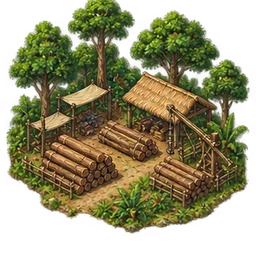
Stone Quarry
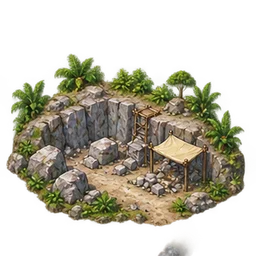
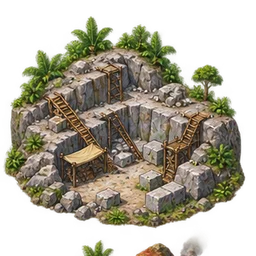
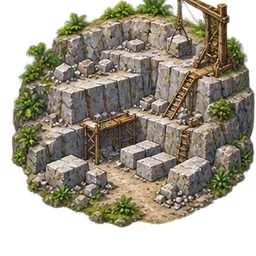
Iron Mine
Paddy Field
Grand Balai
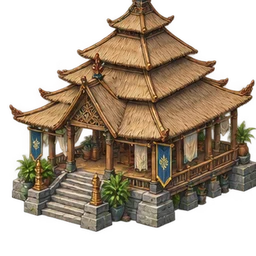
Storehouse
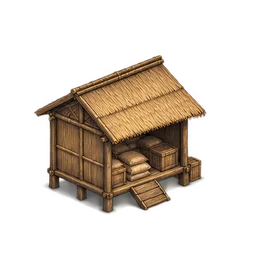
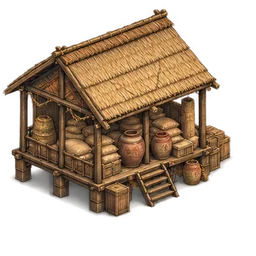
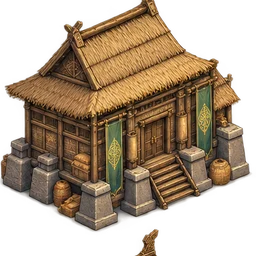
Rice Barn
Kolong
Bazaar
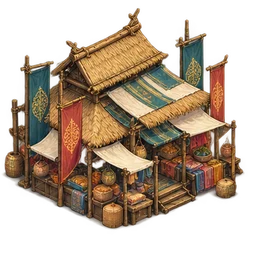
Balai Ilmu
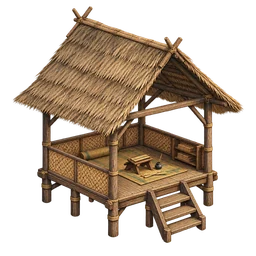
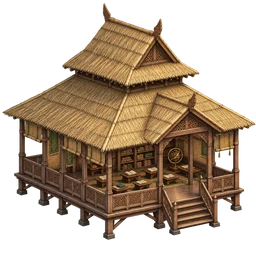
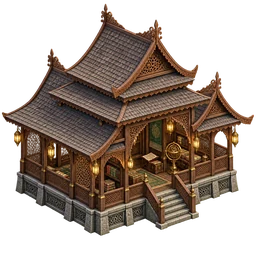
Warrior Hall
Stable
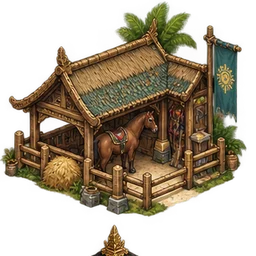
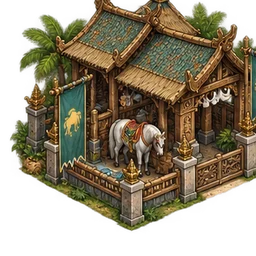
Workshop
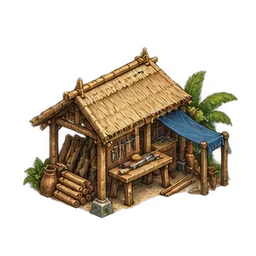
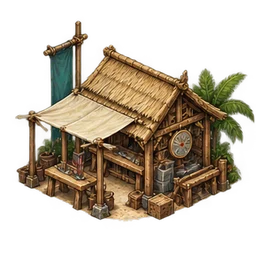
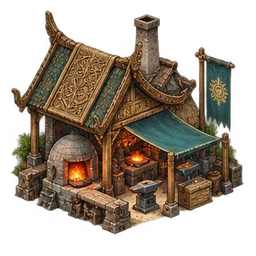
Palisade
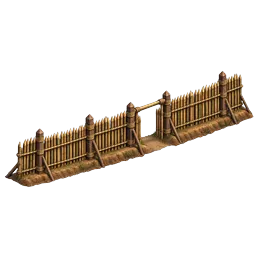
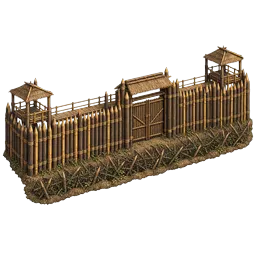
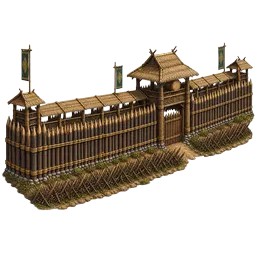
Consulate
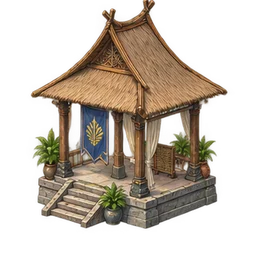
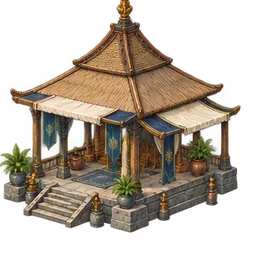
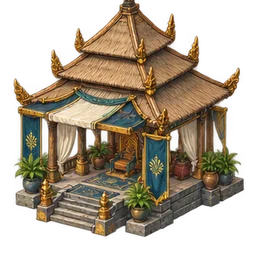
Muster Ground
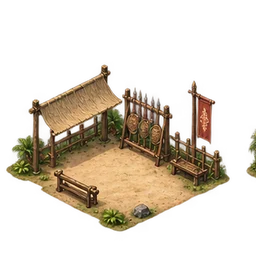
Balai Pahlawan
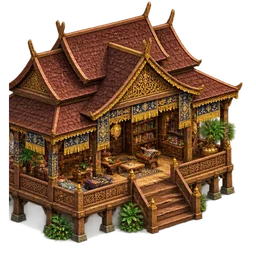
Longhouse
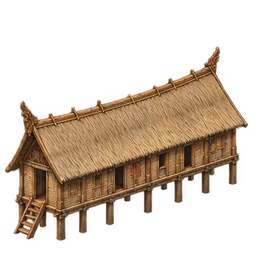
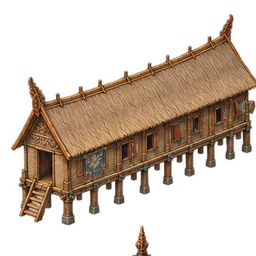
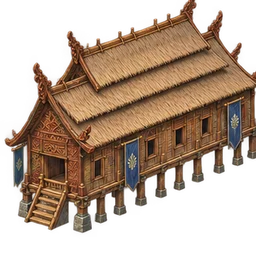
Shipyard
Watchtower
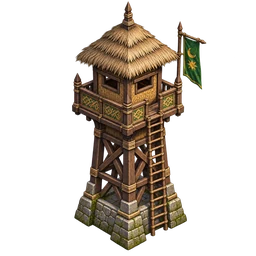
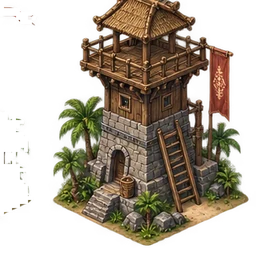
What the next level buys
Every level, and what it gives

For nearly every plot, its level is the whole of its effect: what follows is what each one actually does as it grows, so a cost can be judged against what it buys rather than guessed at. The Balai Ilmu is the one exception — its level is a ceiling on how far a troop may be studied, and the study is what the troop is worth.
Worked fields
All four resource fields share one curve. The gain per level grows steadily, which is why a level 15 field is worth far more than three level 5 ones — and why the villages that win are usually the ones that pushed a few fields high rather than all of them evenly.
| Level | Per hour | Gained |
|---|---|---|
| 1 | 12 | +12 |
| 2 | 19 | +7 |
| 3 | 27 | +8 |
| 4 | 36 | +9 |
| 5 | 45 | +9 |
| 6 | 57 | +12 |
| 7 | 72 | +15 |
| 8 | 90 | +18 |
| 9 | 112 | +22 |
| 10 | 140 | +28 |
| 12 | 210 | +38 |
| 14 | 312 | +55 |
| 16 | 455 | +78 |
| 18 | 657 | +110 |
| 20 | 945 | +157 |
| 22 capital | 1,317 | +195 |
| 24 capital | 1,755 | +226 |
| 26 capital | 2,235 | +243 |
| 28 capital | 2,717 | +238 |
| 30 capital | 3,178 | +235 |
Storage
Production is wasted the moment a store is full, and a village that fills overnight is a village earning nothing until morning. Storage is not exciting and it is not optional.
| Level | Holds | Gained |
|---|---|---|
| 1 | 2,000 | +1,200 |
| 2 | 2,600 | +600 |
| 3 | 3,400 | +800 |
| 4 | 4,400 | +1,000 |
| 5 | 5,700 | +1,300 |
| 6 | 7,300 | +1,600 |
| 7 | 9,400 | +2,100 |
| 8 | 12,000 | +2,600 |
| 9 | 15,400 | +3,400 |
| 10 | 19,700 | +4,300 |
| 12 | 32,200 | +7,000 |
| 14 | 52,700 | +11,500 |
| 16 | 86,200 | +18,800 |
| 18 | 141,000 | +31,000 |
| 20 | 230,000 | +50,000 |
| 22 capital | 360,000 | +70,000 |
| 24 capital | 527,000 | +88,000 |
| 26 capital | 722,000 | +100,000 |
| 28 capital | 922,000 | +99,000 |
| 30 capital | 1,115,000 | +101,000 |
Everything else
| Building | What another level gives |
|---|---|
| Grand Balai | Every level after the first cuts 3% off the time of every other building in the village, and it compounds: about 24% faster at level 10 and 44% at level 20. At level 10 a second crew takes the field and at level 20 a third, so two or three plots rise at once instead of one after another. It is the only building that makes all the others cheaper in the one currency you cannot buy — time — so it is usually the first thing worth pushing. |
| Paddy Field | Grows rice like the other fields, and each level also feeds 12 more villagers. Population is the ceiling on everything else you can build, so a village that has stopped growing has usually stopped here. |
| Palisade | Each level multiplies the strength of everyone defending by a further 5% — 100% at level 20 — and adds 10 flat defence per level, which is what stops an empty village being free to take. It never eats. |
| Watchtower | Level 1 shows that something is coming. From level 5 it warns you on every screen; from level 8 it tells you how many. Its reach over the map grows with it — 2 fields at level 1, 6 at level 8, 10 at level 15 — and it also blinds enemy scouts. |
| Bazaar | One merchant per level, to 15 at level 15, each carrying 5,000. Merchants are booked for the whole round trip, so the Bazaar's level is really the number of bargains you can have in the air at once. |
| Longhouse | Every five Longhouse levels grants one more village, and every Longhouse you own counts: a capital builds to 15 for three, each other village to 10 for two. It is the only way to expand, and it is gated behind a level 10 Grand Balai for that reason. |
| Balai Pahlawan | Every level speeds a champion's mending by 15%. A champion only mends at home, so this is what decides how soon they can ride out again. |
| Muster Ground | Level 1 is what lets you send troops anywhere at all. Higher levels are a requirement for the Shipyard, the Workshop and the Longhouse rather than a bonus of their own. |
What a level unlocks
| Building | Unlocks |
|---|---|
| Warrior Hall | Bamboo Spearman at 1, Kris Swordsman at 3, Kelasi at 3, Blowpipe Archer at 5, Bajau Harpooner at 5, Ironwood Shieldman at 5, Upahan at 5 |
| Stable | Outrider at 1, Light Horseman at 3, Royal Lancer at 5 |
| Workshop | Meriam at 1, Battering Ram at 1 |
| Shipyard | War Prau at 1, Dragon Jong at 8 |
| Longhouse | Pioneer at 1, Penghulu at 9 |
Every figure on this page is read out of the game's own rules rather than written down beside them, so it cannot drift from what the server actually does. They assume this world's speed of ×1.
Eleven kinds of soldier
Every soldier
Read the table this way: Attack matters only when you are the one marching. The two defence numbers are used depending on who is coming — a wall of Bamboo Spearmen shreds cavalry and merely inconveniences infantry. Speed sets how long a march takes; a war party moves at the pace of its slowest member. Carry is how much loot each soldier hauls home.
| Unit | Atk | Def inf | Def cav |
Speed | Carry | Cost | Time | Upkeep |
|---|---|---|---|---|---|---|---|---|
| Infantry — trained in the Warrior Hall | ||||||||
| Bamboo SpearmanCheap levy. Braces well against horse. | 10 | 35 | 60 | 7 | 20 | 60/30/20/20 | 1m 30s | 1 |
| Kris SwordsmanThe backbone of any raiding party. | 40 | 35 | 20 | 6 | 20 | 60/30/80/20 | 2m | 1 |
| Blowpipe ArcherDeadly behind a palisade. | 25 | 50 | 25 | 6 | 25 | 80/50/40/25 | 2m 30s | 1 |
| Cavalry — trained in the Stable | ||||||||
| OutriderScouts. Fights nobody, sees everything. | 0 | 10 | 5 | 16 | 0 | 90/40/60/20 | 2m | 1 |
| Light HorsemanDeep saddlebags. Built for plunder, not sieges. | 65 | 30 | 40 | 14 | 80 | 140/60/110/40 | 4m | 2 |
| Royal LancerExpensive, and worth every grain. | 110 | 70 | 50 | 10 | 60 | 220/100/190/60 | 6m | 3 |
| Siege — built in the Workshop | ||||||||
| Battering RamBrings the Palisade down. | 50 | 40 | 20 | 4 | 0 | 350/200/180/70 | 13m 20s | 3 |
| MeriamBronze siege cannon. Levels enemy buildings when the assault wins. | 60 | 40 | 20 | 4 | 0 | 400/300/250/80 | 15m | 4 |
| Fleet — built in the Shipyard | ||||||||
| War PrauCarries 30 soldiers across open water. | 30 | 45 | 30 | 12 | 100 | 320/60/140/90 | 7m | 3 |
| Dragon JongCarries 110, and fights when it lands. | 90 | 110 | 70 | 9 | 260 | 900/240/520/300 | 25m | 8 |
| Settlers — provisioned in the Longhouse | ||||||||
| PioneerThree of them found a new village. | 0 | 15 | 15 | 5 | 0 | 900/800/700/1600 | 40m | 5 |
The Bamboo Spearman has an attack of 10 and is nearly useless on the march. Defending against cavalry it is worth 60 — better than a Royal Lancer costing four times as much. Cheap troops are not weak troops; they are troops for the other job.
What they look like
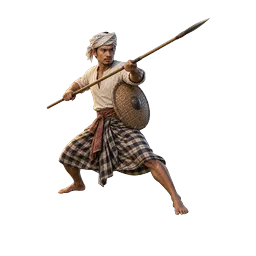

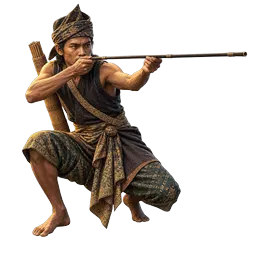
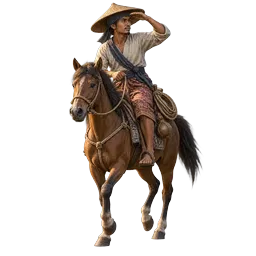
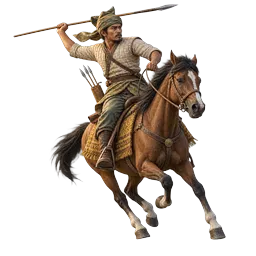
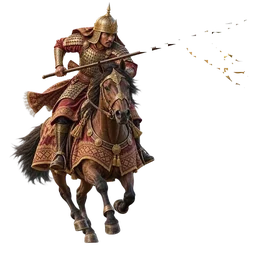
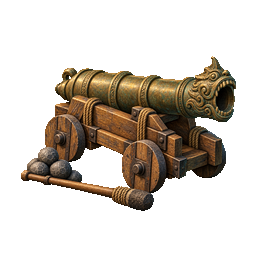
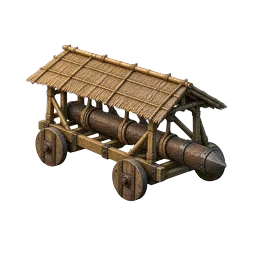
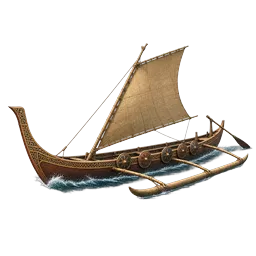
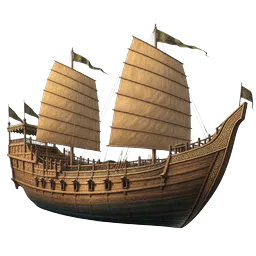

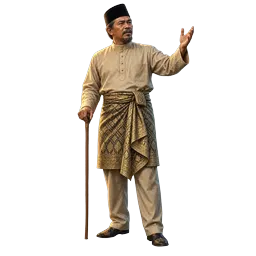

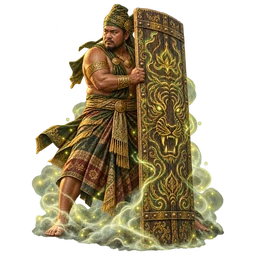

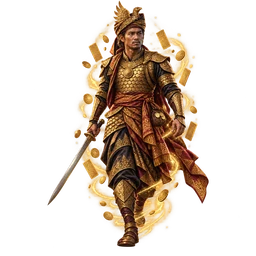
A column can be called back in its first forty-five seconds. After that it is committed. The window is deliberately short: long enough to catch the wrong village on a crowded map, too short to have learned anything by it — no scout has reported, no battle has resolved, and nobody has seen you coming and reacted. Inside it nothing is charged and nothing refunded, because nothing happened: the soldiers walk straight back through the gate.
Meriam can be aimed. When you send a column with meriam in it, the send dialog lets you name a building — and every level they bring down goes into that one first. It takes twenty meriam to knock down a single level, so a siege that flattens anything is a serious army, and spreading that across nine buildings at random was spending it on nothing in particular.
Two buildings are safe from meriam altogether: the Grand Balai and the Paddy Field. A village that loses its hall can never build again and one that loses its fields starves, and neither is a defeat worth inflicting. This page used to say they could still be caught by the ordinary spread and were only safe from being named — that was wrong, and it had been wrong since meriam could be aimed. No siege touches either of them by any route, so however badly an assault goes, your hall and your fields are exactly as they were. And if what you aimed at is already rubble, the meriam knock down whatever else they can reach rather than wasting the shot, so scouting an hour early costs you nothing.
The Palisade is the Rams' work, not the meriam's. Battering Rams break the wall level by level during the battle; meriam cannot touch it at all — not aimed, and not in their spread. Until 1.145.0 the meriam's spread could knock a Palisade flat in an assault that brought no rams, while the report's wall line still said it stood. If you want a wall down, bring rams.
Everything else can be knocked down to nothing, and that is not a figure of speech: a building taken to level zero is gone, and rebuilding it starts from the first level again. Your report now names every building the meriam levelled and what it went from and to, so a defeat tells you what it cost. Reports from before this was recorded do not carry it — the damage happened, it simply was not written down at the time, and the page says so rather than claiming nothing fell.
Combat
How a battle is decided

There are no rounds and no dice you can watch. When an army arrives, the server works out both sides' strength and settles it at once.
- The attacker's strength is every soldier's attack value, added up.
- How much of that strength is cavalry is measured — call it the horse share.
- The defender's strength is worked out using that share. If half the attack is mounted, each defender contributes half their anti-infantry value and half their anti-cavalry value. This is why the composition of an attack matters as much as its size: send pure cavalry into massed spearmen and you are attacking their best number.
- The Palisade multiplies the defenders — 5% per level — and adds a flat amount of its own.
- Luck swings the result by up to 15% either way. Small enough that the better army usually wins; large enough that a close fight is never a certainty.
- Losses fall on both sides, scaled by how lopsided the fight was. A narrow win is expensive. A crushing one is nearly free.
Scouting is resolved separately: your Outriders either slip through or are cut down by the defender's own scouts, and a Watchtower both stiffens that screen and guarantees the defender is told they were scouted.
A won assault carries off resources up to the raiders' total carry capacity. What is in the Kolong is not among them: the boarded space under the stilts keeps back a fixed amount of every resource — 200 of each at level 1, 4,200 of each at level 10 — so a raid takes what is above that and no more. A village holding less than it can hide has nothing to take at all, which is the point: it is a shelter for whoever is being farmed rather than a wall for whoever is winning, and against a large store it is a rounding error. It costs no population, so being raided does not also cost you the villagers to recover. Battering Rams bring down Palisade levels; meriam level other buildings. Losing a fight costs you the soldiers, the goods, and some of the work.
Working out the odds. Before you send an army, the send dialog offers to work out what is likely to happen: your chance of taking the village, what you would lose, and what they would. It runs the same rules the battle itself uses, two hundred times over, so what comes back is a chance and a range rather than a promise — luck swings every fight by up to a sixth either way, and a close number means a close fight rather than a safe one.
Where you have scouted the village, your own report fills the enemy's numbers in, and says how old it is. Where you have not, you type what you think is there. Nobody else's scouting is ever used: finding out is what an Outrider is for.
Defence, as one number. Every village now has a standing figure — its garrison and its Palisade added up the way a battle adds them up, so a wall counts and an empty village with a tall wall is not reported as nothing. On a village of your own, the map panel measures it now, because it is yours and adding it up by eye is how people get it wrong. On somebody else's, you are shown what your last scout measured and the hour they looked, and nothing at all if you have never looked — a live figure for a village you do not hold would make scouting pointless. It is a snapshot, not a feed: they may have reinforced since, and the panel says so rather than letting the number look fresher than it is.
The send dialog puts your own column's attack strength beside it as you pick soldiers, so an attack shows what it is worth against what was last seen standing there before you commit it. That pair is a comparison and not a promise — luck, the wall's level at the hour you arrive, and anybody who has marched in since are all outside it. Where you want the real odds, the calculator underneath still runs the actual battle engine two hundred times and reports a chance and a range.
Your reports are ordered by what they are about, not only by when they happened. Anything involving somebody else — a fight with another player, a Lanun camp, the Compact — comes first, newest at the top. Your own movements sit underneath, behind a heading that says so, because a page that quietly stops being chronological reads as broken.
Sharing a report. A report has its own address, and pasting that address into your kingdom’s channel lets your kingdom read it — both kingdoms in the fight, and the kingdoms allied to either. It is not public: opening one still needs an account, and it needs to be an account on one of those two sides. What your mates see is the fight as the attacker saw it, which is why this is safe to do after a raid on your own village: they learn what the raider learned and no more, and the copy that lists your garrison is never the one shared. This works for a fight over a spice grove as well as for an assault; a scouting report is not shareable, because it describes a third party’s village. Your kingdom’s defence board does this for you: once an attack on any member has landed, the row carries a way straight through to the fight.
Reading one report after another. A report has Newer and Older at the top, which step through your reports in the same order as the list, and Next unread when any are still waiting — so a pile of them can be read straight through without going back to the list.
Geography
The sea, and why it says no

The world is water as much as land, and this is the rule new players trip over. A land army can wade a little — but if more than 40% of the route is open water, the march is simply refused. It is not slower; it is impossible.
Where a column can ford, water still costs two and a half times what the same distance costs on land. A target that looks close across a bay is often further, in time, than one twice the distance inland.
To cross properly you need the Shipyard. A War Prau carries 30 soldiers, a Dragon Jong carries 110, and both fight when they land. Ships are what turn a neighbouring island from scenery into a target.
Ships sail connected water, from port to port. A fleet leaves a village with water beside it — the same jetty that lets you build the Shipyard — and sails to another village with water beside it, along water that really joins the two. It goes the whole way by water at the fleet's speed and the troops step off at the quay: there is no stretch of land to march. A river that never reaches the sea can carry ships only to places on that same river. A fleet will not be sent to a village inland, or to one whose water is not joined to yours — the send screen says so, and the troops go on foot instead. On the Military page every soldier carries three small marks for the sea, rivers and lagoons so you can see at a glance what it can cross.
Rather than one broad landmass with a wet edge, this map is two great islands and a small one in the strait between them — a long island bending down the west, a broad round one east with a bay facing the crossing, and a stepping stone in the middle that belongs to nobody until somebody takes it.
Which is why this section matters as much as it does. Water is not something at the edge of the map here — it is between you and most of your neighbours, and a Shipyard is not a late convenience. Read the terrain key before you choose where to send a founding party: ground that looks close can be a fleet away.
Scouts are the exception. A party of nothing but Outriders will get itself across water an army cannot — they take a fishing boat, buy a passage, swim the narrows — so you can look at a neighbour across a strait without building a fleet first. Add a single spearman and the party is an army again, with an army's limit.
It is not unlimited. Past about 85% open water the crossing is ocean and nobody is swimming it. And scouts pay for the water in time: it costs them twice what a detour costs a land column, so a long crossing is a real decision rather than a free look.
Expansion
Founding more villages

A second village is the single biggest step up in the game — and the most expensive.
- You need a Longhouse, which needs a Grand Balai at 10 and a Muster Ground at 5. Every five levels of every Longhouse you hold grants one more village — not each level, and not only your tallest. A capital’s Longhouse builds to 15 and is worth three villages; every other village’s builds to 10 and is worth two. So a Longhouse at level 4 has earned nothing yet and the fifth level is the one that pays. No player holds more than sixteen villages however much they build. Rounds 1 and 2 counted differently — one village per level of your tallest Longhouse alone — so a number you remember from then does not apply here.
- You need three Pioneers, travelling together. They are slow, costly, and eat five rice an hour each.
- The site must be dry land, a tile nobody is standing on, and reachable — the water rule above applies to settlers too. There is no minimum distance any more: you may settle the tile next to your own village, and a tight cluster is a legitimate plan rather than something the server refuses.
- If somebody takes the ground while your party is walking, the Pioneers turn round and come home rather than vanishing.
- Anything else you send with them — the War Prau that carries them over water, an escort to hold the new ground — stays in the new village as its first garrison. Only the three Pioneers are spent founding it.
Loyalty
Taking a village from somebody

An assault burns what it finds and walks away. Taking a village is a different undertaking: the buildings, the fields and the levels stay exactly as they are, and the name on them changes to yours.
Loyalty
Every village holds a loyalty between nought and a hundred, and every village on the map starts at a hundred. It is not a wall you knock down with soldiers — no amount of fighting moves it on its own. It moves only when somebody brings a headman.
Loyalty recovers by itself, two points an hour at this world's speed. That number is the spine of the whole thing: a village talked down to forty is whole again in a day and a bit, which means a single attacker chipping away once a night never gets anywhere. The recovery outruns them. To take a village you have to arrive with enough at once.
The Penghulu
A Penghulu is a headman of standing, and the only unit in the game that can move loyalty at all.
- Trained in your capital and nowhere else, from a Longhouse at its greatest extent — the last thing that building is for. Expensive, slow to raise, and heavy to feed.
- They do not fight. They are carried into somebody else's battle and contribute nothing to winning it.
- Only the ones who survive do any talking. A wave that wins badly arrives with fewer headmen than it set out with, and the ones who fell talk to nobody.
- Each surviving Penghulu talks the village down by 20 to 30, rolled for each of them separately.
- They can be sent ahead to wait with the Reinforce order: to another village of yours, or to a forward base in somebody else's village that has a Muster Ground, so the assault that carries them sets out near the target instead of from your capital. A village with no Muster Ground is refused, because no column could ever leave it.
So the arithmetic is deliberately blunt. One headman needs four winning assaults, spread across days, against a loyalty that is climbing back the whole time — which usually means it cannot be done at all. Three or four in one wave will usually take a village in a single afternoon — usually, because each headman is rolled separately and four unlucky rolls can leave a village standing on two or three loyalty. You will see how close you came, and one more headman finishes it. Conquest is a campaign you commit to, not something an ordinary raid does by accident.
The assault still has to win. Headmen riding with an army that loses achieve nothing at all, and you have paid for them.
And the Longhouse has to be gone. A village whose Longhouse still stands will not change sides, however far its loyalty falls: when the headmen finish talking it is left at a loyalty of one instead. Bring it down with meriam — aim them at it from the send dialog — and the headmen can finish the job. The siege lands before the headmen speak, so a single wave carrying enough meriam and enough headmen can raze the Longhouse and take the village in the same blow. A village that never built a Longhouse has nothing standing in the way.
What can never be taken
- A capital. Ever. However many headmen arrive, however long the siege. Whatever else happens to a player, there is somewhere they still are.
- A village belonging to somebody still under beginner protection.
- A Lanun camp — there is nobody there to talk to. Burn it instead.
- A village that has just changed hands, for eight hours. Without that pause the second wave takes it off the first and a village changes owner four times in an evening while nobody holds anything.
Most players hold exactly one village, and that village is their capital — so it cannot be taken. If you read this in the first weeks, look at the map and find nobody you could march on, you have not misunderstood the rules. Conquest arrives on its own as a round matures and people spread out, and nothing anywhere makes that happen on a schedule. Early on it is a thing between the few players who have expanded.
What you actually get
Everything standing on it, at the level it stands — which never includes a Longhouse, since that had to come down first. What leaves with the old owner is what was never really the village's:
- Spice groves held from there are released, and the soldiers holding them march home to the player you took it from. The groves' bonus to the village goes with them.
- Soldiers other players had stationed there march home rather than switching sides.
- If the old owner's champion lived there, they go to that player's capital.
- The village counts against your Longhouse allowance like any other. If you are already at your limit when the headmen finish talking, the village is left at a loyalty of one instead of changing hands — so it is worth checking your allowance before you commit a wave to it.
- It arrives at a loyalty of 25, not nought, and cannot be taken again for eight hours. That is your day to garrison what you have just taken.
Knowing what you are marching at
A village's loyalty is not written on the map. You find it out the way you find out anything else about somebody else's village — send scouts, and it is on the report. What the map will tell you is whether a village can be taken at all, because that much is public: a capital is visibly a capital, a camp is a camp, and a village that changed hands this morning did so in front of everybody.
That is on purpose. If you could read the number from the map, conquest would be arithmetic — count the headmen, send exactly enough, never scout, never risk anything.
Moving your capital
Because a capital cannot be taken, which village is your capital is a real decision rather than an accident of where you started. You may move it to any village you own — once every three days.
The ration is the whole rule. Without it, anybody watching a village fall would simply promote it as the army arrived, and conquest would stop existing: the defence would be a button rather than an army. Three days means the choice has to be made before you know where the blow is coming.
The levels past twenty stay with the capital, not with the village. Fields and stores in your capital build to 30; everywhere else they stop at 20. Move the capital and the old one keeps every level it has — nothing is pulled down or refunded — but anything past twenty works as twenty there: it produces and holds what a level-twenty field or store does, and its page says so. Make it your capital again and they work again. The villagers working those levels are still fed either way.
Two villages, one economy
Moving goods to your own villages

A second village starts poor, and the one with two iron sites will never grow enough rice. Goods move between villages you own by the same merchants that trade with other players, on the same roads, at the same speed — a caravan leaves, travels, unloads and walks home.
- It costs merchants, which are then not trading, and it costs travel time. Distance is a decision here as everywhere else.
- A load is never smaller than 100 of a resource — below that it is not worth the round trip.
- A shipment is capped by what the destination can actually store, so nothing is carried across the map to overflow on arrival.
- A standing route always leaves one merchant at home, so feeding your own villages never quietly closes your Bazaar.
Every caravan you have on the road is listed in the Bazaar — from all of your villages, not only the one you happen to have open — with what it carries and when it lands. They used to sit among your war parties on the Army screen, which counted a load of timber as a column in the field. Soldiers are on the Army screen; goods are with the merchants who carry them.
Moving your own soldiers between your own villages writes no battle report, because there was no battle. The column shows on the Army screen while it walks and the soldiers appear in the garrison and on the muster roll when it lands. Reinforcing somebody else still writes one, for both of you — that is a commitment to another player and worth a record.
A fifth thing to hold, and it is not in the storehouse
Gold coins, and what they buy

Nothing produces gold coins. No field grows them, no building makes them, and a raid cannot take them — it is not in the storehouse to be taken. Every coin in the world came over the Bazaar's own counter.
Your gold is yours, not a village's. It sits in one vault shared by every village you hold: coin earned at one Bazaar pays for study, mercenaries or a trade in any other, and a village that changes hands takes none of it with it. Click the coins in the resource bar for your balance sheet — every coin in or out this round, what it was for, which village, and the vault after each. A new round starts every vault empty.
Spending coin to finish a build sooner
Where a world switches it on, a build that is already running can be hurried with gold coins. In a village’s Construction panel, and in the side panel of the building being worked on in the village picture, a build with a crew on it shows a button: Take 2 hours off · 4 coins (1 of 3). Press it and that much comes off the clock, and the coin comes out of your vault. The price is for exactly the time it takes off, at a set number of coins for each hour of real time, rounded up to a whole coin — so a long build is no cheaper to buy down than a short one, and the same on a world that runs faster.
Each press takes a share of what is left, so it never finishes a build outright. The default is a quarter of the time remaining: eight hours becomes six, then about four and a half. A build can be hurried only a few times (three by default) and then no more, a build still waiting for a crew has no clock to shorten and a demolition cannot be hurried, and a press sent twice buys once. Every purchase is a Build boost line in your balance sheet. The administrators set whether it is on, the share, the price and how many presses a build takes, and can change them during a round; the button always quotes the current price.
Your analytics: the timeline, the resources and the ledger
"How your round went" on your profile now opens a whole page of its own. Click Open your analytics there, or go to /analytics. At the top are six figures — your ranking, your villagers and villages, the levels you have built, the enemy levels you have flattened, and how your attacks and your defences went (won, lost and drawn). Click any of them and the timeline underneath draws that figure over time. Tick Compare on a second card to draw it beside the first.
The timeline is yours to move about in. Hover for the exact value and the moment; drag to scroll back through the round; scroll the wheel or press the plus and minus buttons to zoom, and the round-arrow button to reset. The strip beneath it is the whole round in miniature — drag the box on it to move the window. Choose 24 hours, 7 days, 30 days, the entire round or a range of your own, and hourly, daily, weekly or monthly steps. Little diamonds mark the things that happened: a fight, a village won or lost, an unusually large movement of goods. Switch any line off from the key above it.
One scale per kind of thing. Two kinds of figure — villagers and gold, say — get a left axis and a right axis, each named. Pick three or more and every line is rebased so that it starts at 100, and the axis says so; the chart never lays two different units on one unlabelled axis. Ranking is drawn upside down on purpose, so being first is the top of the chart.
Times are shown in Kuala Lumpur time unless you switch them to UTC or to your own device's, and the zone is always named.
Resources and coins, account by account. Resource Income and Resource Expenses give timber, stone, iron and rice an account each: what you started with, what was produced, what came in by trade or as a reward, what went on building, training and study, what was sold, sent away or plundered, and what you ended with. Gold Coin Ledger and Transaction History list every single movement — ten to a page, or 100, 200, 400 or 1000 — newest first, with a search box, filters for resource, category and dates, and a Details button for the full breakdown of a line. You can export what you have filtered as a spreadsheet.
History starts when it began being kept. Goods are recorded from the day this arrived and rank and the hourly figures from a little earlier; before that the page says historical data unavailable rather than draw a line it cannot stand behind. What is recorded stays after the round ends and after you rename yourself.
It is private. Only you see your own page, and nobody sitting for you can. An administrator can look at any player's records when investigating something, and every time one does, the look is written into a trail. Nobody — you, an administrator, anyone — can edit or delete a line of the ledger.
Selling and buying at the counter
Your Bazaar has a counter that will always trade, at a price you do not set. Sell it goods and it pays coin; buy goods from it and it charges coin. It pays less than it asks — that gap is deliberate, and it is the only thing in the game that takes coin back out of the world. Trading with the counter is meant to be the worst price you can get and the one always available.
The Niaga pay less at the counter. It is what the tribe is for, and it compounds: the tribe that trades most cheaply is also the one whose soldiers can be bought.
The chart beside it shows a rate, not a receipt. Every figure on it is what a standard load of that good fetched — so a sale of six hundred thousand stone and a sale of ten thousand sit at the same height if they were paid at the same price, which is what a price is. Each card leads with that rate and with how far it has moved since the start of the window, up or down. The counter's own price is fixed by the world's settings and so draws a flat line, honestly labelled steady; what moves in between is what players are asking each other for.
The rate is on the counter itself, as a load and the coins it fetches — ten thousand timber for a coin, half as much iron for the same, because iron counts double. The card also shows what that same load would cost you to buy back, which is always more: the gap between the two is the counter's cut and the only thing taking coin out of the world. A load too small to be worth a whole coin is refused rather than bought for nothing.
Offers between players
An offer you post is priced in gold coins. You put up goods, you name a price, and whoever takes it pays coin. The goods travel — your merchants carry them, and they are gone from your village the moment you post, exactly as before — but the payment does not travel at all. It is settled at the counter the instant the offer is taken, so the buyer sends no caravan and books no merchants.
Two things follow, and both are worth knowing before you plan around them. A buyer with no merchants can still buy. And a trade now needs only one Bazaar big enough to carry a load: the seller's.
You can also post an order to buy. Name the goods you want and the coin you will pay, and it sits on the board beside the sales, marked as somebody wanting to buy. Your gold is set aside the moment you post it — exactly as goods are on a sale — and returned in full if you withdraw it, so the same coins cannot back two orders at once.
Filling one works the other way round from taking a sale. The goods travel from your village, carried by your merchants, from whichever of your villages you choose when you accept — so the distance shown is your journey, not theirs. You are paid the moment you accept, because the coin was already set aside; the person who posted the order receives the goods when your caravan arrives. One order is filled by one person: a sale cannot be taken in parts either.
Offers made before this change are still on the board, still asking for goods rather than coin, and they are honoured the way they were made — goods both ways, a caravan each way, and the buyer needs the merchants to carry their half. You cannot post a new one.
Hired swords
The Upahan is the Niaga signature unit, and it is bought rather than raised: it costs gold on top of its resources. A new village is founded with an empty treasury, so a Niaga player cannot hire anybody on their first morning — the first thing that tribe does is trade. That is the shape of them, and it is why their discount at the counter matters more than it looks.
The Balai Ilmu
A house of learning, and the one plot whose level is not the whole of its effect. What it does is let you study a troop: pick one kind of soldier, pay resources, coin and time, and every one of that kind you own — in every village, now and in future — fights a little harder.
- Each troop can be taken five rungs, and each rung adds five per cent to that troop's attack and its defence. A troop taken all the way is a quarter stronger, whichever end of the fight it is on.
- It follows the player, not the village. Study spearmen once and every spearman you own is better, wherever they stand and wherever they were raised.
- One study at a time, however many Balai Ilmu you have built. A second hall does not let you learn two things at once; it lets you learn where you happen to be.
- The building's own level is a ceiling on how far you may go. The fifth rung needs a Balai Ilmu of five.
- Each rung costs more than the last, in goods, in coin and in time. The coin is the part that bites: ten gold for the first rung, and ten more for each one after it, so taking a single troop all the way costs a hundred and fifty gold. At roughly ten thousand timber to the coin, that is a kingdom's project rather than an afternoon's.
Where to find it. Study is its own tab on the Military page, beside the barracks, your columns and your reports — not a panel inside the training list, which is where it used to hide. Each troop there shows the three numbers a battle actually uses: its attack, its defence against foot and its defence against horse, as they stand and as they would be after the next rung, with what that rung costs in goods, coin and time. Those are the figures the fight is settled with rather than a separate sum, so what the screen promises is what your soldiers do.
The building points there itself. Upgrading the Balai Ilmu does not make your army stronger on its own — studying does. Open the Balai Ilmu in your village and Choose what to study takes you straight to the tab; when it is first built you are told the same; and while it stands idle, with something left to learn, the Army button and the Study tab carry a small gold dot until you choose.
A study that finishes while your column is walking still counts when it lands. The same is true defending: if the rung completes before the attack arrives, your soldiers fight at the better number. Nothing has to be collected and nothing expires.
Training speed subscription
Gold coins can also buy faster training. Every unit's box on the Military page has a Training speed subscription under its Train button, with four cards: None, Basic (1 coin an hour, 7% faster), Advanced (2 coins, 12%) and Elite (3 coins, 18%). Nothing is charged until you press Save and confirm the price.
- It is one subscription for you, not one per unit or village. Every training box shows the same card, the same balance and the same paid time, and the boost applies to every village you hold.
- The percentage is a rate. A Bamboo Spearman that takes 8 seconds takes about 7.48 at Basic, 7.14 at Advanced and 6.78 at Elite. What a unit costs, what it eats and how strong it is do not change.
- Training under way is sped up, not restarted. What a batch has already done stays done; only the time still to go changes, for the batch running and for those waiting behind it. When a boost ends, the time left goes back to normal and nothing already trained is taken away.
- You pay the first hour when you save, then once an hour. The coins come from your gold vault, the same one that pays for study and mercenaries. If the vault cannot cover a renewal the boost ends when the hour you paid for ends, you are told, and it does not start again until you choose it again. Your coins never go below nothing.
- Choosing None stops the renewals but keeps the hour you paid for: the boost runs to the end of it and nothing more is charged.
- Moving up to a better plan starts at once, and the unused part of the hour you paid for is credited back in whole coins, so you are not charged twice for the same hour. Moving down waits for the next renewal.
- The prices and bonuses are set for the world and can change. A change reaches you at your next renewal; the hour you have paid for keeps the terms you bought it on.
Gold coins, spent in a hurry
Hiring a company
When an attack is coming and there is no time to train, the Bazaar can find men for gold. Open the Bazaar and choose Hire. Three companies are on offer:
- Hired Pikemen — long spears for a wall, strong against horse. 2 gold coins a man.
- Hired Blades — swordsmen for an attack. 3 gold coins a man.
- Hired Riders — fast horsemen. 5 gold coins a man.
They stand in the village the moment you pay, and fight, march and reinforce like your own soldiers. They need no rice and no room. A Bazaar can find 25 men a level for one contract, and you can hold one contract for each company at a time.
A contract lasts one day of world time. When it runs out the men leave — from your village and from any village they are defending. Men still on the road finish their march and leave when they get home. You can hire the same company again as soon as its contract has ended.
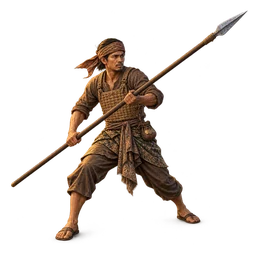
2 gold a man
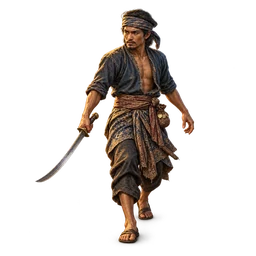
3 gold a man
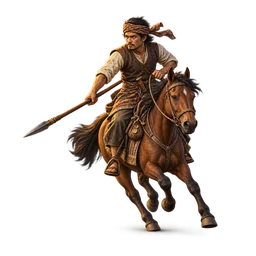
5 gold a man
Somebody else's wall
Helping somebody hold, and marching on from there

Send troops with the Reinforce order and they stay where they land. They defend that village as if they were its own, and they eat that village's rice, not yours — so a host who cannot feed them will watch them starve. The muster roll lists every garrison of yours that is standing in somebody else's village, and they march home whenever you say so.
They do not have to march home. A village you have soldiers standing in is a village you can march from. Pick a target anywhere on the map, and the send dialog offers that wall alongside your own under Marching from — or press March from here on the Military screen, which opens the map with that wall already chosen. An army you sent to an ally three days into enemy country can attack, raid, scout or reinforce from where it stands instead of walking all the way back to be useful again. When it is done, the survivors return to that same wall — not to your village — which is the whole point of having one out there.
What it costs is that a forward base is not free ground:
- The host's Muster Ground is what forms the column. No Muster Ground, no column — the troops can only come home.
- Anything the column carries back is unloaded into the host's stores. They fed the army; they keep the plunder. The dialog says so before you place the order.
- You cannot march out of somebody's gate at another of their villages. A guest may not turn on a host.
- The host's treaties bind your column as firmly as your own do. If they have sworn peace with your target, that attack cannot leave their village — though it can still leave yours.
- Founding a village and holding a grove start from your own ground only.
The host is told when a column leaves their village. The host can also send your soldiers home: on their army screen, under Guests on your walls, each guest has a Send home button. Your soldiers then march back to your village at their own pace, exactly as if you had recalled them, and you get a notification saying who sent them. Letting somebody station an army with you is a real decision on both sides.
With one exception: reinforcing a kingdom you are at war with hands the soldiers over. They walk in and they are theirs — they defend that village, they eat that village's rice, they answer that village's muster, and you cannot call them back. Your champion is not part of the bargain and turns for home. Nothing stops you doing it, and the send dialog says plainly what it will cost before you place the order; there are reasons to, from suing for terms to covering a friend whose kingdom went to war without them. It is simply not a way to lend an enemy a garrison you could take back the moment it mattered.
The war is read when the column lands, not when it leaves. Soldiers who set out in peacetime and arrive into a fresh war are surrendered; soldiers who set out during a war that ended by terms an hour later are not.
But a village that falls while your soldiers are on the road to it is not somewhere they arrive. Every reinforcement still marching to it turns round where it stands and walks home, taking as long to come back as it had already walked, and you are told. It does not matter whose village it was or who sent them: only the new owner's own columns carry on. This is the same as the soldiers already standing inside, who are marched home when it changes hands.
Where your army is
The muster roll

The muster roll is on the Army screen. The box of soldiers at the top counts every soldier you have, not just the village you are in, and pressing it opens the roll beneath: where each of them is standing — in your own villages, on somebody else's wall, or walking. One page and one total, so the question "how many do I have" has an answer you do not assemble by hand.
It also says what each garrison costs. A soldier eats rice every hour, charged to the village it is standing in — so an ally's army on your wall is your rice bill, and yours on theirs is not. The roll adds up what your own villages are paying, guests included.
Two orders sit on it. Call them all home sends a garrison back as an ordinary march. Call some… opens a box per unit so you can bring back the spearmen and leave the horse. Both appear only where the rules already allow a recall: on somebody else's wall, and in a village of yours with no Muster Ground where nothing can form a column. A village of yours that can march uses the ordinary send, which is the order that knows about war parties and treaties.
A village of yours holding nobody is called out in red. That is not an error — it is the thing most worth knowing on the page.
Everybody at once
Striking at one hour

Twelve columns that arrive one after another are twelve columns beaten one after another. Arriving together used to mean every player working out their own travel time, subtracting it from an hour agreed in the channel, and being awake at whatever odd moment that produced — which sorts a kingdom by who can stay up rather than by who can fight.
Your Raja or a Laksamana can now name a target and an hour. Find the village on the map and press Plan a strike with your kingdom; anyone in the kingdom can do that much, and the officers are the ones who can call it.
Everybody else pledges soldiers to it — which village to march from, which units, and either the plan's order or a scout riding in with the wave. The server works out when each column has to leave and sends it. A neighbour two tiles away leaves last; somebody three days out leaves first; everybody lands on the hour.
All, beside Clear, puts every eligible soldier standing in that village into the pledge at once. Civilians and other units that cannot join the selected order are left out; if you switch to a scout, only scouts remain. If the column comes back refused as too slow to arrive in time, it is usually the siege engines — take those out and pledge the rest, or ask for a later hour.
Pledged soldiers leave the garrison the moment you pledge them. That village stands without them until they march. It is the price of a promise that means something — an army that could quietly be spent elsewhere an hour before the strike is not an army anybody can plan around — and it is why you can take them back at any time before they leave, instantly and in full. They never went anywhere. Meanwhile they still eat that village's rice and still occupy its villagers, so pledging is not a way to stop feeding an army.
A plan buys coordination and never permission. Each column goes out under the ordinary rules when its moment comes: a treaty still refuses it, a fleet still has to be big enough to carry it, a village with no Muster Ground still cannot form one. If a column cannot march when the hour comes, its soldiers go straight back on the wall and you are told why.
Your champion can ride with a pledged column, on the plan's order — not on a scout, where they would be risked for a report you would have got anyway. A champion works differently from the soldiers above: they are asked for, not taken. They stay yours the whole time the plan waits, free to defend, to mend, or to go out on an expedition, and they are looked for only when the column forms. If they are wounded, away, or standing in another village when the hour comes, that column marches without them rather than not marching at all — because a column that fails is not one player's misfortune here, it is a hole the rest of the wave lands into. The plan says which columns brought a champion, and which asked for one and went without.
A strike can be aimed. Beside the mission, the officer calling it may name one building to bring down — the same list a single assault may point its meriam at, so never the Grand Balai, never the Paddy Field, and never the Palisade, which is the Rams' to break. The aim is carried out by whichever pledged columns are bringing meriam; everybody else simply fights. So the plan says what it is aiming at, and it says it where the kingdom is deciding what to pledge: a wave that turns up with no meriam in it has named a target nothing can hit. Anything the aim cannot use — a Warrior Hall already flattened by the first column — falls on whatever else those meriam can reach, rather than being wasted. Raids take goods and leave, so a raid is not offered the choice.
The hour must be at least ten minutes away, so the kingdom has time to answer it, and at most a week. An officer can call the whole thing off, and every pledge goes home.
Two strikes can land together. When a plan is already open, the officer calling another can choose Lands with the strike on … instead of a time, and the new plan lands on the same second as that one. Otherwise the hour is set in hours and minutes, or with the quick buttons from half an hour to a day, and the form says what time that is on your own clock before you call it.
You can pledge from where your army is standing. Soldiers you have sent to hold a friend's village are listed under March from as well as your own villages, and they march from there — their travel is worked out from where they are, not from home. The column forms on that village's Muster Ground, so a village without one is listed but cannot be chosen.
Somebody has to hold
Calling the kingdom to a wall

The mirror of the war plan, and deliberately not the same machine. A village expecting a blow raises a call — the village, the hour help is needed by, and a line saying what is coming — and everybody in the kingdom sees it, in the Defence tab and as a notice.
You may pledge from as many of your kampung as you like — one pledge from each. Post one, choose another village in the picker, and post again; every column marches from its own village and they all land on the same hour. What is refused is pledging twice from the same village, which is why the message names the village rather than the plan. Once you have a pledge standing, Pledge more, from another village stays on the plan so the next village is one press away.
Anybody can call for their own village. Calling a strike is an officer's decision because it spends the kingdom's armies; being attacked is not a decision at all, and a member who has to wake a Laksamana first will be sacked before they find one. An officer can raise a call for anyone's wall, which is what lets them rally a village whose owner is asleep. One call per village at a time — two would split the kingdom's answer between them and each would look under-answered.
Nothing is held. This is the real difference from a war plan, and it comes from a difference in what the two are for. An attack has to be simultaneous: twelve armies landing an hour apart are twelve armies beaten one at a time, which is why a war plan takes your soldiers off the wall and holds them until the moment that lands everybody together. Defence buys nothing with that. Two reinforcements arriving an hour apart are worth what they would be worth arriving together, and the earlier either stands on the wall the more use it is. So what you send to a call marches at once, as an ordinary reinforcement, and can be recalled from the muster roll like any other.
You are told what your soldiers did. If a village you have reinforced is attacked, the battle report comes to you as well as to the two sides — you fought in it, and your losses are in it. A notification names the village, so if you are holding three walls you know which one was struck. Somebody who simply lives nearby is told nothing.
Late help is still help. A war pledge that cannot make the hour is refused, because a column landing after the wave feeds itself to a defence the others already failed to break. A defence column that arrives after the blow has still arrived — the village may hold without it, the attacker may come again, and a garrison on the wall the day after a siege is worth having. So nothing is turned away for being slow. The call shows two numbers instead: everything promised, and the part of it that will actually be standing there when the hour comes. The second is the one to read.
Closing a call does not turn anybody round. Those soldiers are an ordinary reinforcement belonging to whoever sent them, and recalling them is that player's decision to make.
Not being at your desk
The Steward

Everything here happens in real time whether or not you are watching, which is the point — but it also means an empty build queue at 3am is a wasted night. The Steward is the standing order you leave behind.
- A build plan: the buildings you want raised, in the order you want them, started as soon as they are affordable. Each step has a number you can type into — type 1 on the fourth step and it goes to the top, with the rest renumbered behind it — and a target level you type too, anything from one above where the building is now up to its highest. When you add a step, buildings already at their highest level are not offered, and you can type a name to find the one you want. A village with no shoreline is not offered a Shipyard, because it can never build one. A plot with nothing built on it yet is listed as not built yet and can be planned like any other: you do not have to raise it by hand first, the Steward builds its first level when the step's turn comes.
- The Niaga pay less. The merchant tribe gets a percentage off the Steward fee, set by the administrators (it is in the settings table under Steward discount for Niaga, and is nothing until they set it). It is worked out for each village and rounded to a whole coin, and never below one coin: at a fee of 12 and 10 percent off, a Niaga village pays 11. The price on your Steward screen is the price you are charged, discount taken.
- Garrison targets: keep this many of these units in this village, and train the difference.
- A supply route: ship the surplus to another of your villages on a schedule, under the rules above. A village runs up to three standing routes — the first with any Bazaar, the second at Bazaar 8, the third at 15 — and the routes take turns, one shipment per sweep, so one full caravan beats three underloaded ones.
The Steward has no privileges you do not. It cannot spend what you have not got, cannot exceed a queue limit, and obeys exactly the rules your own orders obey — it is you, doing the boring part on time.
A world may charge for it. Where it does, the fee is gold coins, per village, for the period ahead, taken from your vault — so six automated villages cost six times one, and a village that has never switched the Steward on is never charged for it. The period is a day unless the administrators have set it shorter: a fee of one coin every two hours is twelve coins a day, but it is taken in small pieces through the day, so a purse that cannot find twelve at once can still keep the Steward running for a while. The price and the period can be changed during a round and take effect at once; your Steward screen always quotes the current figure and how often it is taken, and the settings table near the top of this page lists both. Where the price is nought, the Steward is free.
It is never a debt, and it never loses your setup. A village that cannot find the coin simply stops being worked until it can. Your build plan, your garrison targets, your routes and your rules all stay exactly as you left them, nothing is switched off, and the Steward starts again by itself on the first sweep after a coin arrives — there is nothing to turn back on. Gold comes over the Bazaar counter and nowhere else, so if a village has gone quiet, sell it something.
It tells you what it is waiting for. Every step of the build plan shows the cost of its next level with its state beside it in a word: Ready to upgrade in green, Not enough resources in red, Waiting in gold (for an earlier step, since steps go in order, or for a free building slot), Currently upgrading in blue with a bar and the time left, Completed, or Paused. Each resource you are short of is red on its own, and the line underneath says exactly how much is missing and roughly how long your production will take — or, when no wait will help, what to do about it (nothing is producing it, or your store cannot hold the cost on top of the reserve). Press the costs to see, for each resource, what you have, what it needs, and what is left or missing. “Available” always means above your reserve, which the Steward never touches. Ready is about the next level only: a plan to level 20 does not wait until you can pay for all of it, and the whole climb’s estimated cost is folded away under each step. Garrison targets show how far along each one is and what the next batch needs. A Steward that is waiting will carry on by itself; there is nothing to press. And the bar at the top of every screen says whether it is working the village you are in — Steward on in green beside your gold, or off in grey — and takes you here if you press it.
Ground worth holding
Spice groves

The gold tiles on the map are wild nutmeg and clove. Station at least one soldier in one and it adds 8% to everything the village they marched from produces — up to ten groves per village, which is a village producing at 1.8×.
No grove is empty any more. Every spice grove that nobody holds is guarded — by the Lanun or by wild beasts. Which, and how strong (a small band, a strong band or a large host), is fixed by the tile, so everybody sees the same thing: tap a grove on the map and it says who is in it. Taking one means beating the guard, and a guard that survives your assault is whole again six hours after the last fight, so a failed attack is worth following up quickly. The fight writes a report like any other.
Held groves are raided. Between three and six hours after you take a grove — and again after each raid — either wild beasts or the Lanun come for it, chosen by chance. Beasts fight at once. The Lanun march a column you can see on the road, and if they win, the grove becomes theirs. How big a raid is depends on how big you are: the more villagers you have across your villages, the stronger the camp the Lanun send, and the larger the pack of beasts. A grove that falls goes back to the wilds, and it can be taken again. A player still under beginner protection is left alone.
Wild beasts, and who else guards a grove
A Wild Beast is tigers, boars and crocodiles that have taken a grove for their own. Nobody trains, hires or sends them; they hold ground and they raid it. They are poor at pulling down a wall and good at standing where they are, and they carry nothing away.
| Unit | Atk | Def inf | Def cav | Speed | Carry |
|---|---|---|---|---|---|
| Wild Beast | 30 | 40 | 35 | 8 | 0 |
Which kind guards a grove, and how strong, is fixed by the tile. The wilds refill every 6 hours — four times a day — and the beasts grow each time, with no ceiling: a grove left alone through the round gets harder every refill, and the Lanun, who live alongside the beasts and wait for someone to come, do not grow. A guard that survived your attack is whole again at the next refill.
| Strength | If the Lanun | If wild beasts | Beasts added per refill |
|---|---|---|---|
| Tier 1 | 6 Bamboo Spearman | 8 | +1 |
| Tier 2 | 12 Bamboo Spearman, 6 Kris Swordsman | 16 | +2 |
| Tier 3 | 24 Bamboo Spearman, 14 Kris Swordsman, 10 Blowpipe Archer | 30 | +3 |
| Raid tier | Your villagers | Beasts in a pack |
|---|---|---|
| Tier 1 | 0-59 | 8 |
| Tier 2 | 60-249 | 16 |
| Tier 3 | 250-699 | 30 |
| Tier 4 | 700 or more | 48 |

tiger, boar and crocodile
The catch is that a grove has no Palisade and no champion to mend. The garrison stands in the open, everyone can see exactly where it is, and anybody who wants the grove has only to beat it. Holding ground is the one thing in this game you do somewhere that is not somebody's home.
Your own kingdom’s groves are marked. A grove held by you or by somebody in your kingdom is ringed on the map — gold for yours, jade for a kingdom mate’s — and named when you are zoomed in far enough to read it. That is so you can see at a glance which groves are friendly before you send anybody at one. Nobody else’s is named: whose garrison stands on a grove across the water is still something to find out by scouting or by clicking the tile.
You feed the men holding it. A grove garrison eats rice like any other soldiers of yours, charged to the village whose grove it is — the same village the yield goes to. That was not true for a while: a grove garrison was the one part of an army nobody was paying for, so an army parked on groves cost nothing and did not count against what your rice can support. It does now, and they appear on the muster roll where the rest of your soldiers are.
Beyond the tenth, a grove pays nothing — but it is still denied to everyone else, which is a reason to take one anyway.
Sending more out, from the same screen. Every grove you hold has a Send button beside the recall ones. It opens the ordinary march dialog with that grove already chosen, so reinforcing a grove no longer means finding it again on the map. What arrives joins the garrison already standing there.
Where to see what you hold. Your village page carries a grove tile: how many feed that village, how many of them are paying, and what they are adding to it — pressing it opens the grove screen. There, if you hold groves for more than one village, you can show one village’s at a time rather than reading one long list. The paying count is always worked out against every grove that village holds, so narrowing the list never changes which of them are earning.
A fight over a grove writes a report, for both sides. It is a battle like any other — the same resolution, the same losses, the same luck — so if your grove is taken you get the whole account of it: who came, how many, what they lost taking it and what your garrison took with them. Your notification links straight to it. The same is true when your garrison holds: you can read how close it was.
Calling a grove garrison home still has to be a possible march. If the return crosses water and the ships standing in the grove cannot carry the troops you are recalling, the order is refused before anybody leaves the grove. Call back fewer troops, or leave enough War Praus and Dragon Jongs in the recalled stack to carry them.
Intelligence
Seeing trouble coming

Without a Watchtower you learn about an army when it arrives. With one you learn earlier, and the taller it is the more it tells you.
| Level | What you gain |
|---|---|
| 1 | You are told how many soldiers are coming at your village, and watch a ring 2 tiles wide around it — any hostile march landing inside it is reported, even when it is aimed at somebody else. |
| 5 | You can read the banner: who is on the move out there, not just that somebody is. |
| 8 | You can count a distant column, not only your own attackers. |
| 15 | The ring reaches the full 10 tiles — the crown level is the only thing on the map that sees the cap. Scouts sent against you are far more likely to die at the treeline. |
That ring is the difference between defending your village and defending your neighbourhood — it catches marches on the groves you hold and on the allies beside you, which is usually where a war actually starts.
A kingdom shares what its towers watch. What your kingdom can see is the union of its members' rings, not each member squinting over their own wall: when a mate's tower makes out a column near their frontier it reaches your list too, and it says which village saw it. So a kingdom wants a lookout on each frontier rather than everybody watching their own doorstep.
Allies share their towers too. If your kingdom is allied with another, what their towers see reaches your list and your map as well, marked as an ally's tower. It is sight and nothing more: the count of villages nobody is watching stays your own kingdom's.
You need a Watchtower of your own to receive it, at any level. That is the lowest bar there is and it is deliberately a contribution rather than a tax — if one member's tower lit the map for everybody, nobody else would ever raise one.
A tower watches the tile it stands on at no distance at all, so any village with a tower is covered by definition — and a village with none is covered only if some other ring in the kingdom happens to reach it. A kingdom with lookouts along most of its border can still hold two or three villages that no ring touches, and a column landing on one of those is seen by nobody until it arrives.
The sightings panel on In the field counts them and names your own, because the fix is cheap and the gap is otherwise invisible: one Watchtower level, on the village itself, closes any of them outright. Raising a tall tower somewhere already watched does nothing for it.
Your watch is drawn on the map too. Press Marches and every ring your sightings come from appears as a faint dashed circle — your own towers in gold, your kingdom mates' in grey-blue, an allied kingdom's in violet — so "what can we see" is a shape on the ground rather than arithmetic. The ground inside any circle is ground where a landing gets reported.
All of it is drawn on the map. Press Marches and the columns appear as lines with a mark creeping along each one: red for anything coming at you, drawn from the village it set out from, amber for an attack on your kingdom, and your own columns by what they are doing — gold going to fight, jade reinforcing, trading or settling, tan on the way home — blue for what your kingdom mates have on the road, and a grey ring on the landing tile for something sighted. The ring has no line on purpose — a tower reads a landing and an hour off the horizon, not a departure, so where that column started is not yours to know and the map will not pretend otherwise. It does say where: the tile's name sits under the ring, so an assault on a kingdom mate reads as one rather than as a column landing in a field.
Your kingdom's own columns are on the map. Every attack, raid and reinforcement a kingdom mate has on the road is drawn as a blue line from the village it left, with their name at the far end, so you can see who is already marching at a village before three of you send at it. No Watchtower is needed. It shows whose each column is and where it is going, not what is marching in it. It is your kingdom's and nobody else's: an ally's columns are not drawn, because alliances end.
The Watch lists all of it. Your kingdom's screen has a Watch tab: one live list of every column you can see, soonest to land first — your own in gold, your kingdom mates' in blue, anything marching on you or on a mate or an ally in red (marked at you when it is yours), and tower sightings in grey, with an ally's tower named in violet. The chips above it narrow the list to one side. It shows nothing the map does not — same Watchtower rules, same reason an ally's own marches stay theirs — it just puts it in the order it will land.
The neighbours nobody chose
Lanun camps

The unclaimed villages scattered across the map are camps, and they are the safest fight in the game — the first war band most players ever send out goes to one. They are not, however, a vending machine.
- They rebuild. A camp you clear replaces what it lost over about 60 game-hours. Come back the same evening and there is a garrison waiting again.
- They grow. Left alone, a camp gains a tier roughly every 480 game-hours — two days at this world's pace — up to four tiers. A corner of the map nobody patrols quietly becomes something worth bringing friends to.
- They raid. From the second tier a camp sends out about 40% of its garrison at a village within 10 tiles — roughly once every 240 game-hours at tier 2, and more often the bigger it grows: every 160 at tier 3 and every 96 at tier 4. A zombie village keeps tier 2's pace. The world's keepers can also take a camp or a zombie village in hand — its tier, its pace, its garrison, or one player it is sent after — so now and then a raid comes from further off than ten tiles. It only picks on villages of at least 120 people, so a beginner is never the target — but a fat undefended second village near an ignored camp certainly is.
Everything above is worked out from when the camp was last touched, not ticked while you were away, so a camp is exactly as strong as the time says it should be the moment you knock. What the map shows you is what you are about to fight.
They do not always stay. The corsairs are here to give an early map something to push against, and a world can outgrow them — hundreds of thousands of soldiers standing on ground nobody can settle. When that happens they may be sent away, and you will know: the wind turns, the stockades are found cold, and a notice across the top of every screen says so. Any column of yours already marching on a camp turns round rather than arriving at empty sand, and you are told why.
They may fight as a tribe. A camp's soldiers are not always the plain kind. The world's operator can have the corsairs fight as a tribe — Pelaut, say — and can set one camp apart from the rest. A Pelaut camp's spearmen are Penjaga Geladak and its swordsmen Lanun Penyerbu, with those tribes' own strengths and weak points, so the figures you scouted against a camp are the figures it fights with, defending and raiding alike. A camp can also be made to hold a larger garrison and larger stores than its tier gives. Scout before you send: a camp that looks like the one you cleared last week may not be.
Some have a champion. A camp can be given a champion of its own — named, with its own strengths and its own kit. It rides out with the camp's raids and stands in the camp when you attack it, and it counts exactly as a player's champion does: its strength is added to the fight and it lifts the whole column or garrison around it. It is the Lanun's, not yours to fight separately — it cannot be killed or hurt, and a won fight does not take it. The battle report names it when it was there, so you will know after the first time; scout before you send, because a camp that a few swordsmen cleared last week may now be standing behind a champion.
The neighbours, at sea
Fleets at sea

An operator can call out a Lanun war fleet — not one camp but seven, standing in open water rather than on any village, scattered across the archipelago. It is not a standing feature of the world; it happens when somebody in charge decides it should.
- You are warned first. A banner and a notice go out the moment the wave is called, naming when the ships will actually make landfall. Nothing can be sent at them until then — the mark on the map is faint and the fleet is not yet a target.
- Then they arrive, and the clock starts. Once landfall happens the mark turns sharp and a second notice says so. You have a window to sink each one before it slips away.
- Nothing points you at them. The banner says how many are still standing and the clock they are standing against; it does not say where. A fleet is drawn where it sits, on water you have actually looked at, so finding one means panning out over the open sea rather than reading a list. That is the event: seven ships somewhere in the strait, and whoever goes looking finds them first.
- You need ships to reach one. A column with no War Prau or Dragon Jong in it is refused outright — a fleet sits on water no army can wade to, whatever the map's distance says.
- They scale with the world. A bigger world faces a stronger fleet, by the same rule the Compact's landings use, so a young world is not asked to sink what a mature one can.
- Sinking one pays. Loot, the same as any won fight, and it counts toward the Bandit Hunter medal exactly as clearing a camp does.
- The end is announced. When the last ship of a wave is gone — sunk or sailed off — the whole world is told how it went: how many went down, how many slipped away, and who sank what. Whoever sank one takes renown for it, three a ship and a little more to whoever took the most. Renown is a record of what you did and nothing else: it buys nothing, unlocks nothing, and appears in no calculation anywhere in this game.
- Ignoring one has a cost. A fleet nobody sinks in time raids the nearest coast once, then sails off for good — it does not linger, and it does not raid twice.
The report it leaves reads like any other fight, with one difference: the panel that would normally name an attacker or a defender instead says Fleet, because there was no village to fight over — only ships, and what was left of them afterwards.
Other people
Kingdoms and treaties

A Consulate lets you found or join a kingdom: a private channel, a shared defence board, and diplomacy the server actually enforces.
- Alliance — both kingdoms must agree. The server will refuse an attack on an ally; it is not an honour system.
- Non-aggression pact — both must agree, and attacks between you are likewise refused.
- War — declared unilaterally, and it tears up whatever stood before.
Marking a player as an enemy. A treaty is with a kingdom, and some of what a kingdom needs to say is about one person: the player who keeps scouting, poking and raiding your members, who may be in no kingdom at all. Your Raja, Bendahara or Laksamana can mark them from the Diplomacy tab, with a note for your own members, up to twenty at a time.
It is a label and nothing else. Nobody may attack them who could not before, no treaty changes, and no battle is decided differently. Your own members see a ring around their villages on the map and the list on the kingdom page; nobody else sees your marks at all.
Two kingdoms agreeing makes it public. One kingdom's mark is one kingdom's opinion. When a second kingdom marks the same player, the mark is shown to everybody — on that player's profile and beside their name on every leaderboard, naming the kingdoms that made it. Letting one go is a press, and the public mark goes when the kingdoms behind it do.
There is exactly one relationship between any two kingdoms at a time. You cannot quietly upgrade a standing treaty into something else — end the current one first, in the open, where the other side can see it happen.
Open war. A kingdom's Raja — and only the Raja — can declare open war: a challenge to the whole archipelago at once, announced to every player. While it stands, any attack, raid or scout between that kingdom and another — whichever way it goes — puts the two at war from that moment, with the full war board, timeline and record. Allies and kingdoms with a non-aggression pact are never drawn in. A player in no kingdom can join the fight as an individual, with Join the fight on the kingdom's page or simply by marching on it; from then on they are at war with that kingdom as a kingdom would be. The send dialog warns you before a march that would start a war. The officers can close the open call at any time: no one new is drawn in after that, and the wars it started carry on until they end in the usual ways. Once an open war is closed, the kingdom must wait a day of world time before its Raja can declare another. The Laksamana and the Bendahara may propose open war: the Raja is told, and approving the proposal declares it. Any officer can close one.
Emptying a kingdom at war is surrendering it. Members can still leave a kingdom that is at war, but when the last one walks out the war does not simply vanish. It is archived as that kingdom's surrender, and the record names everybody who fought it on both sides, including anyone who left part-way through. The other kingdom is told. A war otherwise ends by terms, or at the end of the round.
The front line. Each war your kingdom is fighting shows, under its painting, the attacks on the road between the two kingdoms right now: green columns marching out from you, red ones coming in, with how many each way and a countdown to the next to land. It counts attacks and raids, not scouts or reinforcements, and refreshes every half-minute while you watch.
A war, hour by hour. Every war on your kingdom's War tab, running or finished, carries a painting of where it stands (declared, fighting, or how it ended) and Show the timeline. That opens the totals, with the soldiers each side lost as one green and red bar; a line of battles won and lost for every hour of the war; and green and red bars of each side's dead for the same hours. Hours with no fighting stay on the chart, so the gaps are real time, and a castle marks any hour a village changed hands. Switch to By day for a long war. Press any hour to see its fights, each with its own green and red bar of the dead. Green is always what went your way, red what it cost you. An attack by somebody in neither kingdom is shown as a third party. A finished war shows only what happened between its declaration and its end.
An assault on any member — or an ally's — is not only on the defence board. It is drawn on the map too, named in full with no Watchtower required, and everyone in the kingdom but the one under attack gets a notification the moment the war party marches, not only once somebody thinks to check.
The defence board also names how many soldiers are standing in the threatened village right now — the host's garrison and anyone reinforcing it, added together — so a kingdom can judge how many more to send without asking. It is a live figure, not a record of what the attacker will actually meet: it moves as the garrison does, right up to the moment the fight lands.
Officers can rewrite the kingdomâs description. Press Edit description beside it on the kingdom page. Up to 500 characters, held to the same rules as when the kingdom was founded. The name and the tag cannot be changed yet.
Looking at other kingdoms. The All kingdoms tab on your kingdom page lists every kingdom in the archipelago with its members, leader and population; open one to see its page and everybody in it.
A round ending ends every war. When the world is decided, any war still running between kingdoms stops with it — and each one is written down as it ends: how long it ran, how many battles, the dead on both sides, the villages taken. They join the events list on the war screen alongside the Lanun fleets and the bounties. The record says which kind of ending it was, because the two are not the same thing: terms agreed means somebody made peace, and ended with the world means nobody did and the round simply stopped. Until now a war nobody got round to settling left no trace at all, which meant the wars still being fought when the world ended — the interesting ones — were exactly the ones the record lost.
Who speaks for a kingdom
Offices

A kingdom has a Raja who founded it, and two offices the Raja may grant: one Bendahara, the Raja's own minister, and up to four Laksamana. Everyone else is a subject.
An office is not a decoration. An officer can invite people, answer the requests of those asking to join, remove members, and act for the kingdom in diplomacy — so a Raja who is asleep is no longer a kingdom that cannot admit anybody.
Every kingdom has a channel its members can talk in, and the Kingdom button in the menu carries a mark when somebody has spoken in it since you last looked — so a conversation does not wait on you happening to open the screen.
Granting one is on the members list, on the Raja's screen only: the shield beside a name opens the offices, and an office already full is shown as full rather than refused after you pick it. A Raja may also hand the crown over entirely, which steps them down to Laksamana in the same movement — the one choice here that cannot be taken back by the person making it.
Whose ground is whose
Borders, and what marching over them costs

Zoom the map out and the islands are washed in colour: every tile belongs to whichever kingdom is nearest to it, and "nearest" is weighted by how many people actually live there. A capital of two thousand throws its border much further than a hamlet on the next island, and the line between two kingdoms sits where the two claims are equally strong rather than halfway between the villages.
The 3D map. The 3D button beside Borders opens the map full screen in 3D: the ground stands at different heights — open sea lowest, then plains and spice groves, then jungle, with the highlands tallest — drawn at an angle from a corner of the world, in the same painted ground as the flat map. Drag to pan and use the wheel to zoom. The buttons at the top right zoom in and out, switch the 3D off and on, take you back to your own village, and close it; Esc closes it too. Villages, marches, borders and the sites highlight all sit on top of the blocks, and a click lands on the block you pointed at. The heights are modest on purpose, so a hill never hides the village in front of it, and zoomed far out they would be smaller than a few pixels, so the map draws flat there and the 3D returns as you zoom in. The map on the page itself is always the flat one.
The map is wide. On a desktop the map takes the whole width of the page. Tap a tile and its details float over the left edge of the map, with the buttons for what you can do there; close them and the map is clear again. The short note about sailing and crossing water sits underneath the map.
- A village's reach grows with the square root of its population, so doubling a border costs four times the people. It is capped, so no single village paints the map.
- A spice grove you hold projects a flat 3 tiles regardless of anything — a grove has no population, and the ground round it is claimed because your soldiers are standing on it.
- The colours mean something fixed: gold is always your own kingdom, jade an ally, blue a pact, and dark red a kingdom at war with yours. Strangers get quieter hues, enough to tell two of them apart.
Borders are not decoration. Where a column marches changes how fast it marches, sampled along the whole route rather than judged by the destination:
- Friendly ground — yours or an ally's — moves you 20% faster. Roads, food, and nobody shooting at the baggage.
- Enemy ground — a kingdom you are at war with — is 25% slower. A deep strike through hostile country arrives tired and late.
- Neutral ground, including a kingdom you merely have a pact with, costs exactly what it always did.
A route that crosses three kingdoms is charged for each stretch in proportion, so the fastest way to a target is often not the straight line you would have drawn — and a war is now won partly by owning the ground your enemy has to walk over.
Who you are, this round
Tribes
At the start of a round you choose a tribe, and it changes how your whole round plays. Every one of them is best at something and worst at something else, and the two are far enough apart that the choice is a plan rather than a preference.
It is chosen once and cannot be changed until the world ends — nobody swaps into the raiders the hour before an assault and back into the highlanders before being assaulted. It is chosen per round rather than for good: when the next world opens you choose again, and a veteran of nine rounds starts the tenth level with somebody who registered that morning.
Where to choose. Until you have chosen, the tribe screen opens by itself each time you sign in. Pick one there, or press Decide later and play on; it will ask again at your next sign-in. It is also reached any time from Settings, under Your tribe. A player who never chooses plays the round at the plain figures, with none of a tribe's strengths, none of its drawbacks, and no soldier of their own.

The archipelago is not an obstacle.

Fat, walled, and slow.

Eat what you take.

Rich, and soft.
| Tribe | In their favour | Against them |
|---|---|---|
| PelautThe archipelago is not an obstacle. |
|
|
| DaratFat, walled, and slow. |
|
|
| SambarEat what you take. |
|
|
| NiagaRich, and soft. |
|
|
A tribe changes nothing else. Everything absent from a row is played at exactly the figures in the rest of this handbook — which is also what a player who chooses no tribe at all plays, in every row.
Every tribe gives something up. If one of them looks like pure advantage you have not found its drawback yet — it is in the table above, in the same size type as everything else.
One soldier each
Beyond the numbers, every tribe raises one soldier nobody else can. They are trained from buildings you already have, so there is no new chain to climb — and each does something none of the eleven can, because a unit that is merely a better Kris Swordsman is a costume rather than a choice.
| Tribe | Soldier | What only they do |
|---|---|---|
| Pelaut | Bajau HarpoonerWarrior Hall 5 | Hits hard, holds nothing, and takes up no room in the fleet — sea nomads are not cargo. A Pelaut sea raid sails with a fraction of the praus anybody else would need. |
| Darat | Ironwood ShieldmanWarrior Hall 5 | Cannot attack at all. Not "attacks weakly" — zero. In exchange, the heaviest infantry defence in the game, cheap and slow. The Spearman already answers horse; this answers everything else, and only ever at home. |
| Sambar | KelasiWarrior Hall 3 | Carries more than anything else that walks and moves fast, with almost no defence and a heavy appetite. The Sambar cannot hoard, so what they need is not a bigger granary but more hands. |
| Niaga | UpahanBazaar 5 | Hired swords, unremarkable in every direction, ready in seconds — bought rather than raised, at the Bazaar rather than the Warrior Hall. Heavy to buy and heavier to feed. The Niaga answer to being attacked is a chequebook and an afternoon. |
Each tribe's own soldiers
The six soldiers every player raises — spear, blade, bow, scout, horse and lance — and the two siege engines are raised differently by each tribe, under the tribe's own names and in its own colours, and each is shaped to the tribe. No tribe's soldiers are simply better: every strength in a unit is paid for in that same unit, a harder blade being a thinner one, and the training screen shows each figure as your tribe fields it.
- Pelaut — Nibong Spearman, Parang Boarder, Sumpit Skirmisher, Shore Runner, Beach Rider, Tide Lancer, and for a siege the Lela Rentaka (a ship's swivel gun brought ashore) and the Prow Ram. Quick blades and stinging darts that cover less well; horses and siege engines that are lighter, weaker and cheaper.
- Darat — Ironwood Pikeman, Golok Hillman, Highland Bowman, Ridge Watcher, Hill Pony Rider, Bukit Lancer, and for a siege the Lontar Batu catapult and the Gajah Perang — a war elephant in quilted armour that tears down more palisade than any ram, and is dear to keep. The line that does not move: thick defence, a lighter blow, less carried home.
- Sambar — Raider Spearman, Amok Blade, Dart Raider, Night Scout, Sambar Raider, Warlord Lancer, and for a siege the Fire-Pot Thrower and the Fire Ram. The hardest blows and the deepest saddlebags, and very little to stand behind.
- Niaga — Guild Pikeman, Bazaar Guard, Caravan Archer, Courier, Caravan Rider, Syahbandar Lancer, and for a siege the Bronze Meriam and the Iron-shod Ram, each knocking down more and costing more. Well armed and steady all round, carrying trade goods as readily as loot, and some of it dearer to raise.
A tribe's siege engines also differ in how much they knock down: what a won assault takes off a Palisade or a building is the engine's own figure, so a Gajah Diraja breaks more wall than a Naga Haluan. Ships, settlers and each tribe's signature soldier above are the same as before. A player who has not chosen a tribe raises the six as they have always been.
Not every tribe rides horses. The Pelaut have none: their scouts, raiders and war-captains come by sampan and prau and go ashore on foot, so on land they march about a sixth slower than a horseman would, and cost less to raise — the price of a sea people. The Darat ride the jungle: a tiger scout outruns any horse, a boar rider is cheap and hard to break, and a rhino knight hits hardest and guards best of all their soldiers but arrives last. The Niaga ride armoured kerbau: slower than horsemen, tougher, and carrying more home than anybody. A march goes at the pace of its slowest member, and the send dialog shows the time it will take.
Pelaut
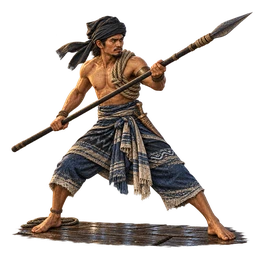
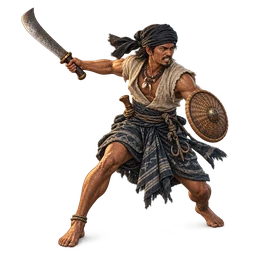
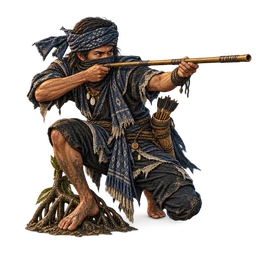
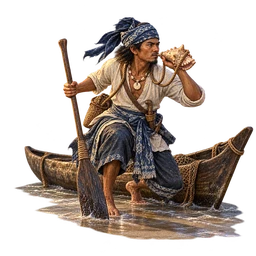
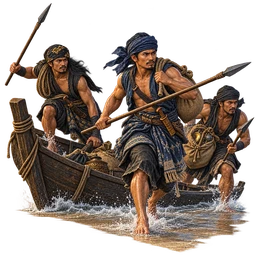
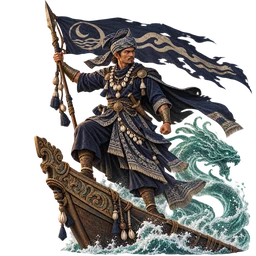
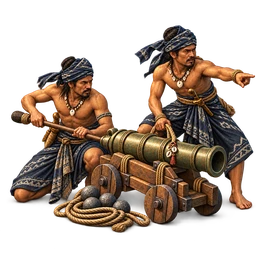
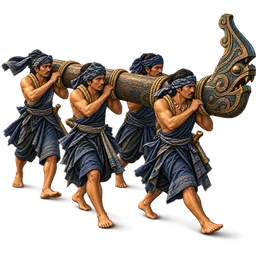
Darat

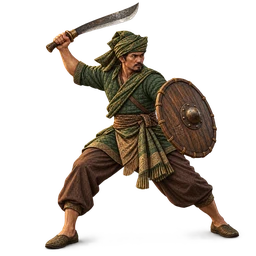
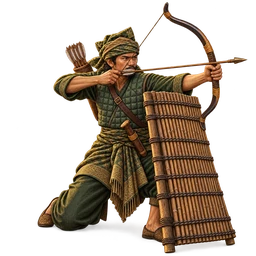

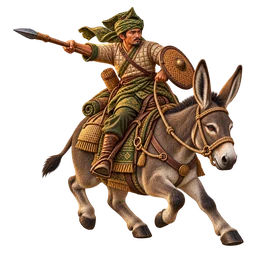
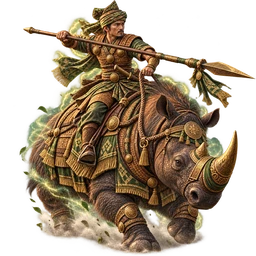
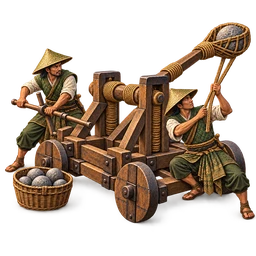
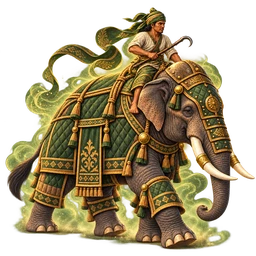
Sambar

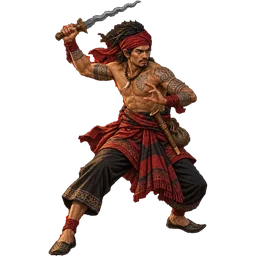
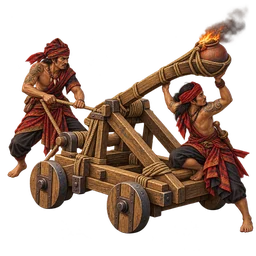
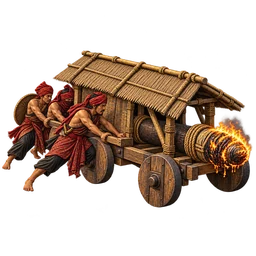
Niaga
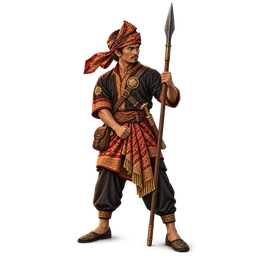
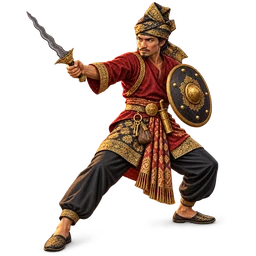
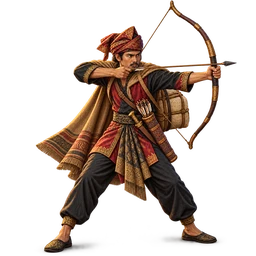
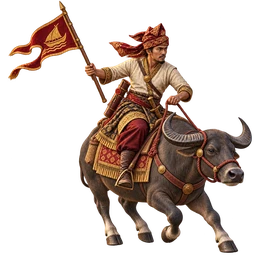
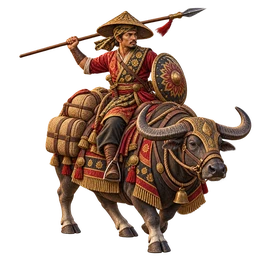
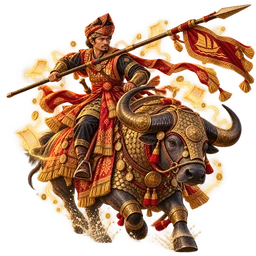
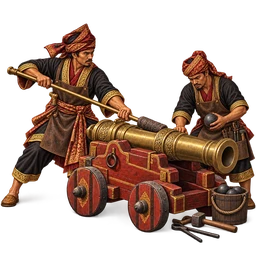
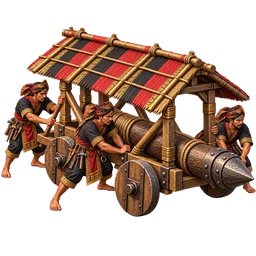
Every tribe's soldiers, in numbers
The paintings above name each tribe's soldiers; these are their figures. Each row is the tribe's own version of one of the plain soldiers, and the small grey line under its name says which. Times are for a Warrior Hall, Stable or Workshop at level 1 at this world's ×1 pace — every level of the building takes a further 2% off. The three right-hand columns are what a training speed subscription does to that time, with the price in gold coins an hour (the shipped prices; the Military page always shows the current ones).
Pelaut
| Soldier | Atk | Def inf | Def cav | Speed | Carry | Water | Cost | Upkeep | Time | Basic 1 coin/h +7% | Advanced 2 coins/h +12% | Elite 3 coins/h +18% |
|---|---|---|---|---|---|---|---|---|---|---|---|---|
| Penjaga GeladakBamboo Spearman | 12 | 33 | 56 | 7 | 20 | Fords up to 60% of a route; no open sea | 60/30/20/20 | 1 | 1m 30s | 1m 24s | 1m 20s | 1m 16s |
| Lanun PenyerbuKris Swordsman | 46 | 32 | 18 | 6 | 20 | Fords up to 60% of a route; no open sea | 60/30/80/20 | 1 | 2m | 1m 52s | 1m 47s | 1m 42s |
| Pemburu KabusBlowpipe Archer | 30 | 46 | 22 | 6 | 25 | Fords up to 60% of a route; no open sea | 80/50/40/25 | 1 | 2m 30s | 2m 20s | 2m 14s | 2m 7s |
| Pengintai SelatOutrider | 0 | 10 | 5 | 13.6 | 0 | Fords up to 127% of a route, slips further; no open sea | 81/36/54/18 | 1 | 2m | 1m 52s | 1m 47s | 1m 42s |
| Perompak SampanLight Horseman | 58 | 28 | 36 | 11.9 | 80 | Fords up to 60% of a route; no open sea | 112/48/88/32 | 2 | 4m | 3m 44s | 3m 34s | 3m 23s |
| Panglima OmbakRoyal Lancer | 98 | 64 | 46 | 8.5 | 60 | Fords up to 60% of a route; no open sea | 176/80/152/48 | 3 | 6m | 5m 36s | 5m 21s | 5m 5s |
| Meriam RentakaMeriam | 54 | 36 | 18 | 4 | 0 | Fords up to 60% of a route; no open sea | 360/270/225/72 | 4 | 15m | 14m 1s | 13m 24s | 12m 43s |
| Naga HaluanBattering Ram | 46 | 36 | 18 | 4 | 0 | Fords up to 60% of a route; no open sea | 315/180/162/63 | 3 | 13m 20s | 12m 28s | 11m 54s | 11m 18s |
Darat
| Soldier | Atk | Def inf | Def cav | Speed | Carry | Water | Cost | Upkeep | Time | Basic 1 coin/h +7% | Advanced 2 coins/h +12% | Elite 3 coins/h +18% |
|---|---|---|---|---|---|---|---|---|---|---|---|---|
| Penjaga RimbaBamboo Spearman | 8 | 40 | 70 | 7 | 20 | Fords up to 40% of a route; no open sea | 63/32/21/21 | 1 | 1m 30s | 1m 24s | 1m 20s | 1m 16s |
| Pendekar GolokKris Swordsman | 34 | 42 | 26 | 6 | 20 | Fords up to 40% of a route; no open sea | 60/30/80/20 | 1 | 2m | 1m 52s | 1m 47s | 1m 42s |
| Pemanah BukitBlowpipe Archer | 20 | 58 | 30 | 6 | 25 | Fords up to 40% of a route; no open sea | 80/50/40/25 | 1 | 2m 30s | 2m 20s | 2m 14s | 2m 7s |
| Pengintai HarimauOutrider | 0 | 10 | 5 | 18.4 | 0 | Fords up to 85% of a route, slips further; no open sea | 103/46/69/23 | 3 | 2m | 1m 52s | 1m 47s | 1m 42s |
| Penunggang KeldaiLight Horseman | 52 | 44 | 52 | 12.6 | 60 | Fords up to 40% of a route; no open sea | 129/55/101/37 | 2 | 4m | 3m 44s | 3m 34s | 3m 23s |
| Kesatria BadakRoyal Lancer | 112 | 92 | 62 | 8.5 | 40 | Fords up to 40% of a route; no open sea | 220/100/190/60 | 3 | 6m | 5m 36s | 5m 21s | 5m 5s |
| Pelontar Batu BukitMeriam | 52 | 46 | 24 | 4 | 0 | Fords up to 40% of a route; no open sea | 420/315/263/84 | 4 | 15m | 14m 1s | 13m 24s | 12m 43s |
| Gajah DirajaBattering Ram | 60 | 50 | 30 | 4 | 0 | Fords up to 40% of a route; no open sea | 438/250/225/88 | 5 | 13m 20s | 12m 28s | 11m 54s | 11m 18s |
Sambar
| Soldier | Atk | Def inf | Def cav | Speed | Carry | Water | Cost | Upkeep | Time | Basic 1 coin/h +7% | Advanced 2 coins/h +12% | Elite 3 coins/h +18% |
|---|---|---|---|---|---|---|---|---|---|---|---|---|
| Raider SpearmanBamboo Spearman | 13 | 30 | 52 | 7 | 28 | Fords up to 40% of a route; no open sea | 60/30/20/20 | 1 | 1m 30s | 1m 24s | 1m 20s | 1m 16s |
| Amok BladeKris Swordsman | 48 | 30 | 16 | 6 | 20 | Fords up to 40% of a route; no open sea | 60/30/80/20 | 1 | 2m | 1m 52s | 1m 47s | 1m 42s |
| Dart RaiderBlowpipe Archer | 30 | 42 | 20 | 6 | 32 | Fords up to 40% of a route; no open sea | 80/50/40/25 | 1 | 2m 30s | 2m 20s | 2m 14s | 2m 7s |
| Night ScoutOutrider | 0 | 10 | 5 | 16 | 0 | Fords up to 85% of a route, slips further; no open sea | 90/40/60/20 | 1 | 2m | 1m 52s | 1m 47s | 1m 42s |
| Sambar RaiderLight Horseman | 74 | 24 | 32 | 14 | 104 | Fords up to 40% of a route; no open sea | 140/60/110/40 | 2 | 4m | 3m 44s | 3m 34s | 3m 23s |
| Warlord LancerRoyal Lancer | 124 | 58 | 40 | 10 | 60 | Fords up to 40% of a route; no open sea | 220/100/190/60 | 3 | 6m | 5m 36s | 5m 21s | 5m 5s |
| Fire-Pot ThrowerMeriam | 72 | 34 | 16 | 4 | 0 | Fords up to 40% of a route; no open sea | 400/300/250/80 | 4 | 15m | 14m 1s | 13m 24s | 12m 43s |
| Fire RamBattering Ram | 62 | 32 | 14 | 4 | 0 | Fords up to 40% of a route; no open sea | 350/200/180/70 | 3 | 13m 20s | 12m 28s | 11m 54s | 11m 18s |
Niaga
| Soldier | Atk | Def inf | Def cav | Speed | Carry | Water | Cost | Upkeep | Time | Basic 1 coin/h +7% | Advanced 2 coins/h +12% | Elite 3 coins/h +18% |
|---|---|---|---|---|---|---|---|---|---|---|---|---|
| Tombak SerikatBamboo Spearman | 10 | 38 | 62 | 7 | 20 | Fords up to 40% of a route; no open sea | 76/38/25/25 | 1 | 1m 30s | 1m 24s | 1m 20s | 1m 16s |
| Pengawal BazaarKris Swordsman | 38 | 40 | 24 | 6 | 20 | Fords up to 40% of a route; no open sea | 72/36/96/24 | 1 | 2m | 1m 52s | 1m 47s | 1m 42s |
| Pemanah KafilahBlowpipe Archer | 24 | 52 | 28 | 6 | 35 | Fords up to 40% of a route; no open sea | 96/60/48/30 | 1 | 2m 30s | 2m 20s | 2m 14s | 2m 7s |
| Utusan DagangOutrider | 0 | 10 | 5 | 14.4 | 0 | Fords up to 85% of a route, slips further; no open sea | 100/44/66/22 | 1 | 2m | 1m 52s | 1m 47s | 1m 42s |
| Penunggang KerbauLight Horseman | 56 | 40 | 50 | 12.6 | 120 | Fords up to 40% of a route; no open sea | 168/72/132/48 | 2 | 4m | 3m 44s | 3m 34s | 3m 23s |
| Kesatria SyahbandarRoyal Lancer | 106 | 80 | 60 | 9 | 70 | Fords up to 40% of a route; no open sea | 264/120/228/72 | 3 | 6m | 5m 36s | 5m 21s | 5m 5s |
| Pandai Putih MeriamMeriam | 64 | 40 | 20 | 4 | 0 | Fords up to 40% of a route; no open sea | 538/403/336/108 | 4 | 15m | 14m 1s | 13m 24s | 12m 43s |
| Bengkel PelantakBattering Ram | 50 | 40 | 20 | 4 | 0 | Fords up to 40% of a route; no open sea | 462/264/238/92 | 3 | 13m 20s | 12m 28s | 11m 54s | 11m 18s |
The four tribes side by side
The same soldiers laid out by role, one measure at a time, so the question “whose spearman is best for what I want?” can be answered by reading one table.
Attack
| Role | Pelaut | Darat | Sambar | Niaga |
|---|---|---|---|---|
| Infantry | ||||
| Bamboo Spearman | 12 | 8 | 13 | 10 |
| Kris Swordsman | 46 | 34 | 48 | 38 |
| Blowpipe Archer | 30 | 20 | 30 | 24 |
| Cavalry | ||||
| Outrider | 0 | 0 | 0 | 0 |
| Light Horseman | 58 | 52 | 74 | 56 |
| Royal Lancer | 98 | 112 | 124 | 106 |
| Siege | ||||
| Meriam | 54 | 52 | 72 | 64 |
| Battering Ram | 46 | 60 | 62 | 50 |
Defence against infantry
| Role | Pelaut | Darat | Sambar | Niaga |
|---|---|---|---|---|
| Infantry | ||||
| Bamboo Spearman | 33 | 40 | 30 | 38 |
| Kris Swordsman | 32 | 42 | 30 | 40 |
| Blowpipe Archer | 46 | 58 | 42 | 52 |
| Cavalry | ||||
| Outrider | 10 | 10 | 10 | 10 |
| Light Horseman | 28 | 44 | 24 | 40 |
| Royal Lancer | 64 | 92 | 58 | 80 |
| Siege | ||||
| Meriam | 36 | 46 | 34 | 40 |
| Battering Ram | 36 | 50 | 32 | 40 |
Defence against cavalry
| Role | Pelaut | Darat | Sambar | Niaga |
|---|---|---|---|---|
| Infantry | ||||
| Bamboo Spearman | 56 | 70 | 52 | 62 |
| Kris Swordsman | 18 | 26 | 16 | 24 |
| Blowpipe Archer | 22 | 30 | 20 | 28 |
| Cavalry | ||||
| Outrider | 5 | 5 | 5 | 5 |
| Light Horseman | 36 | 52 | 32 | 50 |
| Royal Lancer | 46 | 62 | 40 | 60 |
| Siege | ||||
| Meriam | 18 | 24 | 16 | 20 |
| Battering Ram | 18 | 30 | 14 | 20 |
Cost (all four resources added up)
| Role | Pelaut | Darat | Sambar | Niaga |
|---|---|---|---|---|
| Infantry | ||||
| Bamboo Spearman | 130 | 137 | 130 | 164 |
| Kris Swordsman | 190 | 190 | 190 | 228 |
| Blowpipe Archer | 195 | 195 | 195 | 234 |
| Cavalry | ||||
| Outrider | 189 | 241 | 210 | 232 |
| Light Horseman | 280 | 322 | 350 | 420 |
| Royal Lancer | 456 | 570 | 570 | 684 |
| Siege | ||||
| Meriam | 927 | 1082 | 1030 | 1385 |
| Battering Ram | 720 | 1001 | 800 | 1056 |
Training time, no subscription
| Role | Pelaut | Darat | Sambar | Niaga |
|---|---|---|---|---|
| Infantry | ||||
| Bamboo Spearman | 1m 30s | 1m 30s | 1m 30s | 1m 30s |
| Kris Swordsman | 2m | 2m | 2m | 2m |
| Blowpipe Archer | 2m 30s | 2m 30s | 2m 30s | 2m 30s |
| Cavalry | ||||
| Outrider | 2m | 2m | 2m | 2m |
| Light Horseman | 4m | 4m | 4m | 4m |
| Royal Lancer | 6m | 6m | 6m | 6m |
| Siege | ||||
| Meriam | 15m | 15m | 15m | 15m |
| Battering Ram | 13m 20s | 13m 20s | 13m 20s | 13m 20s |
Marching speed (fields an hour)
| Role | Pelaut | Darat | Sambar | Niaga |
|---|---|---|---|---|
| Infantry | ||||
| Bamboo Spearman | 7 | 7 | 7 | 7 |
| Kris Swordsman | 6 | 6 | 6 | 6 |
| Blowpipe Archer | 6 | 6 | 6 | 6 |
| Cavalry | ||||
| Outrider | 13.6 | 18.4 | 16 | 14.4 |
| Light Horseman | 11.9 | 12.6 | 14 | 12.6 |
| Royal Lancer | 8.5 | 8.5 | 10 | 9 |
| Siege | ||||
| Meriam | 4 | 4 | 4 | 4 |
| Battering Ram | 4 | 4 | 4 | 4 |
You may only raise your own. Change nothing else about how you play and the soldier alone is a reason to pick one tribe over another.
What they eat. A soldier's rice an hour is the tribe's own figure, not always the plain one. The Darat's Pengintai Harimau eats 3 rice an hour, where an ordinary scout eats 1, and the Gajah Diraja eats 5, where a plain ram eats 3 — a tiger and an elephant are dear to keep, as their entries say. Every other soldier, of every tribe, eats what it always did. Your village feeds them at your tribe's figure, so the rice figure on the village and the muster roll counts the tigers and elephants as they eat.
One named hero
Your champion
Every player has a champion from their first village — no building is needed; name them on the champion screen. A champion belongs to you rather than to a village, and mends faster at the Balai Pahlawan, the hall of heroes. They ride with an army, add their own strength to the battle, and lift the whole force alongside them.
You can rename them. The pencil beside your champion's name opens it for editing, exactly as a village name does. The name is not only yours to read — it appears on every report a champion fights in, on both sides — so the same rules apply as anywhere else a name is chosen.
- They gain experience and level up — 100 for level 2, 1,600 for level 5, 8,100 for level 10. Fighting no longer pays it: a champion is levelled by adventures, and a world pays experience for a fight only where the operator has switched that kind of fight on (attacking an NPC village or a player's, or being attacked by an NPC village, wild animals or a player). Where a kind is on, it is full experience for winning and a quarter for losing, and your battle report shows what each side's champion learned. A fight that pays nothing still wounds the champion and still counts as won or lost.
- They carry equipment found on expeditions, and you choose where their levels go.
- Five slots to begin with — weapon, armour, mount, charm and cloth — and in a world that has them switched on, four more that open as your champion climbs: head at level 5, waist at 10, feet at 15, off hand at 20. The pieces for those slots are deliberately slighter than the founding four; together they add about a third to a fully kitted champion, and they arrive one at a time rather than all at once.
- They have health, which recovers at the Shrine, and below 20% they will not march at all.
- They always come home. A champion is never lost the way soldiers are lost.
- They outlive the round. When a round turns over and the archipelago is swept away, your champion is not: their name, look, kit, pets and whetstones all carry into the next round. Their level and experience start again at level 1, and with them their attribute points, which come with levels — so every round is a climb, made with the kit you already own. A piece worn in a slot that opens only at a higher level is taken off and kept aside until they reach it again. They begin it rested and with no home; the first village you found takes them in. Anything you had at the Bazaar is taken back for you. The one exception is the four treasures of the realm, which go back to the realm at the end of every round to be found again.
- They look like somebody you chose. You choose who they are and their hair; the cloth they are painted in is the baju they wear. Six people, three hairs and three cloths is 54 champions, and every one of them is painted. Not a drawing assembled from parts: a picture somebody made of that exact person.
- There is no level cap, and no attribute cap either. The curve is the only ceiling and it steepens for ever: a quarter of a million experience to reach 50, nearly a million to reach 100. Every point you earn can be spent, and all of it can go into one attribute if you want it there — three points a level, for as many levels as you can win. Bearing is the one to think hardest about: it lifts the strength of the whole army your champion rides with, and nothing bounds it any more.
The six attributes
Every level gives three points to place, wherever you like:
- Valour — attack. Your champion's own strength when they ride out to fight.
- Guard — defence. Their own strength when holding a village, and fewer wounds.
- Bearing — the attack buff. Lifts the attack of the whole army they ride with, 0.2% a point.
- Resolve — the defence buff. Lifts the defence of everybody holding the village they stand in, 0.2% a point.
- Stewardship — the resource buff. More timber, stone, iron and rice from their home village, 0.2% a point, up to half again.
- Vigour — speed. The column they ride with marches faster, 0.2% a point, up to half again; they also mend sooner and haul more home.
Stewardship and Vigour, told apart. They are the two that get mixed up, because both add 0.2% a point and both stop at half again (250 points). Stewardship is about your home village: every point makes it produce more timber, stone, iron and rice, all the time, even while your champion is away or resting, and it never moves a soldier. Vigour is about the road: every point makes the column your champion rides with march quicker, and also makes the champion mend faster between fights and carry more plunder home; it does nothing for production. So a champion who stays at home and keeps the economy going wants Stewardship, and one who rides out a lot wants Vigour. Next to each attribute on the champion screen is a small (i): tap it for what a point is worth, a worked example for a hundred points, where the effect stops, and when it is a good place for a point.
The champion screen shows what Stewardship is worth. Above the attributes, What your champion adds at home gives the percentage Stewardship is adding to the village they call home, how much that is an hour of each resource, and what points you have chosen but not yet placed would make it. It counts the points you have placed, any Stewardship on the gear they wear and the Kancil if it is the pet walking beside them, and it says when you have reached the most it can add.
Placing points in Resolve and Stewardship now works. Until 20 October the screen left those two out when it saved, so a point put into either was never placed and nothing said so. Nobody was ever charged for it — the points simply stayed unspent — so if you tried and gave up, go back and place them.
A raider and a defender want different champions now, and a champion who stays at home can earn their keep there. When the six arrived, every champion's points were handed back once, to be placed again — Bearing used to lift both sides of a fight, and points bought for that should not be stuck in something that does less.
Beasts, and the pets they become
Sometimes the word that reaches your champion is not of a ruin or a wreck but of a beast abroad — something large taking livestock at the forest edge. It is marked on the map like any other site, and on its card you see which beast it is, how strong, and your champion's chance of beating it as they stand now. Their own attack strength is what counts, so Valour, level and the right kit all help; perilous ground is about twice as hard.
Beat it and it may follow your champion home — a quarter of the time on easy ground, half on perilous. There are six, and each lends a different attribute:
- Harimau (tiger) — Valour
- Buaya (crocodile) — Guard
- Beruang (sun bear) — Bearing
- Seladang (gaur) — Resolve
- Kancil (mousedeer) — Stewardship
- Enggang (hornbill) — Vigour
A pet lends three points a level of bond. Bringing home the same kind again deepens the bond, up to five — fifteen points. One pet walks beside your champion at a time; choose which under Companions on the champion screen, whenever they are at home. Pets stay with your champion from round to round.

tiger

saltwater crocodile

sun bear

wild gaur

mousedeer

rhinoceros hornbill
Making a champion look like somebody
Open your champion and click their face. Two rows sit under it — who they are and their hair — and every option in every row is the painted face that choice would give you, so you are choosing between people rather than between words. A click saves straight away.
Cloth is worn, not chosen. A champion is painted in the baju in their cloth slot, and each baju carries its own virtue: the Jade Baju mends them faster and adds vigour, the Clay Baju adds valour, the Indigo Baju adds bearing and a little pace on the road. Expeditions find them like any other piece. Above all three is the Royal Songket, gold thread from collar to sampin, the one cloth that lifts all four attributes — found only by a champion of level 20 or more. With no baju on, a champion stays in the cloth they already had.
Six people, three hairs and three cloths is fifty-four champions, and all fifty-four are painted: a bust for the boards, and a full-length figure on your own screen. There is no drawn stand-in behind any of them and nothing that looks different once you change it.
Fewer choices than a slider-and-swatch character maker, and that is on purpose. Every combination you can make is a picture somebody painted, rather than a great many combinations that mostly are not.
Your champion stands down the left of their own page, with everything about them — attributes, expeditions, the kit — in the two columns beside. The figure is dressed in what they wear — their armour and their footwear, painted for the way your champion stands and in their own cloth, changing the moment you change either. The rest of the kit — blade, off hand, headgear, sash, charm and mount — is listed beside them rather than drawn.
Finding somewhere to go. Word of a place worth looking reaches you from time to time — a wreck, a shrine, a bandit hoard. It does not come with directions. What you are told is that there is something, and roughly how long before the trail goes cold; where is marked on the map, as a ring with a cross through it, gold where the going is ordinary and red where it is perilous. Only you can see your own: a site is rolled for you when word of it arrives, so somebody else’s is not a place on the map at all.
They sit within a ride of home — between four and twenty-two fields — so the ground to search is the ground you already know. Click the mark and send your champion from there. Nothing is lost by not looking except the trail itself, which goes cold on its own and is replaced in time by another.
The fifty-four painted champions
Six people, three hairs and three cloths, and every one of the combinations is painted — a bust at the size of a coin for the boards, and the same champion head to foot on their own screen. There is no drawing behind any of them and no preset that has to be kept to: change your hair or your cloth and you get another painting, not a diagram of one. It is only a face either way — nobody's champion is stronger for it.






And any of them with any hair and any cloth — here is one of the six, nine ways:








Your own face
Your portrait, which is not your champion
Two different faces, and they are easy to mix up. Your champion is a person in the world who marches with an army and can be killed out of a battle report. Your portrait is you — the face beside your name on the boards, in a letter and on your profile — and it does nothing at all.
Pick one in Settings. There are twenty-four, every one of them painted, and no rule anywhere reads which you chose.
























What a champion can carry
The later slots
Every champion has four slots from the day they are commissioned: a weapon, armour, a mount and a charm. One piece in each, and what it adds folds into your champion's own attributes — so the strength on the card is always the champion as they would actually be fielded.
In a world with the later slots switched on, four more open with your champion's level:
| Slot | Level | What goes there |
|---|---|---|
| Head | 5 | A helm, or the cloth of an office. |
| Waist | 10 | The sash or belt everything else hangs from. |
| Feet | 15 | What they march in, over ground that does not care. |
| Off hand | 20 | A shield, a second blade, a horn. |
They are slighter than the founding four, and that is deliberate. A head piece is worth less than a weapon; the four together add about a third to what a fully kitted champion carries, spread across fifteen levels. The point is that something new becomes possible as you climb, rather than every number getting bigger at once.
Your champion is drawn wearing it. The standing figure on the champion screen shows the kit you have actually put on — the blade in their hand, the shield on their arm, the sash, the boots, the helm. Put something on and it appears; take it off and it goes. The mount is the one exception, being a thing they travel on rather than a thing they wear.
You will not find a piece you cannot wear. An expedition only ever brings back something for a slot your champion has already opened — so each unlock widens what the ground can give you, which is also why a particular sword gets harder to find as the list grows. That is what the forge and the whetstones are for.
If your world has them switched off, your champion has the four and the screen says so. Nothing is hidden behind a wall you cannot see: the slots that do not exist here are not drawn at all.
Weapon
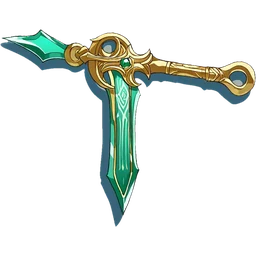
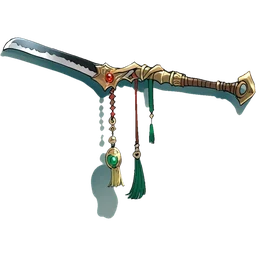
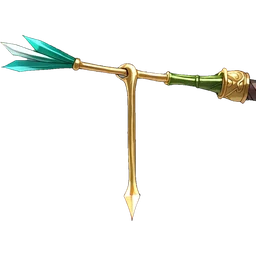
Armour


Mount
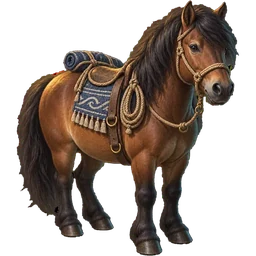

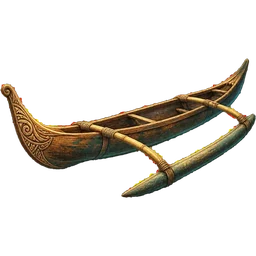
Charm
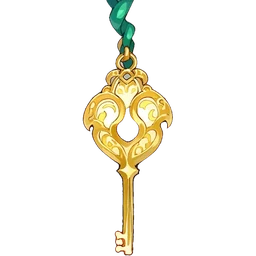


Head

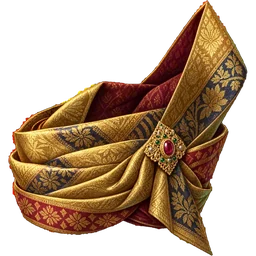

Waist


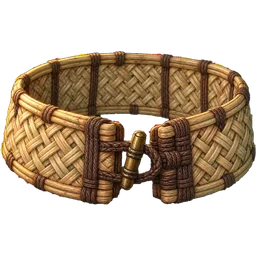
Feet


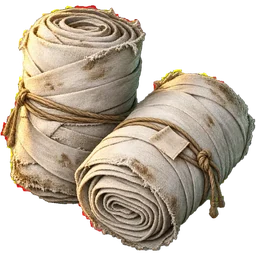
Off hand
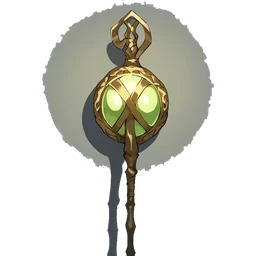


Cloth
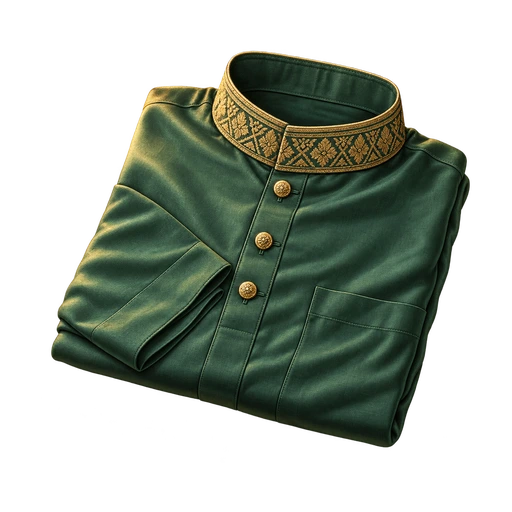
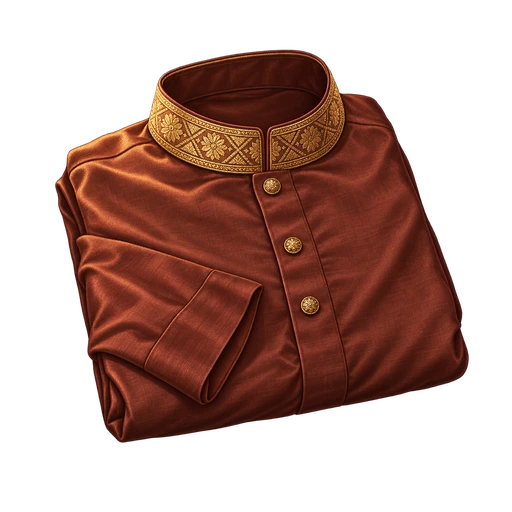

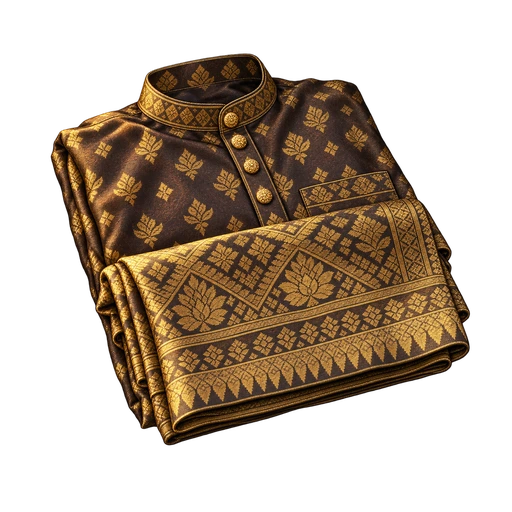
Making something of a pile
The forge

Equipment arrives by luck, so a long round leaves a champion with a pack of common pieces, one of them worn and the rest worth nothing. Two pieces of the same standing can be worked into one of the next: two common into a fine, two fine into an heirloom. There is nothing above an heirloom.
| Making | Balai Pahlawan | Cost |
|---|---|---|
| A fine piecefrom two common ones | 5 | 600 timber, 300 stone, 900 iron, 300 rice |
| An heirloomfrom two fine ones | 10 | 2,400 timber, 1,200 stone, 3,600 iron, 1,200 rice |
- Both pieces are consumed, including the one whose shape survives. What comes out is the same kind of thing in the same slot as the piece you chose to keep — which is how you steer the luck: a spare charm can become the weapon you actually wanted.
- The village where your tallest Shrine stands pays for the work.
- The result is rolled fresh, not your old piece with bigger numbers. A forged heirloom is its own object, and two players who melt the same pair do not end up with the same sword.
- A piece you were wearing comes back on, so upgrading the blade in your hand does not disarm you. Your champion must be home.
Whetstones. The forge stops at Heirloom, and a champion wearing four of them has nothing left to work. Expeditions also bring back whetstones, and each one improves a single piece a little — five is all one piece can hold, and together they add about a quarter to what that piece rolled.
A stone is a share of what the piece itself is worth, so tempering never lifts a poor piece past a good one: spend them on the finest thing you own. Nothing is ever risked — the stone is used and the piece improves, and there is no chance of losing either.
Your champion
Selling a piece at the Bazaar

A piece your champion is not wearing can be offered for gold. On the Champion screen, under Kept aside, choose Sell and name your price — anything from 1 to 100,000 gold coins. It appears in the Bazaar under Wares, where every player can see it, with exactly the numbers you see.
While it is for sale it is still yours, but it is promised: it cannot be worn, tempered, forged or thrown away. Take back returns it to you at any time before somebody buys it. You can have up to ten pieces on offer at once.
When a piece sells, the gold goes straight into your vault and you are told who bought it. The buyer pays from their vault, needs a champion to carry the piece, and receives it ready to wear. Both lines are on each player’s balance sheet.
Your champion
The treasures of the realm
Four pieces are above everything else a champion can carry, and there is only ever one of each in the world. They are the pusaka: the kris Taming Sari, the Baju Rantai of the Bendahara, the royal elephant Gajah Kenaikan, and the sceptre Cogan Alam — a weapon, an armour, a mount and a charm. Each always comes at Heirloom, and each is stronger than the best ordinary Heirloom of its kind.
They are found only on perilous expeditions, rarely, by a champion of level 15 or more — and only while nobody holds them. Once a treasure is found it is somebody’s, and it cannot turn up again until it changes hands or the round ends. The whole archipelago hears when one is found.
A treasure can be sold at the Bazaar like any other piece. That is the only other way to come by one.
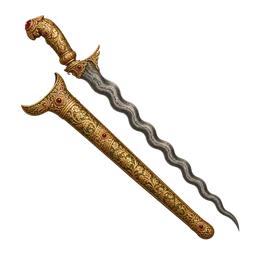
Weapon
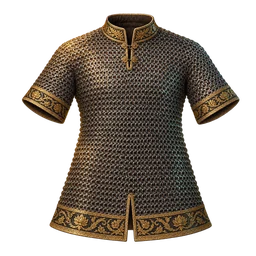
Armour

Mount
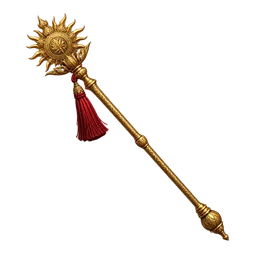
Charm
A storm, not the end
The raiding season

Some rounds get a raiding season: an outside fleet that lands, takes what it can and leaves again. It is the Compact's little brother — the same beachheads at real coordinates on your map, the same pooled damage, about a third of the strength, and it does not end the world.
- Seven waves, one every 240 game-hours — about a day apart at this world's pace, so a season runs the better part of a week.
- One landing per wave, so there is always a fight somebody can reach rather than a front nobody can hold.
- Damage against a beachhead is pooled across every player: the kingdom that could not have cleared it alone still contributed to clearing it.
- When the season is spent the sails leave and the round carries on. Nothing is archived, nobody is wiped. A season is spent once the last wave has landed and its landing is broken — the ships go straight away rather than waiting out the day.
- Everybody who marched at a landing is remembered. When the season ends, every player who made at least one assault on one of its beachheads — won or lost — is credited with a war fought, which is the Pahlawan Selat medal. Your battle reports of the fighting stay in your reports after the landings are gone. The same is true when the Compact's war for the world ends.
It is the same machinery as the endgame with the ending taken out — a reason for people who have spent the round raiding each other to point their armies the same way for a week.
The thing nobody beats alone
The Westward Compact

At some point in a world's life, an outside power arrives — Marines, Musketeers, Dragoons and Bombards, landing at real coordinates on the same map you have been fighting over. They are not another player and they are not scaled to you.
This is the part of the game that is not about beating your neighbours. It has two shared endings, and which one a world gets depends on what everybody in it does — including the people you have spent the round raiding.
If somebody else breaks the works while your column is still on the road, it turns round. A landing that is down stays down — an assault arriving afterwards fights an ordinary garrison for no damage to the Compact at all — so rather than let you spend an army on a fight that counts for nothing, the column comes home and you are told why.
Every assault on every landing is on the War screen, under Assaults on the Compact — who went, which wave and how it went, with your own rows linking to your report. It is a long list in a busy wave, so press its title to fold it away; it stays folded on that browser until you open it again.
You are told where the next wave will come ashore. The War screen names the ground and the hour, and the map marks it with a ringed cross — no line, because the Compact comes out of the sea beyond the western edge of the world and there is no road to draw. It is a forecast rather than a promise: it is worked out by the same search the landing itself runs, so it is exact for the world as it stands now and it moves if somebody settles that ground first.
This is deliberate. The Compact is the one enemy the whole world is meant to throw itself at, and a shared enemy nobody can muster against in advance is a shared enemy in name only. Knowing the tile a week early is what lets a kingdom call an hour on it and be standing there when the ships arrive.
Not the same war every round. How long a tide lasts, how much warning the sails give, how many waves come and how many landings each one brings are set for a world before it opens — as is the hold that loses the islands, and how quickly a beachhead left standing gains it. So do not carry a number from a previous round into this one. What yours is being fought at is in the settings table under the pace, and what is set, and the War screen counts the waves against your world rather than against a figure written here.
What is happening, in pictures
The Events screen

Where to find it. Events is in the menu down the left, straight after the Map, and on a phone it has a button of its own in the bar along the bottom. When the war moves — the omen, the landing, every new wave, the ending — Events wears a dot until you open it: ember while the Compact is ashore, gold otherwise. The dot is remembered by your browser, so a second device shows it once more.
A tab for every event. Across the top of the Events screen is a tab for each of the world's events, the busiest first. A bell marks the one happening now, a gold dot the one that is coming, and a tick the one that has just ended. Each tab opens that event's own page: its status laid over a painting of where it stands now, then its own sections. The address in your browser remembers where you are, so a refresh or a link you share lands on the same page.
The war, wave by wave. Under the Westward Compact — and a raiding season — are Overview, Landings broken and the Assaults. The assaults are split into a tab per wave, W1 to W7, opening on the wave the war is on, newest first; you can show only your own, only those thrown back or only those that broke through, or search for a player, a landing or a coordinate. Your own assaults open your full report; everyone else's army stays in their own report, as it always has.
The painting behind each event's status is where that event stands right now: sails on the horizon while it is coming, the fight while it is happening, and how it ended once it is over — the strait held or the islands fallen, the fleets sunk or the coast raided. It changes by itself as the event moves on. An event that is not running shows its first picture and says it is quiet, with when the next one is due where the game knows. An ending stays up for three days, so if you were away you can still see how it went.
Something worth taking
Bounties

From time to time a prize appears on the map: a village that is not anybody's, holding a garrison, with a reward on it. When one opens you are told across the top of every screen — the name, the coordinates and exactly what it is worth.
The first player to win an assault against it takes the whole reward. Nobody else takes anything. There is no share for turning up and no second prize, so going late is going for nothing — and the moment somebody breaks it the world is told that too, so nobody marches for a hoard that has already gone home with somebody else.
The fight itself is an ordinary assault. The garrison defends as any garrison does, the battle is resolved exactly as every other battle is, and the spoils go into the village your column set out from — capped by what that village can store, like any other load arriving. Bring enough.
The record keeps up with names. In the chronicle of worlds that have ended, everyone is listed under the name they use today, and that name opens their profile. If they have renamed since, the name and the kingdom they had in that round are shown beneath it — the record of what happened is never rewritten, and nobody leaves it by changing their name.
Kingdom against kingdom
The five strongholds

Some evenings, five forts appear on the map among the villages, for a set time — often two hours, sometimes longer; the announcement says how long, and the Strongholds page counts it down. Everybody is told when they rise and where they stand, and they are on the Strongholds page of the Events screen with a button to march on each. They are walled and well garrisoned — nobody takes one by accident.
It is kingdom against kingdom. Beat a fort’s garrison and it belongs to your kingdom, and the soldiers who survived your assault stay inside as its new garrison. Anybody in your kingdom may send more soldiers in to hold it; anybody else who arrives is attacking it — allies too, because every kingdom is scored on its own. If you are in no kingdom you can still fight, as a kingdom of one. Raids are refused (a fort has nothing to carry off), and Penghulu do nothing there: a fort is beaten, not talked down.
The kingdom holding the most forts when the time runs out wins. If two hold the same number, the one that held forts for longer in total wins. Who is ahead is on the Strongholds page the whole time; who is standing inside a fort is not — send scouts, as anywhere else.
Gold for holding a stronghold. When a contest ends, every fort that a kingdom is still holding pays out — to that kingdom’s members who took part. Of those, the one who held the fort longest is paid 20 gold coins, and everyone else who took part — who held it for a while, or stood soldiers in it to defend it — is paid 15. It is per fort, so holding three pays three times. A kingdom that held a fort for hours and lost it near the end is paid nothing for it, and a member who did not take part in the event is paid nothing at all. Who was paid what is listed under the result.
Earlier contests are kept. The Strongholds page lists every contest that has ended, newest first, each filed under the round it was fought in: who won, and how many forts each side held. A new contest no longer pushes the last result off the page.
Nothing you send is lost. When the time runs out the forts vanish, and every soldier who fought for them comes home — the garrisons, the columns still on the road, and everybody who died. The dead are counted against the village they marched from and handed back there. Fighting for the strongholds costs you the evening and nothing else, so send what you dare.
Medals go to the people who fought. Everybody in the winning kingdom who attacked a fort or stood in one counts the win towards Penakluk Kubu, and everybody who fought for a kingdom holding forts at the end counts each of those forts towards Penjaga Kubu. A kingdom’s win is not a medal for members who slept through it.
Endings
Worlds end, on purpose

A world does not run forever. Rounds come to an end, the standings are written into a chronicle that outlasts them, and a new world opens with everybody back to one village.
A new world opens empty. Your village is not standing there waiting for you: it is raised the first time you look in after the round begins, wherever the placer likes on the fresh map. Nothing is lost by arriving late except the days you were not there — and your beginner protection starts when you do, rather than running out while you were away. What this spares everyone is a map dotted with the villages of people who never came back, each of them somebody else’s farm.
This is deliberate rather than a reset button. It means a bad first week is not permanent, a dominant kingdom does not own the map indefinitely, and the question of who actually won gets an answer instead of trailing off.
How your own round went, on your profile. Your page carries where you stand and out of how many, the villagers you hold, how many building levels you have raised and how many you have flattened, and what your attacks and defences came to — with the shape of all three over time beneath them. That is the part a total cannot tell you: four hundred levels razed is a number, and only a line says you did it in one night in week three. It keeps working after the round is archived, because the shape is copied into the chronicle as the world is swept. If the line is missing the figures are still exact — they come from the world itself, and only the picture is drawn from readings taken as the round ran.
The shape of the round, on the standings page. Under the boards there is a line showing how many villagers the whole archipelago holds — over a day, a week, or the round so far. It is the world’s total rather than yours: whether the world is still growing, when it stopped, and what a war cost everybody at once. Your own figures are on your own screens and are exact; this is a picture, drawn from readings taken every minute or so, and it begins short because it only knows what it has watched. If it says it cannot be drawn, nothing is wrong with your world — the record is kept beside the game rather than inside it, and it is the record that is unavailable.
Once a week
The Friday night
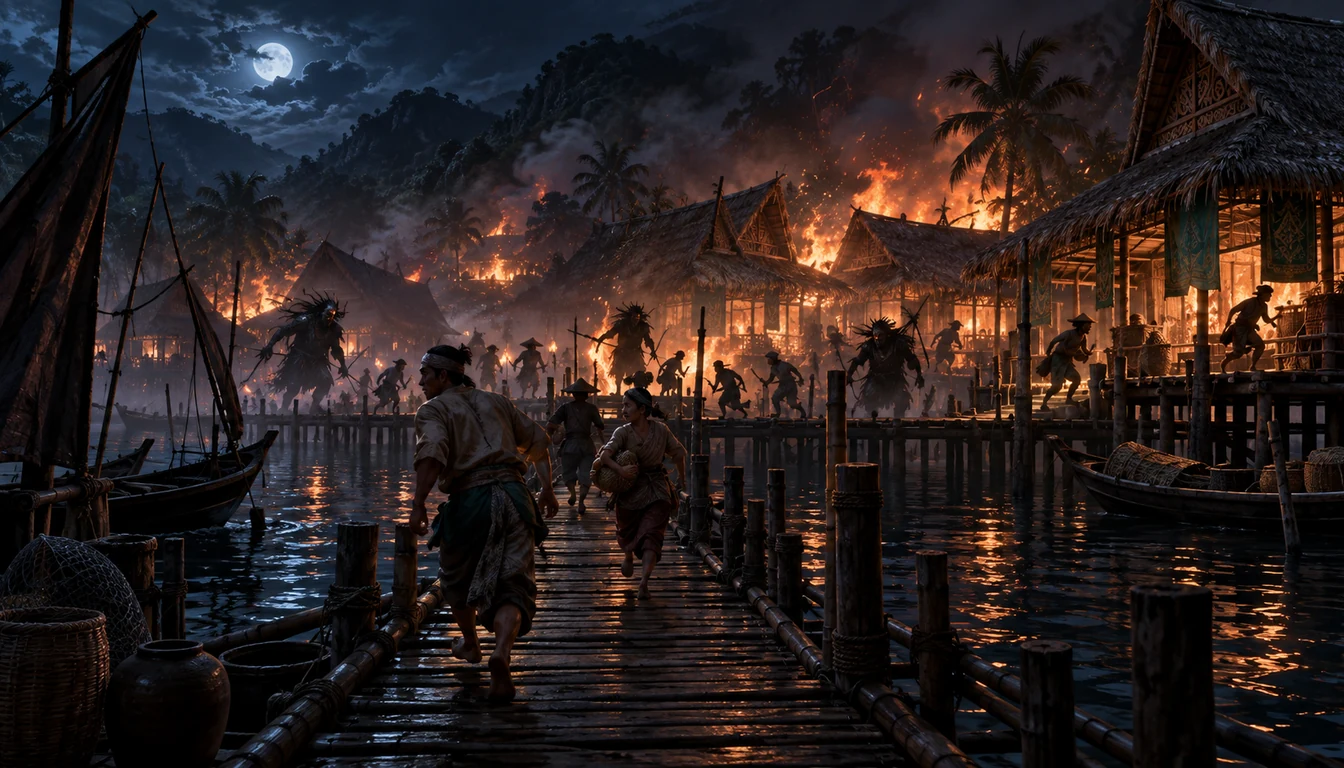
From 10pm to 1am, every Friday, up to six villages get up and walk. They are chosen from villages whose owners are not online at the time — nobody sitting at their own wall loses anything — and at the end of the three hours every one of them is handed back.
Your soldiers are not touched. What marches out is raised for the night and belongs to the world: a wave of thirty to fifty, roughly every minute, for three hours. Your own garrison stays exactly where you left it, is never sent anywhere and is never spent. You may come back to a village that was busy without you; you will not come back to an army you no longer have.
Signing in gives it straight back. If your village has risen and you open the game, it stops and returns to you at once — you do not have to wait out the night. That is the whole bargain: being there on a Friday is what keeps a village yours.
A capital is never taken, so if you hold only your first village you are never part of this at all, and neither is anybody still under beginner protection. If one of these hordes marches on you it is an ordinary assault and can be beaten like any other — and the village it came out of can be raided back while it stands.
A village that has been fought over rises bigger. Every soldier lost fighting at a village — whichever side lost them — is remembered, and click any village on the map to see the count. On the next Friday night that takes it, those dead rise on top of the horde its size alone would raise, so a village that has seen a lot of fighting is a real fight even if it is small, and a peaceful one stays a small night's work however big it has grown. The count is spent the moment it rises — it does not sit there building toward the week after.
Turning up is rewarded. Everybody who is signed in for long enough during the three hours — ten minutes by default, and the administrators can change it — is paid when the night ends: gold, and resources into your capital (or your largest village), up to what its storehouse can hold, as with anything arriving at a village. You are paid once for a night, you are sent a note saying what you received, and the names of those rewarded are posted in the Discord events channel. Opening the game for a moment does not count, and neither does a village that merely rose — it is being there that is paid. The amounts are the administrators’ to set, and the reward can be switched off.
The event calendar
The calendar icon in the top bar opens a month. Every day that has something on it carries a coloured dot, and pressing a day lists what is on it, with the time. It shows the Friday nights, the strongholds contest (and each time it repeats), the next wave of a war that has already begun, and the hour a bounty on a village is withdrawn. It looks sixty days ahead and steps forward a month at a time; it never goes back before this month. Times are in your time zone, so a Friday night that begins at 10pm in Malaysia is on the right day wherever you play from.
What it does not show is a war that has not begun. The Westward Compact gives its warning by the omen, six hours before the landing, and a date on a calendar would be a different game. A war already under way is on the calendar, because it is already public.
Going away
Zombie villages

A round runs for weeks, and people leave in the middle of one. If you have not signed in for a fortnight, the world takes what you left. How long that is exactly is set for each world — a fortnight is the usual, and the figure yours is played at is in the settings table under the pace, and what is set. Your villages stop being yours: they keep your buildings and your name over the gate, they stop growing entirely — nothing is produced in them and nothing is built — and whatever garrison was standing in them turns to banditry on its own account.
They show on the map in grey, marked zombie village, and they are neither a player nor a Lanun camp. They can be attacked, they can be taken, and they will raid their neighbours the way a camp does. The difference is that a camp grows its garrison back and a zombie village cannot: every party it sends out is one it is permanently weaker for, so a neighbour who keeps answering will eventually put it down for good.
Two things do not go with the village. Soldiers somebody else had standing there march home — an ally who reinforced you a fortnight ago has abandoned nothing, and their troops do not become part of a garrison that then raids them. And anything on the benches stops there: a village with nobody home does not finish raising its palisade.
If you come back, you start again. Sign in and you are given fresh ground — one new village, as your capital, and the same protection from attack that a new player gets, because you are in the same position as one. What you had is not returned: by then it is walking about without you, or has been put down by whoever lives next to it.
However long it is set to, it is counted in real days and is not affected by the world’s speed. Everything else here is divided by the pace — a ten-times world builds ten times as fast — but this is a fortnight of your life rather than of the world’s, and it stays a fortnight however quickly the harvests come in.
Who you have been
Your Chronicle

A player's profile is their history, round by round. Under the name sits a row: Overall, then each year with its rounds. Overall is the lifetime — rounds played, battles won and lost, the highest population ever reached, villages founded and lost, renown — with every name the player has gone by and when. Pick a round and the page becomes that round: where they finished, their kingdom and champion, and three tabs — an Overview with their population over the round, the kingdoms they belonged to and who they fought most; Battles, every fight with filters and a record against any one opponent; and Villages, each one founded, taken, lost or given up, and when.
The Battles tab opens on a trend chart: every battle a point, on a Victory lane or a Defeat lane, joined in order so a run of wins or losses shows at a glance. Above it are the battles, victories, defeats, win rate and the current streak; below it, the filters (time: 24 hours, 7 days, 30 days, this round or all time; attacking or defending; victory or defeat), which change the chart and the table together. Point at a battle, or tap it, for the whole fight; click it to find its row in the table.
The Villages tab is the archive of every village the player held in that round — held, lost, handed over or given up — listed on the left. Pick one and the chart above shows its population over time (hourly, daily, weekly or monthly), with its events marked on the line, and the story on the right tells it from founding to the end: milestones reached, attacks sent from it, attacks it suffered and whether the walls held, who captured it and when. Click a marker to find its line in the story, or a line to light its marker. Village populations have been recorded since 4 October 2026, so a village's line begins then.
What everybody can see, and what they cannot. Your battle log is yours. On somebody else's profile you see only the battles between the two of you — when, where, who won, and the strength and losses on both sides — and nobody else's fights with them. Your army's size over time is shown to you alone. Population is public, as it is on the boards.
When the record begins. The game always kept each round's final standing, so every round you played shows where you finished. Battles are kept from round 4 onward — before then a world took its battle reports with it when it ended. Population and army over time, kingdom changes and village histories have been recorded since 3 October 2026. A panel with nothing before that says so, rather than drawing a line nobody recorded.
What you are known for
Medals

The leaderboards answer one question — who is biggest — and most players cannot win it. Nothing else recorded the camp cleared in week one or the raid held off at four in the morning. Your profile carries a case of twelve medals, each a different kind of play, at three tiers apiece.
They are worn where other people can see them: the ones you have earned sit as small marks under your name on your profile, beside your name on every leaderboard, and on your kingdom's roster — where everybody's name is known already and the marks are what says which of them clears camps and which holds walls — coloured by tier — iron, jade, then gold. A board answers who is biggest; the marks beside it say what somebody is actually known for, which is often a different person. Press or point at one to be told what it is and what it took — the answer appears underneath, which is the same on a phone as on a desk.
| Medal | Earned by | Tiers |
|---|---|---|
| Pemburu LanunPirate-hunter | Lanun camps beaten | 5 · 25 · 100 |
| Perisai KampungShield of the village | Raids by Lanun or invaders held off at your own walls | 3 · 15 · 50 |
| Pemecah PendaratanBreaker of landings | Beachheads whose last defender you felled | 1 · 5 · 15 |
| Pahlawan SelatHero of the strait | Compact wars you fought in — a raiding season or the war for the world — with at least one assault on a landing, counted when the war ends | 1 · 3 · 10 |
| PanglimaWar leader | Attacks won against other chieftains | 10 · 50 · 200 |
| Penjaga RempahKeeper of spices | Spice groves held | 1 · 5 · 10 |
| SaudagarMerchant | Trades carried out | 10 · 50 · 200 |
| Orang LamaOld hand | Days since you founded your first village | 7 · 30 · 180 |
| Saksi DuniaWitness to worlds | Worlds seen through to their end | 1 · 3 · 10 |
| Penakluk KubuTaker of forts | Stronghold contests your kingdom won, while you fought in them | 1 · 5 · 15 |
| Penjaga KubuKeeper of forts | Forts your kingdom held when a contest ended, while you fought in it | 1 · 10 · 40 |
Feeding an army
Rice is what limits an army here, rather than villagers. A soldier does not take a villager's place, so the Paddy Field is not a ceiling on how many you may raise: train as many as you can pay for.
What stands in its place is the granary. A village may eat more rice than it grows — that is a plan, not a failure — for as long as the store lasts or a caravan keeps arriving from somewhere that grows more than it eats. Only an empty store costs you soldiers: each hour with nothing in it, the village loses troops eating a quarter of the rice it could not grow, shared out by what each kind eats. After about four hours of famine the army matches the harvest and the dying stops — you come back to the garrison your fields can feed, never to an empty village.
Everyone standing there starves together, including reinforcements somebody else sent: they eat the host's rice, so they share the host's hunger.
What a kingdom wears
A kingdom cannot earn a medal — a person cleared that camp — and the sum of its members' medals would only say "this kingdom is large", which the population board says already. So a kingdom wears honours, and an honour is comparative: it belongs to whichever kingdom leads the archipelago in something, and there is one of each at a time.
| Honour | Held by the kingdom with |
|---|---|
| Sharpest Spears | Most offence, summed across its members |
| Unbroken Wall | Most defence |
| Richest Bazaar | Most trades carried out |
| Scourge of the Camps | Most Lanun camps beaten |
| Breakers of the Tide | Most beachheads broken |
They are shown on the kingdom board and on a kingdom's own page. If two kingdoms are level at the top they both wear it, and an honour nobody has any of — a world where no landing has yet been broken — is worn by nobody rather than by whoever happens to sort first.
Exactly like renown: no rule anywhere asks whether you hold one, and none can be granted by hand — every medal is worked out from a tally the server keeps anyway. The tallies are for your whole time here rather than for one round, so a case does not empty when a world ends. Counting began on the day medals arrived, so a camp you cleared before that was never recorded.
Talking
Letters

Where they are. Everything that reaches you is in the top right corner, together: your Kingdom and its chat, Letters and the bell. Letters has two tabs — Personal, your own conversations, and Global, the world chat everyone reads. The game's own screens are in the menu down the left, which folds to icons if you want the room. When something is waiting in one of the three, its icon changes — it turns ember, shows how many beside it, and bobs gently, higher and quicker the more there is. When the number goes up, it rolls up into place and a small +1 floats off the icon. Past 999 it says 999+. If your device is set to reduce motion, it stays still and the number says it all. On a phone, Settings, your profile and Sign out are under More, so the corner has room for the three.
What is waiting. The Personal tab wears the number of letters you have not read, and the Global tab the number of lines said in the world chat while you were away from it; the same two add up on the Letters button. Opening the Global tab clears its count. The world chat count is kept against this browser: when you open the game, or come back to it after your phone slept, it counts everything said by others since you last had the Global tab open. A browser that has never opened the chat starts caught up, so a new player is not met by a pile of lines. The Kingdom, Letters and the bell all move the same way when something is waiting: the icon bobs, faster the more there is, and the number rolls up when it grows.
A chime when something arrives. When a letter or a notification arrives, a soft two-note chime plays, so a letter that comes while this tab is in the background does not go unnoticed. World chat never chimes. Your browser only allows sound once you have clicked or pressed a key on the page, and you can switch the chime off in Settings, under Sound. On a narrow phone the corner now keeps the Kingdom, Letters and the bell on screen — the pace badge steps out of the way to make room.
You can write to any other player by name. Letters travel instantly — this is correspondence, not a caravan — and there is a flood guard: about 20 letters a minute in total, and no more than 5 to the same person in that window. Enough to rally a defence; not enough to be a nuisance.
Talking
World chat

One conversation for the whole archipelago, under Letters → Global. It is joined to the chat channel of the Cyberjaya Discord: what you say in the game appears there, and what people say there appears here, marked Discord. If you have linked your Discord account, your Discord lines are shown under your player name.
It keeps the same manners as everything else anybody reads — the same words refused as in names and letters — and a light flood guard of about eight lines in thirty seconds. Mentions such as @everyone do nothing when they cross over from the game.
Every six hours the bot also posts a short Server status: online line in that Discord channel — the round, how many players are on, and how long the server has been up — so anyone can tell the world is alive. It appears on Discord only, not in the game’s chat.
Talking
Your kingdom on Discord

Every kingdom has its own private channel on the Cyberjaya Discord, under the kingdoms category, and it is joined to your kingdom chat in the game: a line written in either place appears in both.
To see it, link your Discord account in Settings. Within a minute you are added to your kingdom’s channel. Nobody outside the kingdom can see it, and nobody who has not linked an account is let in. Your Discord account has to have joined the Cyberjaya Discord server first — the bot cannot let in somebody who is not there.
Everything written in the channel comes into the kingdom chat. A linked member of the kingdom appears under their name in the game, with their office; anybody else who writes there — one of the server’s staff, say — appears under their Discord name, marked Discord.
It follows the kingdom, not the other way round: leave and the channel disappears from your Discord; join another and its channel appears; a kingdom that ends takes its channel with it.
One name in both places. Once your Discord is linked, Settings → Your name asks which name leads. Follow KAMPUNG, the default, sets your nickname in the Cyberjaya Discord to your name in the game, and keeps it so. Follow Discord does the opposite: your name in the game becomes what the server calls you — your nickname there, or your Discord display name. A name from Discord obeys every rule a name typed into Settings does: letters and numbers, three to twenty of them, nobody else already called it, and the usual wait between changes. One it cannot take leaves your name as it is, and Settings says why. A change made on Discord arrives within ten minutes. The bot cannot rename the server's owner, or anybody whose role ranks above its own; Settings says that too.
Who gets in
The gate

New registrations are read for the marks of a script before an account is made. A world is worth defending from someone who signs up forty times to farm their own villages, vote their own kingdom up a board, or sit on ground you wanted — and the cheapest moment to stop that is the moment the account is made.
What it looks at is shape and behaviour, not spelling: a name and an address that were obviously generated together, a throwaway mail service, a rush of sign-ups from one place in a few hours. No single one of those refuses anybody. It takes two independent things being wrong at once, because the alternative is turning away real people with unusual names, and a name being unusual to us is not a fact about the person holding it.
A held registration founds no village and takes no ground — there is nothing of it on the map. If it happens to you, it is reversible and it is not an accusation: a person opens the door by hand, and your name is kept for you in the meantime.
If that happens to you, write to nurayuze@cyberjaya.pro with the name you tried to use and an administrator will open the door by hand.
Some worlds also ask new arrivals to pass a Cloudflare check before signing up. If yours does, it appears on the registration form and takes a moment.
Your say
Being asked

Some decisions about a world are put to the people playing in it. When one is open, a strip appears across the top of every screen with the question, the answers, and — where the question is about the next round — exactly what that next world would be played under.
That list is not a promise somebody typed. It is read from the settings actually staged for the next world, so if something is unstaged the list stops claiming it.
The strip does not close. Everything else that appears up there can be dismissed; this cannot, because it is a question rather than news, and the way to make it go away is to answer it. One vote each, and you can see how the vote is going once you have cast yours — not before, because a running total shown to somebody still deciding is an argument rather than information.
A vote is not a switch. Nothing happens the moment a result lands: it is read by a person, who decides. A world ending is irreversible for everybody at once and is not the sort of thing a majority should be able to trigger by accident.
When you are away
Sitters

A world runs whether or not you are looking at it. If you are going to be away, you can name a sitter — somebody you trust to play your account while you are gone.
A sitter is not your password. They sign in as themselves and step into your seat, which matters in three ways: everything they do is recorded as theirs, you can end it in one press without changing anything about how you sign in, and it lapses on its own even if you forget. You can name two at a time, for up to three weeks each.
They can play. Build, train, march, trade, answer your kingdom — the ordinary game, from your villages.
There are three things they cannot do, and they are worth knowing before you decide:
- They cannot touch the account itself — not your name, not your sign-in. A sitter who could set a password would not be a sitter, they would be the new owner.
- They cannot name sitters. Otherwise trust would be transferable, and you could end up with somebody in your seat you had never met.
- They cannot send anything of yours to their own villages — no soldiers, no goods, and they cannot take their own market offer from your seat. This is the one that protects everybody else's game rather than your account: the way sitting is abused is not smashing a village up, it is quietly walking your rice and your army into the sitter's own, which looks like ordinary play in any record that does not know who sent it.
Not across a war. While your kingdom and the owner's are at war, nobody on either side can sit for the other: you cannot name a sitter from a kingdom you are fighting, a sitter named before the war cannot take the seat, and anybody already in it is sent back to their own account at once. Nothing is cancelled. When the war ends, the arrangement works again.
Going back to your own account. While you sit for somebody, a strip across the top of every screen says whose seat you are in, with Return to my account. Press it and you are back in your own villages, with no need to sign in again. Signing out while sitting does the same, and so does the owner ending the sitting while you are in it.
Either of you can end it at any moment, and it stops immediately — not when some token expires. The sitter can stand down too, because somebody handed responsibility for your round should be able to put it down rather than simply stop looking.
Find it under Sitters in the footer, next to Report a problem.
When something is wrong
Telling us

If something is broken, confusing, or simply not what you expected, there is a Report a problem link in the footer of every screen. It goes to the people who can change it.
You do not have to explain where you were. The form sends the screen you were on, the village you had open and the version you are running along with what you write, so what you type can be the one thing only you know: what happened, and what you expected instead.
There is room to say it properly: a report holds up to 20,000 characters, so an idea with ten parts can go in one report rather than five. Numbered points are easiest to act on — each is read as its own request.
You will get an answer on that same page and in your notifications. Up to five of yours can be waiting at once — a limit, not a discouragement, and answered ones do not count against it.
This is worth using. The two faults fixed on this world in the week before it was written were both found by somebody playing, not by anybody testing.
The roadmap. Where a report goes next is on the Roadmap page, linked from the footer of every screen and readable without an account. Each line there is a fix or an enhancement the administrators have chosen to publish, with the stage it is at — Received, Looking into it, Being built, Being tested, Live, or Waiting on a decision — and, when you open it, the steps it went through with a note at each and the version it went live in. It never shows what you wrote or who you are, only how many reports a line came from. Lines of the administrators’ own, ideas they are working out, sit beside them. The Timeline tab lays the same lines out like a project plan: a row for each, in the order they began, with the days across the top and a stretch of colour for every stage a line spent time in — a diamond where it went live, and a bar running up to the line for now while it is still in hand. A line that was only written down after the fact, in a single step, is shown as a diamond and nothing more, because there is no stretch of time to draw. Since 1.251.0 it covers every version from 1.0 to today, one row each: the subject on the left, up to three lines of it, with the version under it and how many player reports it came from, and a Live or Waiting mark beside a small icon; the progression bar scrolls sideways on the right, with each row’s date written upright beside its marker and the time just after it. Click a subject for what was done in that version; click a bar for when it was reported, how long it was in hand, and whether it has been released to production. A search box and the filters Live, In hand and Waiting narrow the list, and the page fits a phone as well as a wide screen.
An old page. A game tab left open keeps the version it was opened with until it is reloaded. When a newer one is live, a small notice at the bottom of the screen says so and offers Reload; it is checked every few minutes and whenever you come back to the tab, and it never reloads by itself.
Odds and ends
Quick answers

Can somebody take my name by changing a capital?
No. Two names that differ only by capitals — or only by a space, an underscore, a hyphen or an apostrophe — count as the same name, both when somebody signs up and when somebody renames themselves. Nobody can register as your name in different capitals, and nobody can rename themselves into it. The same rule applies to your own: changing your name to what you are already called, in different capitals, is not a change, and it does not spend the wait between renames — you keep that for when you actually want it.
I was told my registration is held. What did I do?
Nothing, most likely. New sign-ups are screened for the marks of a script, and it takes two separate things looking wrong before anybody is stopped — but it is a guess, and guesses are sometimes wrong. It is reversible: the message names where to write, and an administrator opens it by hand. No village was founded and your name is still held for you.
Why does training a soldier cost stone?
Every unit does — shields, helms, whetstones, ballast, counterweights. It is never the biggest part of the price (that is timber, for almost everything), and it runs from a tenth of a War Prau to a third of an Ironwood Shieldman. The point of it is that the Palisade and the barracks draw on the same quarry, so a wall and an army cannot both be built at full speed. The four resources has the detail.
Something is broken. Who do I tell?
Use Report a problem in the footer of any screen. It reaches the people who can fix it, it carries the context automatically, and you get a reply on the same page.
Does it cost anything?
No. There is nothing to buy, no advertising, and no way to pay for an advantage. Nobody's village is bigger because of their bank.
Do I need to install anything?
No — it runs in a browser, on a phone as well as a desktop. An account needs an email address and a name other players see.
What happens while I am asleep?
Everything. Production, construction, training, marches and battles all continue on the server. You can be attacked while offline, which is why the Palisade and a standing garrison matter more than being logged in.
Can I be attacked straight away?
No. A new account has 24 hours of protection. Use it on your economy.
Why was my attack refused?
Three usual reasons: the route crosses more than 40% open water and you have no ships; the target's kingdom has an alliance or non-aggression pact with yours; or you have no Muster Ground.
Why has my production stopped?
A full store. Production stops at capacity rather than spilling — raise the Storehouse or the Rice Barn. If it is rice specifically, your soldiers may simply be eating everything you grow.
How many villages can I have?
One for every five levels of every Longhouse you hold — a capital’s builds to 15 and is worth three, every other village’s builds to 10 and is worth two, and nobody holds more than sixteen. Level 4 is worth nothing and level 5 is worth a village, which catches people out. Rounds 1 and 2 gave one per level of your tallest Longhouse alone.
Why did my march take longer than I expected?
Ground. A route through a kingdom you are at war with runs 25% slower, and one through your own or an ally's territory 20% faster — charged stretch by stretch along the whole route. Water is the other half of the answer: it costs two and a half times what land does.
Something attacked me and it was not a player.
A Lanun camp within 10 tiles that has grown to its second tier. Camps raid villages of 120 people or more, so it is a sign your village has become worth robbing. Clearing the camp stops it for a while; it rebuilds.
How close can my villages be to each other?
As close as you like — any dry tile nobody is standing on. The old three-tile spacing rule is gone, so a tight, mutually defensible cluster is a plan you are allowed to have.
Someone took my grove. Can I get it back?
Yes — a grove belongs to whoever has soldiers standing in it. Send more than they left behind.
Is signing in with Google required?
It reads only your name, email address and profile picture, and posts nothing anywhere. There is no tracking, no analytics and no advertising, and since the game takes no payments, no payment details are held.
Neighbours
Bringing somebody in

Settings carries a link of your own — /?ref= and six characters — with a few posts written for you to paste wherever you talk to people. Anybody who founds a village through it is recorded as yours.
The same link is also a QR code. Beside the link in Settings is a square code made from it: a friend sitting next to you can point their phone's camera at it and land on the sign-up page with your link already on it. Show it large fills the screen with it, so it reads from across a table; tap anywhere to put it away. It is drawn dark on white whatever the colours of the game, because that is what a phone camera reads best.
It pays a medal and nothing else. No resources, no troops, no head start: the moment an invitation paid anything you could spend, the quickest way to earn it would be a second account on the same phone, and this world would be about that instead of about the strait. The medal is Pembawa Orang, at one, five and twenty.
Whoever brought you in is named on your profile. Beside the day you settled, as a link back to them — a credit rather than a label, and the only thing an invitation records about you. Nobody who found the game on their own has anything there.
They count once they have really started. A village of 200 villagers — an afternoon of ordinary play — rather than the moment an account is made, because a board that counted sign-ups would rank whoever can make the most empty ones. Your own panel shows both numbers: everybody who came, and the ones who stayed. The Brought in board on the rankings page shows the second.
With thanks
Who found it

Most of what is fixed here was noticed by somebody playing and written up in a report. These are the players whose reports became changes to the game, and how many each of them has. It is not a score and it buys nothing — it is a thank-you with the arithmetic done.
- Everett Monica 25 changes
- Yukiya 21 changes
- Mat Purple 18 changes
- parameswara 17 changes
- Sang Sing Song 10 changes
- Andromeda 8 changes
- Pokcik 6 changes
- Rigel Ferris 5 changes
- Kayu Berguna 4 changes
- Syafiqjaafar 2 changes
- Zack kib 1 change
- Thunderock 1 change
- aurora 1 change